No products in the cart.
No products in the cart.
Choose car audio power wire from the amplifier's current demand, cable-run length, conductor material and installation conditions. Consider 0 gauge, also called 1/0 AWG, when the manufacturer's sizing guidance calls for it at your current and distance. There is no universal amplifier wattage that makes it the right choice for every vehicle (amplifier installation guidance).
Begin with your amplifier manual's minimum cable size and external protection requirements. Record the operating speaker load and continuous output, commonly labelled RMS power, rather than a peak-watt headline. If those ratings are unfamiliar, Evolution Lithium's car amplifier guide explains how load and continuous output belong together before you plan the supply cable.
When a current specification is unavailable, estimate input current by dividing RMS output watts by supply voltage multiplied by amplifier efficiency, expressed as a decimal. Use efficiency for the intended operating conditions rather than assuming every Class D amplifier behaves identically. Evolution Lithium's amplifier current draw guide explains this relationship and why music does not draw full-rated current continuously.
Lower supply voltage or lower efficiency increases the estimated input current for the same output. For a shared feed, include every amplifier it supplies. Keep a full-output estimate separate from average listening demand: a cable choice should follow the manufacturer's requirements and the intended use, rather than an optimistic average.
American Wire Gauge, abbreviated AWG, describes conductor size. Lower numbers mean larger conductors; after 1 AWG come 1/0, 2/0 and larger sizes. Compare conducting metal, not the outside diameter of the insulation. A thick jacket does not establish the cable's electrical capacity (wire gauge guidance).
For a practical reference, one manufacturer's copper-cable guide specifies these combinations:
These are examples from that manual's power-cable guide, which accounts for terminal connection resistance. They illustrate why both amperes and metres matter; they are not universal ratings for every cable or installation.
Use this sequence to narrow your shortlist: retain the manual's required minimum, increase the conductor where the measured route requires it, then assess the actual cable's current rating and installation conditions. Buying 1/0 AWG solely because the amplifier has a large wattage label skips those decisions.
Measure along the planned cable route, including bends and entry points, rather than across the cabin in a straight line. Write down the positive run and the return arrangement separately. Some charts use the cable run to the amplifier; others use the complete outgoing and return circuit. Mixing those conventions can change the selected size.
Voltage drop is voltage lost through resistance while current flows. A cable must satisfy both current-carrying capacity and the chosen voltage-drop allowance. Passing one test does not establish the other: the required conductor is the larger size produced by those two assessments (circuit protection principles).
For a long boot-mounted installation, assess the whole route before choosing power wire. A shorter route can reduce conductor resistance, but avoid shortening it by routing through heat or vulnerable areas. Include connections in the assessment because cable alone does not represent the entire supply path.
Oxygen-free copper, or OFC, and copper-clad aluminium, or CCA, are different conductor materials. A copper-based sizing recommendation is not automatically suitable for CCA. Use the material specified by the amplifier manufacturer and the cable's own electrical data, rather than treating identical gauge labels as interchangeable.
Evolution Lithium sells car audio installation accessories; consider its car audio website once you have established the conductor size and routing requirements for your build.
Ampacity means the current a conductor can carry under stated conditions. As an overseas reference, Ancor's US marine data gives 1/0 AWG values of 285 A outside engine spaces and 242 A inside them, with temperature assumptions stated in the catalogue. These figures demonstrate the effect of environment, not a New Zealand automotive rating for any 1/0 cable (Ancor cable specifications).
For your own installation, use the actual insulation temperature rating, ambient heat and bundling conditions. Enclosing cable or surrounding it with thermal insulation can change heat dissipation. The DC circuit sizing tool includes these factors; its marine assumptions should not be transferred unchanged to a vehicle.
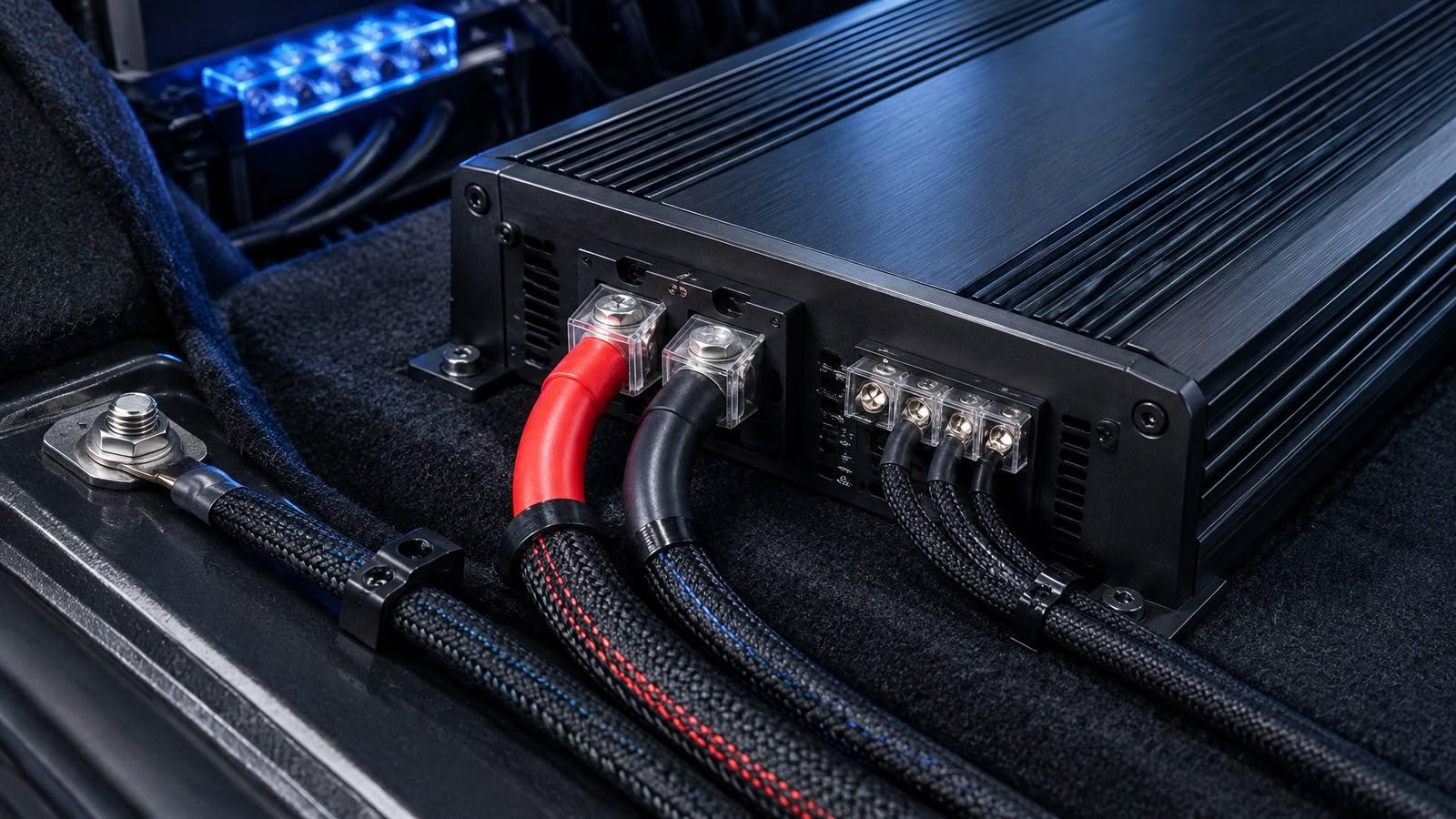
The ground connection carries operating current too. Follow the amplifier's requirements for both power and ground conductors, and assess the complete return path rather than assuming a short ground lead makes every connection adequate. A substantial positive cable cannot compensate for resistance elsewhere in the circuit.
Plan terminal compatibility before ordering larger cable. The amplifier input, fuse holder, distribution block and lugs must accept the selected conductor and have suitable ratings. Do not remove strands to force a larger cable into a smaller opening; choose compatible termination hardware instead. Circuit protection must respect the lowest-rated relevant component.
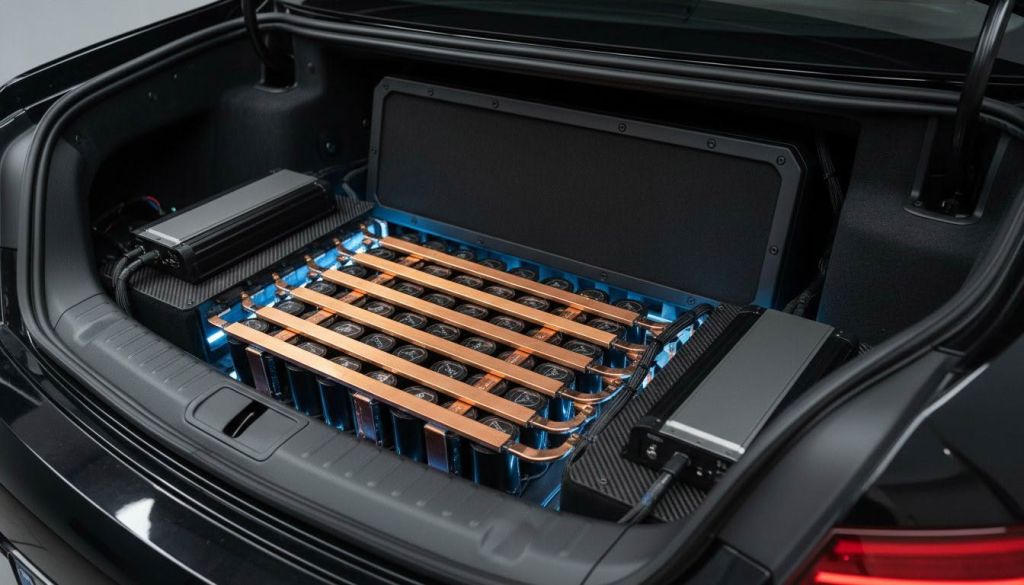
Where a rear battery changes the route, use Evolution Lithium's two-battery wiring guide to understand the additional connections. Treat the front-to-rear feed and each amplifier branch as distinct cable runs, rather than giving every section the same size without assessing its demand.
Fit appropriately rated protection close to the battery supplying the cable. The supply fuse protects the wiring against fault current; an amplifier's internal protection does not protect an unfused upstream run. An unprotected short can overheat the cable and cause a fire.
Select protection for the conductor, holder, connections and equipment requirements together. Where distribution changes to a smaller conductor, provide suitable branch protection. A larger fuse is not a remedy for repeated failures, and a larger main cable does not raise the rating of a smaller downstream connection.
Your shortlist should identify conductor material, AWG or mm², measured length, insulation conditions, compatible terminals and protection. Keep that information together so a future amplifier addition prompts a reassessment of the shared feed, rather than an automatic reuse of existing wiring.
A larger conductor addresses cable losses; it does not create charging current. Separate a wiring problem from insufficient electrical supply before buying hardware. For a run whose requirements suit the documented sizes, browse the OFC power cable range.
Yes. In the cited amplifier manual, 0 AWG denotes the size commonly called 1/0 AWG or one-aught. It is different from 1 AWG, so keep the complete designation on your cable order.
No. AWG describes the conductor, not the jacket. Use the stated conductor size and material; insulation thickness does not establish current-carrying capacity.
No. Correctly sized cable still needs protection because an accidental short can carry damaging current regardless of whether normal operating voltage drop is low.