LTO Battery Banks for Car Audio: Why SCiB Lithium Delivers Stronger Voltage, More Power, and Longer Life
If your headlights dim, your amplifier loses output, or your voltage drops hard when the bass hits, the problem is usually not just the amplifier. It is the electrical system feeding it. High-powered car audio needs fast current delivery, strong voltage stability, and a battery bank that can recover quickly between heavy bass notes.
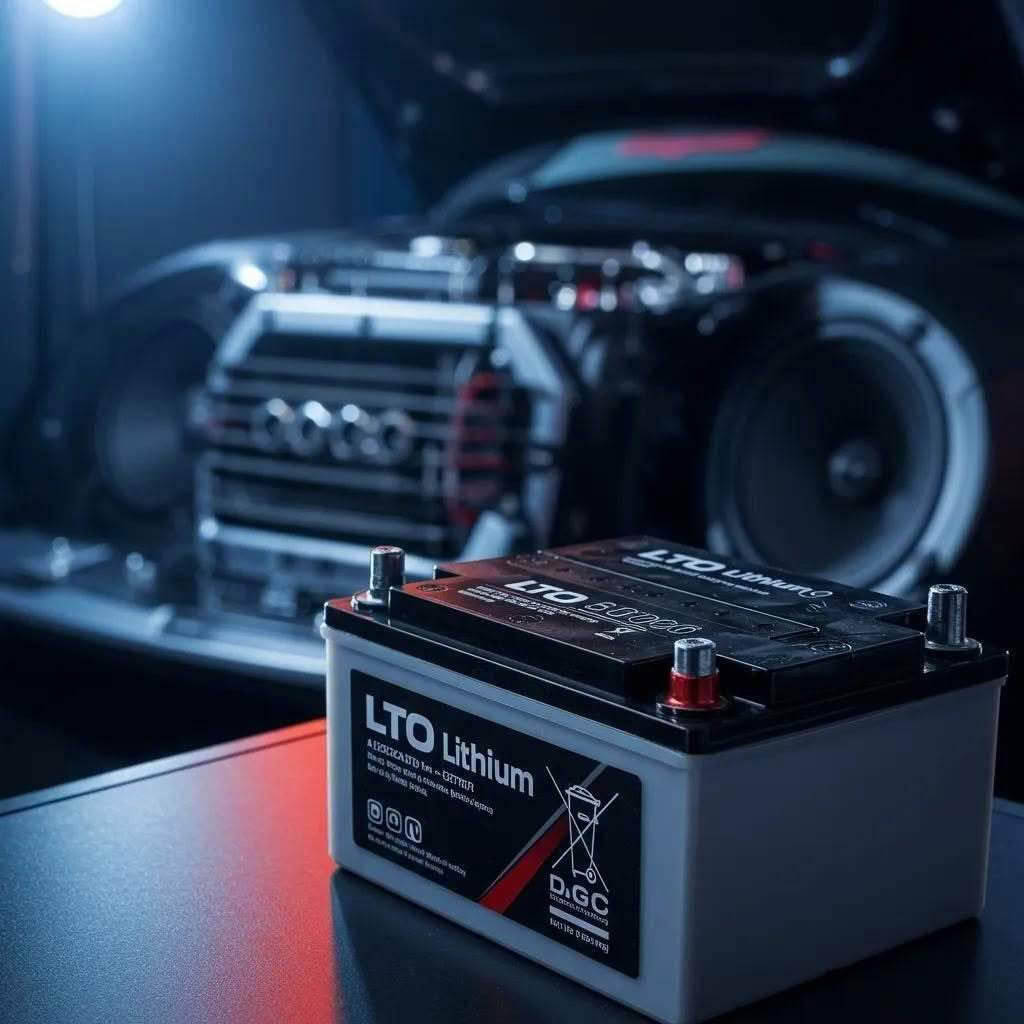
That is where an LTO battery bank becomes one of the strongest upgrades for serious car audio systems. LTO, short for Lithium Titanate Oxide, is a lithium battery chemistry designed for high-current discharge, fast charging, long cycle life, and excellent safety. In car audio, those traits translate into cleaner amplifier power, reduced voltage drop, faster recovery, and more consistent performance.
Evolution Lithium focuses on genuine SCiB LTO battery banks because they are built for the kind of current demand that large monoblock amplifiers, SPL systems, demo vehicles, and serious daily bass setups place on a vehicle’s charging system.
What Is an LTO Battery Bank?
An LTO battery bank is a lithium battery system built from Lithium Titanate Oxide cells. Instead of being designed mainly for slow storage, LTO cells are built to move current in and out very quickly. That makes them well suited to car audio, where amplifiers can demand huge current spikes during heavy bass notes.
In simple terms, an LTO battery bank acts like a high-current energy reserve between your alternator and amplifier. When the amplifier demands more current than the alternator can instantly supply, the battery bank helps hold voltage and feed the system.
This is why a proper SCiB LTO lithium battery bank can make a system feel stronger, cleaner, and more controlled. It is not just about having more amp hours. It is about having a battery that can deliver current fast enough to keep up with the amplifier.
Why Voltage Drop Matters in Car Audio
Voltage drop is one of the biggest performance killers in high-powered car audio. When your amplifier pulls heavy current, the vehicle’s electrical system can fall below the voltage your equipment needs to perform properly.
That voltage drop can cause several problems:
Lower amplifier output. Most amplifiers make less power when voltage falls.
More heat. Low voltage can make the system work harder and less efficiently.
Clipping risk. If the amplifier is pushed hard while voltage is low, distortion and clipping risk increase.
Dimming lights. Headlights and interior lights often show the voltage drop before your ears notice it.
Inconsistent bass. The first bass hit may sound strong, but the next few hits can feel weaker if the battery and alternator cannot recover quickly.
This is why serious systems need more than a standard starting battery. A standard battery is designed to start the vehicle and support factory electronics. A high-powered car audio system needs a battery bank that can support rapid current demand over and over again.
For a deeper technical breakdown, see Understanding Voltage Drop in Car Audio: Causes & Solutions.
Why SCiB LTO Works So Well for Car Audio
Not all lithium batteries behave the same. LTO is different from LiFePO₄, LFP, NMC, and AGM because of how quickly it can accept and release current. Toshiba SCiB LTO cells are especially respected because they are known for strong discharge performance, fast recharge capability, and long service life in demanding applications.
For car audio, the key advantage is not just capacity. It is voltage behaviour under load.
A large AGM battery may have decent reserve capacity, but it usually cannot deliver and recover current as quickly as a quality LTO bank. A LiFePO₄ or LFP battery can be a strong upgrade over AGM, but SCiB LTO is better suited to the extreme current spikes found in serious bass systems.
That is why many car audio enthusiasts choose LTO when the goal is simple: hold stronger voltage when the system gets loud.
Low Internal Resistance
Internal resistance is one of the most important battery traits in car audio. The lower the internal resistance, the easier it is for current to move through the battery.
When internal resistance is high, the battery struggles to supply current quickly. That creates more voltage drop during heavy bass notes. When internal resistance is low, the battery can respond faster and help keep the amplifier fed with cleaner voltage.
This is one of the main reasons SCiB LTO battery banks perform so well in high-current audio systems.
Fast Recharge Between Bass Hits
A serious car audio battery does not only need to discharge quickly. It also needs to recharge quickly.
Every time your amplifier pulls a large current spike, the battery bank gives up energy. Between bass notes, the alternator pushes current back into the bank. If the battery cannot accept charge quickly, the system slowly falls behind and voltage keeps dropping.
LTO battery banks can absorb charge quickly from a suitable high-output alternator. This helps the system recover faster between bass hits and keeps performance more consistent during demos, music, and SPL runs.
Strong Voltage Behaviour at High Current
Car audio batteries should be judged by how they behave under real load, not just by the number printed on the case.
A battery with high amp-hour capacity but poor discharge performance can still drop voltage badly. A smaller high-discharge LTO bank can often outperform a larger weaker battery because it can deliver current faster and hold voltage better.
This is why Evolution Lithium focuses heavily on discharge capability, charging voltage, alternator support, and real system design rather than only quoting amp hours.
The Main Benefits of LTO Battery Banks for Car Audio
1. Reduced Voltage Drop
The biggest real-world benefit of an LTO battery bank is reduced voltage drop. When the amplifier demands current, the bank can respond quickly and help hold voltage higher than a weak AGM or undersized lithium setup.
This helps your amplifier maintain cleaner output and more consistent power. The system feels tighter, stronger, and less strained.
2. Better Amplifier Performance
Large monoblock amplifiers are hungry. They need current, and they need it fast. If voltage drops too low, the amplifier cannot produce its rated power properly.
A proper car audio battery for 3000W, 5000W, 10000W, 20000W or 30000W+ needs to be matched to the amplifier, alternator, charging voltage, and intended use. The higher the system power, the more important battery behaviour becomes.
3. Faster Alternator Recovery
A battery bank and alternator should work together. The alternator produces power while the vehicle is running. The battery bank supports short bursts, stabilises voltage, and absorbs charge between heavy current demands.
LTO works extremely well in this role because it can recharge quickly from a suitable alternator setup. This makes it ideal for daily bass systems, demo vehicles, and SPL setups that need repeatable performance.
For more detail, see High-Output Alternator Compatibility with LTO Battery Banks.
4. Long Service Life
LTO battery chemistry is known for excellent cycle life. In car audio, that means the battery is not just a short-term upgrade. A well-designed LTO bank can deliver strong performance for years when installed, charged, and maintained correctly.
This matters because cheap electrical upgrades often become expensive over time. Replacing weak batteries, chasing voltage problems, and dealing with unreliable performance can cost more than doing the system correctly from the start.
5. Safer Lithium Chemistry
LTO is one of the safer lithium chemistries available. It has excellent thermal stability compared with many other lithium types and is well suited to demanding current applications.
However, safe chemistry does not mean careless installation. No lithium battery should be installed under the bonnet in a hot engine bay. For long-term performance and safety, install LTO battery banks in the boot or rear cabin area, away from sustained engine heat.
For a deeper safety discussion, see Safety and Lithium Fire Myths: Why LTO Is Different for Car Audio Systems.
LTO vs AGM vs LiFePO₄ / LFP for Car Audio
Choosing the best battery for car audio depends on your system power, budget, alternator, charging voltage, and how hard you play the system. AGM, LiFePO₄, LFP, and LTO can all work in the right context, but they are not equal under heavy current demand.
LTO vs AGM
AGM batteries were common in car audio for years because they were stronger than standard flooded lead-acid batteries. They can still work for smaller systems, but they are limited when system power climbs.
Compared with AGM, LTO is lighter, faster charging, more voltage-stable, and far better suited to repeated high-current discharge. AGM may cost less upfront, but it struggles when large amplifiers demand current quickly.
If your system is under roughly 1500W RMS, AGM may still be enough. Once you move into serious power levels, an LTO bank becomes a much stronger choice.
See LTO Lithium Batteries vs. AGM Batteries for Car Audio Systems for a more focused comparison.
LTO vs LiFePO₄ / LFP
LiFePO₄, also called LFP, is a strong lithium chemistry and a major improvement over AGM in many applications. LFP batteries are popular in camping, marine, solar, and general energy storage because they offer good lifespan, good safety, and practical usable capacity.
For car audio, the question is more specific: how well does the battery handle fast, repeated, high-current amplifier demand?
This is where SCiB LTO has the advantage. LTO can discharge and recharge extremely quickly, which makes it better suited to high-output alternators, large monoblock amplifiers, SPL bursts, and aggressive daily bass systems.
LiFePO₄ can still be a good option in moderate systems. But if the goal is maximum voltage stability under hard load, LTO is the specialist chemistry.
For more detail, see LTO vs AGM vs LiFePO4: Which is Best?.
Simple Comparison Table
| Feature | LTO | LiFePO₄ / LFP | AGM |
|---|---|---|---|
| Voltage stability | Excellent | Good | Limited |
| High-current discharge | Excellent | Good to very good | Fair |
| Recharge speed | Excellent | Good | Slow |
| Best use | Serious car audio, SPL, demo, high-current systems | Moderate lithium upgrades, storage, general use | Small systems, budget installs |
| Long-term value | Excellent | Good | Lower upfront, weaker long-term |
Is Your Vehicle Ready for an LTO Battery Bank?
An LTO battery bank is powerful, but it is not magic. It works best when the rest of the electrical system is designed properly.
If your alternator, cable, grounds, fusing, and charging voltage are wrong, the battery bank cannot perform at its full potential. The goal is to build a complete electrical system, not just drop in a lithium battery and hope for the best.
High-Output Alternator
The alternator is the source of power while the vehicle is running. The battery bank supports heavy current demand, but the alternator must refill that energy.
For small systems, a standard alternator may be acceptable. For serious car audio, a high-output alternator is usually one of the most important upgrades you can make.
If your alternator cannot keep up, the battery bank will slowly be drawn down during extended play. That leads to more voltage drop, weaker output, and reduced system consistency.
See Alternator Upgrade: Automotive Electrical System Repair for supporting information.
Charging Voltage
Charging voltage is critical with LTO battery banks. Evolution Lithium SCiB LTO banks perform best when the vehicle’s charging system is set up correctly.
While LTO can operate over a wide voltage range, the preferred charging range for serious performance is around 15.6V to 15.9V. This helps the bank stay at a high usable state of charge and allows faster recovery between heavy loads.
A standard 14.4V system can still charge the bank, but it will not access the same usable capacity or performance window as a properly raised charging system.
For more detail, see Upgrading Your Vehicle for an LTO Lithium Battery with Charging Voltages Above 15V.
Big 3 Wiring Upgrade
The Big 3 wiring upgrade is one of the most important supporting modifications for car audio. It improves the main current paths in the vehicle’s electrical system.
The upgrade usually includes:
Alternator positive to battery positive.
Battery negative to chassis.
Engine block to chassis.
Thin factory wiring can restrict current flow. Upgrading these paths with quality cable helps reduce resistance and supports better voltage stability.
Cable, Fusing, and Grounds
Battery performance is only as strong as the wiring around it. Large amplifiers need proper cable size, secure terminations, correct fusing, and strong grounding.
Poor grounds are one of the most common causes of voltage drop, noise, heat, and unreliable performance. A strong LTO battery bank cannot fix a bad ground path.
For supporting installation guidance, see Proper Grounding Techniques for Car Audio and Wiring for SCiB LTO Lithium Banks.
How to Choose the Right LTO Battery Bank
Choosing the right LTO battery bank is not just about buying the biggest amp-hour number. The correct bank depends on your amplifier power, alternator output, charging voltage, listening style, and how long you expect the system to play hard.
A strong battery choice considers four things:
Current demand: how much current your amplifier can pull.
Alternator support: how quickly the system can replace energy.
Charging voltage: whether the bank is operating in its best usable range.
Use case: daily music, demos, SPL burps, or engine-off play.
This is why a smaller high-discharge LTO bank can sometimes outperform a larger battery with weaker discharge performance. The battery has to move current fast enough for the system, not just store energy on paper.
Use the Car Audio Lithium Battery Calculator if you want a more practical starting point for matching bank size to system power.
Daily Music Systems
Daily music systems need voltage stability over repeated bass notes. The goal is not just one big burp. The system has to recover quickly and keep playing cleanly.
For daily systems, the alternator is extremely important. A well-matched LTO bank with strong alternator support can keep the system more stable than a larger battery bank paired with a weak charging setup.
Demo Vehicles
Demo vehicles need more reserve because they often play hard for longer periods. A battery bank for demo use should be sized with both output and runtime in mind.
If the vehicle is playing engine-on, alternator output and charging voltage become major factors. If the vehicle is playing engine-off, reserve capacity becomes more important.
SPL Systems
SPL systems often need maximum current delivery over short bursts. In this case, discharge capability and voltage behaviour are critical.
A proper SPL battery setup should be matched carefully to amplifier power, impedance, charging voltage, cable layout, and alternator support.
For more focused SPL guidance, see Best SPL Competition Battery System.
Installation Best Practices for LTO Battery Banks
Install in the Boot or Rear Cabin
Do not install lithium batteries under the bonnet. Even though LTO is highly stable, the engine bay exposes the battery to sustained heat, vibration, and harsh operating conditions.
The boot or rear cabin is the correct location for long-term performance and safety. The battery should be securely mounted, protected from movement, and installed where cable runs can be kept clean and safe.
See Lithium Battery Trunk Install Guide for Car Audio for more detail.
Use Correct Fuse Protection
Every serious car audio battery installation needs proper fuse protection. Fuses protect the vehicle, wiring, and equipment if a cable is damaged or a short occurs.
Fuse placement, fuse rating, cable size, and termination quality all matter. Do not treat fuse holders as optional accessories. They are part of a safe electrical system.
See Complete Power Setup for Car Audio: LTO Batteries, Fuse Holders, and Wire.
Use an Active Balancer
An LTO battery bank should be kept balanced so each cell group remains healthy and consistent. Evolution Lithium banks use active balancing to help maintain cell balance over time.
This supports long service life, reliable voltage behaviour, and better consistency across the bank.
Check Your Charging Setup
Before pushing a high-powered system hard, check your charging voltage, cable temperature, fuse condition, ground quality, and battery voltage behaviour under load.
A good installation should be measured, not guessed. If your system is dropping voltage harder than expected, the cause may be alternator output, cable restriction, grounding, charging voltage, or bank sizing.
Who Should Use an LTO Battery Bank?
An LTO battery bank is best suited to car audio systems where voltage stability and high-current delivery matter.
You should consider LTO if:
- You run a high-powered monoblock amplifier.
- Your voltage drops heavily on bass hits.
- Your headlights dim when the system plays loud.
- You are building a demo or SPL vehicle.
- You have upgraded, or plan to upgrade, your alternator.
- You want a long-term battery solution rather than repeatedly replacing weak batteries.
You may not need LTO if your system is small, lightly used, or under roughly 1500W RMS. In that case, AGM or a smaller lithium solution may be enough.
The best choice depends on the full system. Amplifier size, alternator output, charging voltage, cable, grounding, and listening style all matter.
The Evolution Lithium Difference
Evolution Lithium specialises in car audio lithium battery banks for serious NZ and AU systems. The focus is not just selling batteries. It is matching the right battery technology to the way car audio systems actually behave.
Every strong electrical system starts with the same question:
Can the system hold voltage when the amplifier demands current?
That is why Evolution Lithium focuses on SCiB LTO battery banks, proper charging voltage, alternator compatibility, wiring quality, and safe installation. The goal is reliable power delivery, not just a bigger number on a battery label.
Explore the SCiB LTO Lithium Battery range to compare available bank options.
Frequently Asked Questions
What is an LTO battery bank?
An LTO battery bank is a lithium battery system built from Lithium Titanate Oxide cells. In car audio, it is used to supply high current, reduce voltage drop, and help amplifiers perform more consistently under heavy bass loads.
Is LTO better than AGM for car audio?
Yes, for serious high-powered car audio. AGM can work for smaller systems, but LTO has much stronger current delivery, faster recharge behaviour, better voltage stability, and longer service life.
Is LTO better than LiFePO₄ or LFP?
For high-current car audio, LTO is usually the better specialist option. LiFePO₄, also called LFP, is a strong lithium chemistry, but LTO is better suited to rapid discharge, fast recharge, and repeated high-current amplifier demand.
What voltage should an LTO battery bank charge at?
For strong car audio performance, Evolution Lithium generally targets a charging range around 15.6V to 15.9V for SCiB LTO banks. Lower-voltage charging systems can still work, but they will not access the same performance window.
Can I run an LTO battery bank with a standard alternator?
It depends on the system. A standard alternator may work for smaller setups, but serious car audio systems benefit heavily from a high-output alternator. The alternator needs to replace the energy the amplifier pulls from the bank.
Do I need the Big 3 upgrade?
Yes, it is strongly recommended for serious systems. The Big 3 upgrade improves the main current paths between the alternator, battery, engine, and chassis. This helps reduce restriction and supports better voltage stability.
Can I mix LTO with AGM?
It is not generally recommended. Different battery chemistries have different voltage behaviour, charging characteristics, and discharge curves. Mixing them can reduce performance and create uneven charging or discharging behaviour.
Can an LTO battery go under the bonnet?
No. Evolution Lithium does not recommend under-bonnet installation for lithium batteries. Install the bank in the boot or rear cabin area, away from sustained engine bay heat.
What size LTO battery bank do I need?
The right size depends on amplifier RMS power, alternator output, charging voltage, system use, and how long you play the system hard. A daily music system, demo vehicle, and SPL setup may all need different battery sizing.
Why does my voltage still drop after adding lithium?
If voltage still drops heavily, the issue may be alternator output, charging voltage, cable size, ground quality, fuse connections, or undersized battery capacity. Lithium helps, but the full electrical system still has to be designed correctly.
Is amp-hour capacity the most important number?
No. Amp-hour capacity matters, but it does not tell the whole story. For car audio, discharge capability, internal resistance, voltage behaviour, charging voltage, and alternator support are often more important than amp hours alone.
Final Recommendation
If you are building a serious car audio system, the battery bank should not be treated as an afterthought. Your amplifier can only perform as well as the electrical system feeding it.
LTO battery banks are one of the strongest solutions for reducing voltage drop, supporting high-current amplifiers, recovering quickly between bass hits, and improving long-term reliability. AGM may still work for small systems, and LiFePO₄ or LFP can be a good general lithium option, but SCiB LTO is the specialist choice for high-performance car audio.
The best results come from matching the battery bank with the right alternator, charging voltage, wiring, grounding, fusing, and installation location.
Explore Evolution Lithium’s SCiB LTO battery banks, use the car audio lithium battery calculator, or contact Evolution Lithium for help matching the right bank to your system.
Further reading: See the main car audio battery guide for chemistry, sizing and electrical-system planning.