

How to Choose a Lithium Battery for Car Audio: LTO, LiFePO4 & Battery Sizing Guide
Choosing the right lithium battery for car audio starts with the amplifier and charging system, not simply the battery’s amp hour rating. A 30Ah battery is not automatically stronger or weaker than another 30Ah battery because different lithium chemistries and cell designs can have very different voltage, internal resistance, discharge capability and recharge characteristics.
For serious high current car audio, SCiB LTO battery banks are particularly well suited because genuine Toshiba SCiB cells are designed for high input and output power, rapid charging and repeated cycling. LiFePO4, also called LFP, can also be a strong choice for moderate and high power systems where usable capacity, weight and cost are priorities. Neither chemistry should be selected until its voltage range is compatible with the amplifier and vehicle charging system.
Battery sizing should then be based on real amplifier RMS power, operating voltage, estimated amplifier efficiency, alternator contribution and how the system will actually be used. As a planning example, a 5000W Class D amplifier producing its full rated output at 15.0V and 80% efficiency would require approximately 417A of DC input. Music normally averages considerably less than continuous full RMS output, but the battery, wiring and charging system still need to tolerate heavy current peaks without excessive voltage drop.
The correct order is:
Amplifier demand → operating voltage → battery chemistry → discharge capability → battery capacity → alternator support → wiring and fusing.
Quick Answer: Which Lithium Battery Is Best for Car Audio?
| Battery Type | Main Strength | Main Consideration | Car Audio Use |
|---|---|---|---|
| SCiB LTO | Very high current capability, rapid charge acceptance and strong cycle durability | Charging voltage and bank configuration must be matched correctly | High power daily, demo and SPL systems |
| LiFePO4 / LFP | Good energy storage, low weight and strong cycle life | Current capability varies substantially between cells and battery designs | Daily systems and builds needing a balance of capacity and current |
| NMC | High energy density | Voltage, thermal behaviour and pack design require careful engineering | Not our default recommendation for custom high current car audio banks |
| AGM | Low initial cost and simple compatibility with conventional charging systems | Heavy and generally weaker voltage behaviour under large current demand | Smaller systems and conventional electrical setups |
For a deeper chemistry comparison before choosing a battery, see our SCiB LTO vs LiFePO4 vs AGM car audio battery comparison.
Step 1: Calculate What Your Amplifiers Actually Need
One of the biggest mistakes when choosing a car audio lithium battery is sizing it from the subwoofer wattage, the amplifier’s peak rating or a generic rule such as “X amp hours per 1000 watts”.
The battery supports the amplifier.
Start with the amplifier’s genuine RMS output at the impedance you intend to run.
For an approximate full output current calculation:
Current ≈ Amplifier RMS Power ÷ (System Voltage × Amplifier Efficiency)
For Evolution Lithium planning calculations, approximately 80% efficiency is a reasonable working estimate for a modern Class D amplifier when a manufacturer efficiency curve is unavailable.
| Amplifier Output | System Voltage | Assumed Efficiency | Approx. Full Output DC Current |
|---|---|---|---|
| 3,000W RMS | 15.0V | 80% | 250A |
| 5,000W RMS | 15.0V | 80% | 417A |
| 10,000W RMS | 15.0V | 80% | 833A |
| 20,000W RMS | 15.0V | 80% | 1,667A |
These are electrical planning figures at continuous rated output, not predictions of average music consumption.
Music has varying crest factor and duty cycle, so a subwoofer amplifier normally spends much of its time below maximum output. Demo sessions, rebassed music and test tones can move average current considerably closer to the electrical system’s limit.
This distinction is recognised by amplifier manufacturers as well. Taramps publishes a separate musical-use battery calculation for car audio amplifiers based on its measured average consumption. That simplified method is useful for understanding musical duty cycle, but it should not replace checking the actual amplifier, battery and alternator limits in a high power build.
If you are sizing anything from a moderate daily setup through to a serious multi kilowatt system, use our car audio lithium battery sizing guide for 3000W to 30000W RMS amplifiers for system specific examples.
Why You Should Not Add an Arbitrary 20 or 30 Percent to Amplifier RMS
A generic percentage does not turn amplifier wattage into battery requirements.
If you need to estimate electrical current, efficiency already belongs in the calculation. Voltage also belongs in the calculation.
For example, a 5000W Class D amplifier at 80% efficiency requires about 6250W of DC input when delivering a true 5000W output.
At 15.0V, that is approximately 417A.
At 13.0V, supplying the same electrical input power would require approximately 481A.
That is why voltage stability matters. As system voltage falls, more current is required to support the same electrical power.
Crutchfield uses the same underlying relationship in its technical guide to installing 2000W plus car audio amplifiers, where amplifier output, supply voltage and efficiency are used to demonstrate why multi kilowatt amplifiers require hundreds of amps from a vehicle electrical system.
Step 2: Choose the Right Lithium Battery Chemistry
“Lithium battery” is a broad description.
Two batteries can both be lithium based while having substantially different nominal voltage, discharge behaviour, charging requirements, cycle performance and thermal characteristics.
For car audio, the two chemistries most relevant to the Evolution Lithium range are Lithium Titanate Oxide (LTO) and Lithium Iron Phosphate (LiFePO4 or LFP).
SCiB LTO Batteries for High Power Car Audio
Toshiba’s SCiB technology uses lithium titanium oxide in the negative electrode. Toshiba identifies high input/output power, rapid charging, long cycle life, low temperature operation and a wide usable state of charge range among the key characteristics of the chemistry.
The manufacturer’s current Toshiba SCiB high power cell specifications provide useful real data rather than generic “LTO lasts X cycles” claims.
For example, Toshiba states that its 2.9Ah high power SCiB cell retains more than 80% of initial capacity after 40,000 charge and discharge cycles when tested at 10C and 35°C. Toshiba also states that the same 2.9Ah cell can charge from 0% to more than 80% state of charge in approximately one minute under its specified test conditions.
Those figures cannot simply be applied to every LTO cell ever produced. They demonstrate why cell specific manufacturer data matters.
The SCiB high power range currently includes 2.9Ah and 10Ah cells with a nominal voltage of 2.4V. Toshiba lists output performance at 50% state of charge and 25°C of 520W for the 2.9Ah cell and 1800W for the 10Ah cell over its specified ten second test.
This is the type of cell behaviour that makes SCiB attractive for a high power car audio battery. The battery can be configured around rapid current delivery rather than relying solely on large stored amp hour capacity.
For a detailed explanation of the different cell formats, read our technical guide to SCiB LTO cell sizes, voltage behaviour and car audio bank design.
LiFePO4 Batteries for Car Audio
LiFePO4, usually shortened to LFP, uses a different lithium chemistry and operates at a higher nominal cell voltage than LTO.
It can be an excellent car audio option when the required discharge current falls comfortably within the selected cell or battery rating and the system benefits from greater stored energy for its size and cost.
Again, avoid assigning a generic cycle figure to every LiFePO4 battery.
As a real manufacturer example, EVE specifies its LF22K 22Ah LiFePO4 cell at 3.22V nominal with 0.43 ± 0.1mΩ initial internal resistance. EVE reports up to 4500 cycles to 80% state of health under its stated 25°C, 0.5C charge and 0.5C discharge test conditions.
The important words are under its stated test conditions.
Cycle life changes with cell temperature, charge voltage, discharge depth, current and operating conditions. A published laboratory figure should not be advertised as a guaranteed service life in a bass car.
Evolution Lithium also supplies LiFePO4 options for builders who want an alternative to LTO. Browse our car audio lithium battery range including SCiB LTO and EVE LiFePO4 options to compare the available platforms.
What About NMC Lithium Batteries?
Nickel manganese cobalt lithium batteries are widely used where high energy density is important, but that does not automatically make them the best choice for a custom car audio bank.
The exact cell design, allowable current, pack voltage, charging limits, thermal behaviour and protection strategy all need to be appropriate for the application.
For DIY high current car audio, we prefer to work with cell platforms whose electrical behaviour and use case are clearly understood rather than choosing a chemistry simply because it stores more watt hours per kilogram.
LTO vs LiFePO4 for Car Audio: Which Should You Choose?
| Consideration | SCiB LTO | LiFePO4 / LFP |
|---|---|---|
| High current demand | Excellent with appropriate high power cells | Depends strongly on the specific cell and bank design |
| Rapid recharge | A major strength of SCiB | Good when kept within manufacturer charge limits |
| Stored energy | Lower energy density | Generally stronger energy storage per unit mass/volume |
| Extreme repeated bass demand | Particularly well suited | Suitable only when the specific cell’s current capability matches the load |
| Charging system | Must be matched to the selected LTO series configuration | Must be matched to the selected LFP series configuration |
| Best fit | Serious daily, demo and SPL builds prioritising current delivery | Daily systems needing a strong mix of capacity, weight and current capability |
There is no need to claim that one chemistry “wins” every category. The best lithium battery for car audio is the battery whose current capability, usable energy, voltage range and charging requirements suit the actual system.
Step 3: Compare the Battery Specifications That Actually Matter
Once the chemistry has been narrowed down, compare the real electrical specifications.
The important figures are not limited to Ah.
1. Continuous Discharge Capability
Continuous discharge tells you how much current the battery or cell is designed to deliver over the manufacturer’s specified duration and conditions.
For a cell rated in C:
Current = Capacity in Ah × C Rating
A 20Ah cell rated for 12C continuous discharge would theoretically correspond to:
20Ah × 12C = 240A
That calculation applies to the cell or parallel group being evaluated. Series connection raises voltage but does not increase amp hour capacity.
2. Burst or Pulse Discharge Capability
Burst capability is useful in car audio because music creates short periods of high amplifier demand.
Do not treat a burst current rating as a continuous rating.
The duration, starting state of charge, temperature and cell voltage associated with that burst specification matter.
3. Amp Hour Capacity
Amp hours describe stored charge.
They matter for runtime and how far the bank can be discharged before it needs to recover, but Ah alone tells you very little about how aggressively the battery can supply current.
This is one of the main reasons comparing a 30Ah SCiB LTO bank directly with a 30Ah conventional battery can be misleading.
4. Internal Resistance
Every battery has internal resistance.
When current flows through resistance, voltage is lost:
Voltage Drop = Current × Resistance
At 50A, a small amount of resistance may appear insignificant.
At 500A or 1000A, the same resistance matters enormously.
That applies not only to the battery cells but also to busbars, lugs, cable, fuse holders, grounds and every connection between the battery and amplifier.
If your system already struggles under load, our car audio voltage drop diagnosis guide for high power amplifiers explains how to determine whether the battery is actually the problem.
5. Operating and Charging Voltage
The battery chemistry has to match the voltage environment of the vehicle and amplifiers.
Do not buy a lithium bank first and decide how to charge it afterwards.
Confirm:
- Maximum battery bank charging voltage
- Preferred daily charging range
- Amplifier maximum operating voltage
- Alternator regulated voltage
- Voltage at idle and cruising RPM
- Voltage measured at the rear battery under charge
- Whether the vehicle uses smart alternator control
Why Battery Voltage Has to Match the Amplifier
Higher electrical-system voltage can reduce current for a given input power, but only equipment designed for that voltage should be used.
Do not assume every “12V” car audio amplifier is happy at 15.8V or 16V.
Check the amplifier manufacturer’s operating voltage range first.
This is particularly important when planning a 6S SCiB LTO setup. Evolution Lithium generally targets approximately 15.6V to 15.9V for many correctly configured 6S SCiB daily systems, but the actual cell bank, active balancer, amplifier and charging system still need to be verified.
For systems specifically being built around higher charging voltage, read our guide to charging a 6S LTO car audio battery above 15.6V before modifying alternator regulation.
Step 4: Check Whether the Alternator Can Support the Battery
A battery stores electrical energy.
The alternator has to replace the energy the audio system removes while the engine is running.
This means adding more battery capacity can increase playing time and current reserve, but it does not create additional charging power.
If the audio system consumes more energy on average than the alternator can replace, the battery state of charge will continue falling.
Eventually, voltage follows it down.
For high power builds, check:
- Rated alternator output
- Output at idle
- Output once the alternator is hot
- Vehicle factory electrical consumption
- Charging voltage
- Average audio-system load
- Expected demo or listening duration
A battery should therefore be selected together with the alternator rather than treated as an alternative to one.
Our high output alternator guide for SCiB LTO car audio battery banks explains how charging current, idle output and voltage regulation affect recovery.
For vehicles with variable or smart alternator behaviour, a different approach may be required. See the DC to DC charger and alternator upgrade guide for LTO car audio systems for the main options.
A Real High Power Electrical Upgrade Example
For a practical example of how a large lithium bank and alternator upgrade fit into an actual car audio build, Steve Meade’s 400A alternator and lithium battery car audio upgrade on YouTube shows a multi kilowatt system being built around both energy storage and increased alternator capacity.
The useful takeaway is not that every system needs a 400A alternator. It is that large amplifier systems are designed around the complete electrical supply, not a battery in isolation.
Step 5: Verify Wiring, Fusing, Grounding and Installation
A high discharge lithium bank can expose weak wiring very quickly.
The battery may be capable of hundreds or thousands of amps while one poor connection prevents that current reaching the amplifier efficiently.
Power cable size should be selected from:
- Expected current
- Cable length
- Conductor material
- Acceptable voltage drop
- Installation environment
- Fuse rating
Do not size cable from amplifier wattage alone.
Crutchfield’s current car amplifier power cable sizing guide similarly bases conductor size on amplifier demand and cable length and specifically distinguishes copper conductor requirements.
Fuse Every Energy Source Correctly
The purpose of the main fuse is to protect the cable in the event of a short circuit.
With a battery at each end of a long positive cable, both ends can energise a fault.
This is why properly designed front and rear battery systems require source protection at both battery ends rather than installing one fuse at the front and assuming the rear cable is protected.
Crutchfield’s multi kilowatt amplifier installation guidance specifically identifies additional fuse protection when a second battery is added.
For a complete layout, use our step by step guide to safely wiring an LTO lithium battery bank for car audio.
Grounding Is Part of the Power Circuit
Current does not stop at the amplifier ground terminal.
It needs a low resistance path back to the battery and charging system.
Poor chassis preparation, small ground cable, weak factory bonding or loose terminals can all create voltage drop.
Before blaming the battery for falling voltage, follow our proper grounding guide for lithium car audio amplifiers and battery banks.
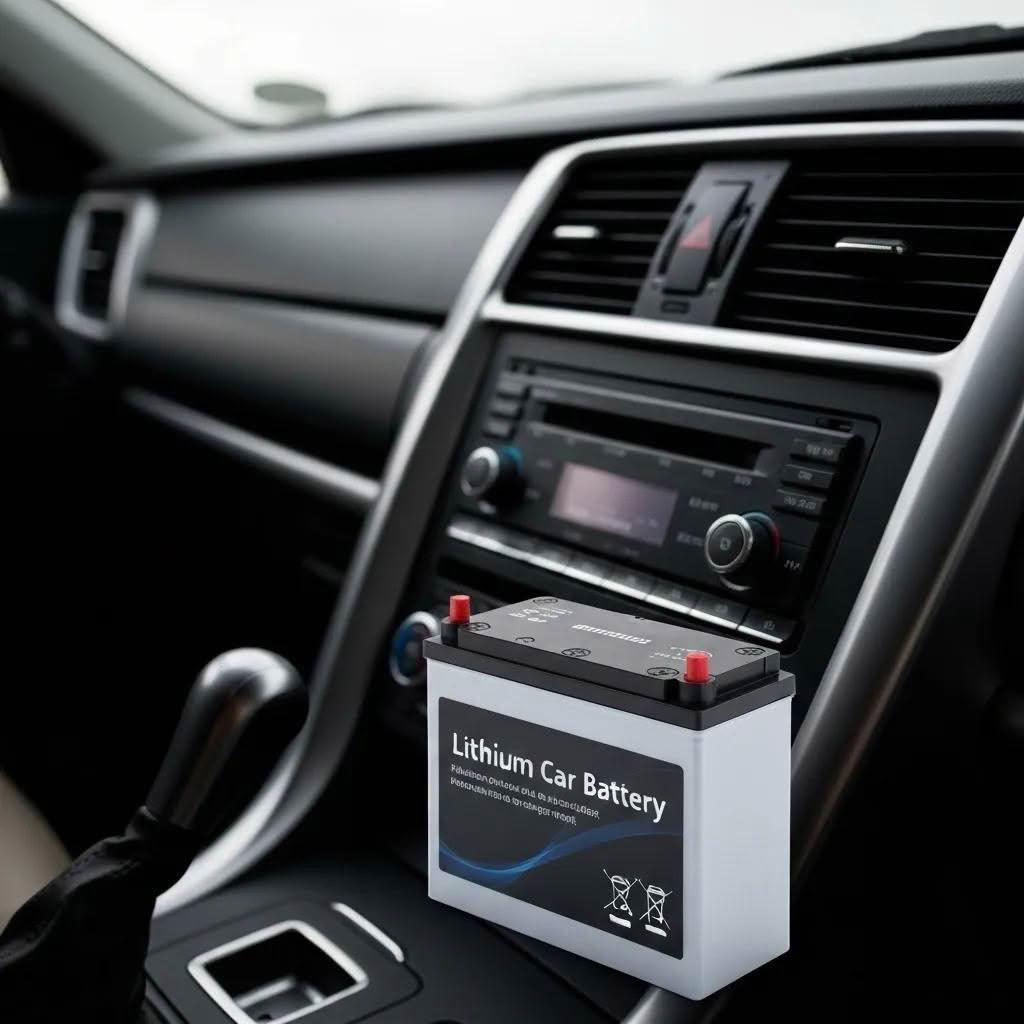
Where Should a Car Audio Lithium Battery Be Installed?
Evolution Lithium does not recommend installing our lithium battery banks under the bonnet.
A protected boot or rear cabin installation keeps the bank away from unnecessary engine bay heat, contamination and harsh environmental exposure while allowing it to be positioned close to the amplifiers.
The bank must be mechanically secured so it cannot move during hard braking, cornering or an accident.
Terminals and busbars should also be protected from accidental contact with tools, seats, cargo or bodywork.
How Battery Capacity and Discharge Rate Work Together
A common misconception is that a larger Ah figure automatically means a battery can support a larger amplifier.
Capacity and current capability are related but separate.
Consider two hypothetical cells:
| Cell | Capacity | Continuous Rating | Calculated Current |
|---|---|---|---|
| Cell A | 10Ah | 35C | 350A |
| Cell B | 20Ah | 12C | 240A |
The 20Ah example stores twice as much charge but has a lower calculated continuous current capability.
That does not make either cell “better”.
The higher capacity cell may be more useful for sustained playback, while the higher C rate cell may suit a system prioritising compact size and aggressive transient current.
This is why Evolution Lithium offers different SCiB cell platforms rather than pretending every car audio system needs the same battery architecture.
Choosing Between 3Ah, 10Ah and 20Ah SCiB Cell Platforms
The cell number describes the individual cell capacity, not automatically the finished battery bank capacity.
A bank assembled from 3Ah cells can contain many parallel strings and have a finished capacity of 15Ah, 30Ah, 45Ah, 60Ah, 90Ah or more.
3Ah SCiB
The 2.9Ah/3Ah SCiB platform is highly power focused. Evolution Lithium uses it where high current delivery, compact cell size and strong transient performance are priorities.
10Ah SCiB
The 10Ah high power SCiB format combines greater capacity per cell with very strong short duration power performance and can be useful where packaging and high current capability need to be balanced.
20Ah SCiB
The 20Ah SCiB format stores more energy per cell and is well suited to battery banks where sustained playback and reserve capacity carry more weight in the design.
The right SCiB bank should therefore be selected from the intended system behaviour, not from the assumption that larger individual cells are automatically stronger.
Browse the Evolution Lithium SCiB LTO battery banks for high power car audio systems to compare the current configurations.
Daily Driver vs Demo vs SPL: The Same RMS Can Need Different Batteries
Two cars with the same 5000W amplifier may need different battery setups.
Daily Music System
A daily system playing normal music generally has a much lower average current demand than the amplifier’s theoretical full RMS input.
Alternator support becomes extremely valuable because the charging system has time between peaks to replenish energy.
Demo System
Long bass heavy demonstrations increase average electrical demand.
More usable capacity and stronger alternator support become important because the battery remains under load for longer periods.
SPL Competition
Short SPL runs can prioritise extreme current delivery and voltage behaviour over long runtime.
That can favour a different cell platform from a vehicle expected to play continuously for an hour.
This is why “What battery do I need for 5000 watts?” is only the beginning of the sizing conversation.
Budget for the Electrical System, Not Just the Battery
There is no useful rule saying a fixed percentage of the total car audio budget should be spent on batteries.
A 1500W system on a vehicle with a strong factory alternator has completely different electrical requirements from a 15,000W build.
Budget for what the system actually needs:
- Battery bank
- High output alternator if required
- OFC power and ground cable
- Correct fuses and fuse holders
- Busbars and terminals
- Active balancer where applicable
- Secure battery mounting
- Charging voltage modifications if required
- Instrumentation for checking voltage and current
Saving money by buying a battery that cannot support the amplifier is false economy.
So is buying a huge battery while leaving an undersized alternator, weak grounds and poor cable untouched.
Common Mistakes When Choosing a Lithium Battery for Car Audio
Choosing by Amp Hours Alone
Ah measures stored charge. It does not tell you the complete current capability, internal resistance or voltage behaviour of the battery.
Sizing from Subwoofer Wattage
The amplifier creates the electrical demand. Use its genuine RMS output at the intended load.
Using Peak Amplifier Ratings
Peak, max and dynamic marketing numbers are poor foundations for an electrical system. Use continuous RMS specifications.
Ignoring the Alternator
A battery can supply missing current temporarily. It cannot replenish its own energy indefinitely.
Assuming More Battery Fixes Voltage Drop
Additional battery capacity cannot repair an undersized cable, weak ground, poor crimp or restrictive fuse holder.
Ignoring Amplifier Maximum Voltage
Never increase vehicle charging voltage until every connected amplifier and electrical component has been checked for compatibility.
Mixing Battery Chemistries Without Engineering the System
LTO, LiFePO4, AGM and other battery types have different resting voltages and charging behaviour. Do not simply parallel incompatible batteries because their labels all say “12V”.
Installing Lithium Under the Bonnet
Evolution Lithium battery banks should be mounted in a protected boot or rear cabin location rather than being exposed to the sustained heat and contamination of the engine bay.
Car Audio Lithium Battery Selection Checklist
- List every amplifier and its genuine RMS output.
- Determine the final impedance each amplifier will run.
- Confirm the amplifier operating voltage range.
- Estimate full output DC current using voltage and efficiency.
- Decide whether the build is daily, demo or SPL focused.
- Measure current charging voltage at the vehicle battery.
- Check alternator output, including hot and idle performance.
- Select LTO or LiFePO4 based on current, capacity and voltage requirements.
- Compare continuous and burst discharge specifications.
- Choose enough Ah for the required reserve and play time.
- Check installation space and secure mounting.
- Size the OFC cable from current and cable length.
- Design fuse protection around every battery source.
- Verify the ground path under load.
- Commission the complete system while monitoring battery and amplifier voltage.
Frequently Asked Questions
What Is the Best Lithium Battery for Car Audio?
For high current daily, demo and SPL systems, SCiB LTO is one of the strongest options because Toshiba’s high power cells are specifically designed for rapid charging, high input/output power and repeated cycling. LiFePO4 can be an excellent choice when the selected cell has sufficient current capability and greater stored capacity is a priority. The best choice still depends on amplifier power, alternator support and operating voltage.
How Big a Lithium Battery Do I Need for a 3000W Amp?
Do not size it from watts alone. At 15.0V and an assumed 80% Class D efficiency, 3000W RMS corresponds to approximately 250A at continuous full rated output. Normal music average will generally be lower. Battery discharge capability, alternator contribution and desired runtime determine the final bank size.
What Size Lithium Battery Do I Need for a 5000W Amp?
A 5000W Class D amplifier at 15.0V and 80% efficiency corresponds to approximately 417A at continuous full output. That does not mean the battery must continuously deliver 417A by itself because the alternator contributes while the engine is running and music demand varies. Size the complete electrical system rather than matching one battery number to 5000W.
What Size Battery Do I Need for a 10,000W Car Audio System?
At 15.0V and 80% amplifier efficiency, 10,000W RMS corresponds to approximately 833A at continuous full output. A system at this level needs serious consideration of battery current capability, alternator output, cable, fusing, grounds, usage pattern and voltage. A generic “100Ah battery” answer is not technically adequate.
Is LTO Better Than LiFePO4 for Car Audio?
LTO is particularly strong where rapid current delivery, fast charge acceptance and repeated high current cycling are priorities. LiFePO4 generally offers stronger energy density and can provide excellent performance when its discharge rating matches the amplifier. Neither chemistry is universally better for every build.
Does a Higher Ah Lithium Battery Give More Amplifier Power?
Not automatically. Higher Ah means greater stored charge. Maximum useful amplifier support also depends on the battery’s discharge capability, internal resistance, voltage, wiring and charging system.
Will a Lithium Battery Fix My Voltage Drop?
It can substantially improve current reserve when the existing battery is the limitation, but voltage drop can also come from the alternator, power cable, fuse holders, grounds and connections. Diagnose the complete circuit before replacing parts.
Do I Need a High Output Alternator with a Lithium Battery?
Not every system needs one. The alternator must, however, be capable of replacing the energy used by the audio system over time. As average amplifier demand rises, alternator capacity becomes increasingly important regardless of how capable the lithium battery is.
Can I Put a Lithium Car Audio Battery Under the Bonnet?
Evolution Lithium does not recommend under bonnet installation for our car audio lithium banks. A properly secured boot or rear cabin location provides a more suitable environment and can position the battery closer to the amplifier load.
Conclusion: Choose the Battery Around the Complete Car Audio Electrical System
Choosing a lithium battery for car audio becomes much easier once you stop looking for a universal watts to amp hours rule.
Start with genuine amplifier RMS power. Convert that power into an estimated electrical current using the actual system voltage and a realistic amplifier efficiency. Then decide how the car will be used and how much of that demand the alternator can replace.
Only then should you choose between SCiB LTO, LiFePO4 or another suitable battery platform.
For serious high current builds, SCiB LTO offers a compelling combination of rapid charge acceptance, high input and output power and exceptional published cycle performance. LiFePO4 can be an equally sensible choice when the system benefits from greater energy storage and the chosen cells have enough discharge capability for the amplifier.
Whichever chemistry you choose, the battery is only one part of the system.
Amplifier → battery → alternator → charging voltage → cable → fusing → grounds → tuning.
If one part becomes the bottleneck, simply installing a larger lithium bank will not fix it.
Evolution Lithium builds and supplies car audio lithium battery systems for NZ bassheads, daily drivers, demo vehicles and SPL builds. If you know your amplifier RMS power, alternator output and current charging voltage, we can help match the battery bank to the electrical demand rather than guessing from a generic Ah chart.
“`