
Best SCiB Bank Size for Car Audio: 15Ah to 90Ah Compared
The short answer: the best choice in Scib car audio battery banks is the bank that holds your target voltage with minimal sag under your real current draw while matching your alternator and amplifier limits. For most daily drivers up to 3–5 kW RMS (root mean square), a 5S or 6S bank built from 10Ah (ampere hour) or 20Ah cells works well; for 8–12 kW, step to 30–45Ah; for 15–25 kW and serious SPL (Sound Pressure Level) competition, 60–90Ah and beyond. Evolution Lithium in NZ (New Zealand) hand-assembles custom LTO (Lithium Titanate Oxide) SCiB (Super Charge ion Battery) banks using genuine Toshiba cells with exceptional voltage stability and rapid charging.
Traditional lead-acid and AGM (Absorbent Glass Mat) batteries are bulky and prone to voltage sag, which wastes power as heat right when your sub-bass hits. By contrast, LTO (Lithium Titanate Oxide) SCiB (Super Charge ion Battery) chemistry delivers very low ESR (equivalent series resistance), incredible burst current and long cycle life, ideal for high-discharge car audio. That means harder, cleaner bass and happier amplifiers.
Below is a practical, no-fluff list of the key decisions that determine the best LTO (Lithium Titanate Oxide) SCiB (Super Charge ion Battery) bank for your system, with real installer context, tables, and examples tailored for NZ (New Zealand) and Australia.
#1 Start With Real Power Math, Not Badge Numbers
What it is: Your amplifier’s real current demand depends on clamped or RMS (root mean square) output, efficiency and operating voltage. A quick estimate uses I = Pout / (V × η). If an amplifier produces 5,000 W RMS (root mean square) at 80 percent efficiency on a 15.0 V bus, average current is about 5,000 / (15.0 × 0.8) ≈ 417 A. Music peaks can be 2–3 times higher for milliseconds, which is where LTO (Lithium Titanate Oxide) SCiB (Super Charge ion Battery) shines.
Why it matters: If you size too small, voltage sags, amplifiers clip earlier, and you lose output. Every 0.5 V of drop at the amplifier can cost roughly 5–7 percent of power, based on Ohm’s law and typical class-D efficiencies. A right-sized bank keeps voltage flat, reducing heat and distortion while protecting equipment.
Quick example: A daily-driven 3,500 W RMS (root mean square) monoblock at 14.8–15.2 V draws about 300 A average. Plan a 240–270 A alternator upgrade plus a 20–30Ah LTO (Lithium Titanate Oxide) SCiB (Super Charge ion Battery) bank to maintain voltage stability under musical peaks.
#2 How LTO (Lithium Titanate Oxide) SCiB (Super Charge ion Battery) Banks Work
What it is: SCiB (Super Charge ion Battery) is Toshiba’s LTO (Lithium Titanate Oxide) chemistry known for high cycle life, ultra-fast charge acceptance, and extremely low ESR (equivalent series resistance). In car audio, cells are arranged in series to set system voltage and in parallel to increase ampere hours and current capability. Common packs are 5S (five cells in series) or 6S (six cells in series).
Why it matters: Low ESR (equivalent series resistance) and very high allowable C-rate (capacity rate) mean LTO (Lithium Titanate Oxide) SCiB (Super Charge ion Battery) banks can deliver huge current bursts without significant voltage droop. They also accept charge aggressively, so your alternator or charger can replenish energy quickly between bass hits.
Quick example: A 6S, 30Ah pack of 3Ah 75C cells offers very high short-duration burst current capability, translating to excellent voltage hold during 10–20 ms bass transients.
#3 Pick the Right Voltage Platform: 5S vs 6S
What it is: A 5S SCiB (Super Charge ion Battery) LTO (Lithium Titanate Oxide) bank operates around 13.0–14.6 V depending on charge target, playing well with many OEM (original equipment manufacturer) charging systems. A 6S bank operates around 14.8–16.0V typical, with an upper limit near 16.2 V depending on cell model and usage strategy. Always consult the cell datasheet and amplifier voltage limits.
Why it matters: Amplifier power increases as voltage rises, all else equal. However, some amplifiers are not rated above 15.5–16.0 V. Additionally, alternator regulation for 6S often requires dedicated charge control to avoid over- or under-charging. Choose a platform that your amplifiers and charging system can safely support.
Quick example: If your amplifiers are rated to 16.0 V and you want maximum headroom for SPL (Sound Pressure Level), go 6S with an external regulator and target 15.2–16.0 V. For a daily driver on a stock alternator, a 5S bank can still stiffen the bus dramatically with less complexity.
#4 Capacity and C-Rate (capacity rate): Translating Ah (ampere hour) Into Amps
What it is: Capacity in Ah (ampere hour) describes how much charge the bank holds, while C-rate (capacity rate) defines how quickly it can be charged or discharged. SCiB (Super Charge ion Battery) cells are available in 3Ah 75C, 10Ah 75C, 20Ah 35C and other variants. Multiply Ah by C-rate (capacity rate) to estimate current capability, noting manufacturers often quote pulse ratings; continuous ratings are lower.
Why it matters: In car audio, dynamic burst current is king. A 30Ah bank at 75C has a theoretical pulse of 2,250 A, while a conservative sustained figure might be 30–40C. These high rates mean a compact pack can deliver the same or better burst performance than multiple large AGM (Absorbent Glass Mat) batteries without the weight or sag.
Quick example: A 45Ah bank from 10Ah 75C cells can realistically support 1,400–1,700 A on sustained basslines with short peaks well past 3,000 A, keeping a 10–12 kW system in its efficiency sweet spot at 14.8–15.8 V.
#5 Scib car audio battery banks Compared: Practical Sizes and Use-Cases
What it is: Translating lab numbers into installs requires mapping common bank sizes to amplifier power, alternator capacity and use-cases. The table below provides conservative, real-world guidance for planning.
Why it matters: A clear sizing table helps you choose a bank that meets transient and average current needs without overspending. It also highlights when alternator upgrades become essential.
Quick example: If you run an 8 kW system with a 270–320 A alternator, a 30–45Ah 6S bank typically holds 14.8–15.2 V under musical program when wired and fused correctly.
| Bank Size (6S) | Typical Cell Format | Conservative Sustained Current | Short Burst Current | Recommended Amplifier Power (RMS) | Alternator Guidance |
|---|---|---|---|---|---|
| 18–20Ah | 20Ah 35C | 600–800 A | 1,000–1,500 A | 2–4 kW | 180–240 A |
| 30Ah | 3Ah 75C (10P) | 900–1,200 A | 1,800–2,200 A | 5–10 kW | 240–320 A |
| 45Ah | 10Ah 75C (5P approx) | 1,400–1,700 A | 2,800–3,300 A | 8–14 kW | 270–400 A |
| 60Ah | 20Ah 35C (3P) | 1,900–2,300 A | 3,500–4,500 A | 12–18 kW | 320–400 A+ |
| 90Ah | Mixed formats (e.g., 3Ah 75C arrays) | 2,800–3,200 A | 5,500–6,500 A | 18–25 kW+ | 400 A+, dual alternators ideal |
Note: Values are ballpark, informed by cell datasheets and installer experience. Always verify amplifier voltage limits and charging strategy.
#6 Charging Strategy: Alternator, Regulation, and Target Voltage
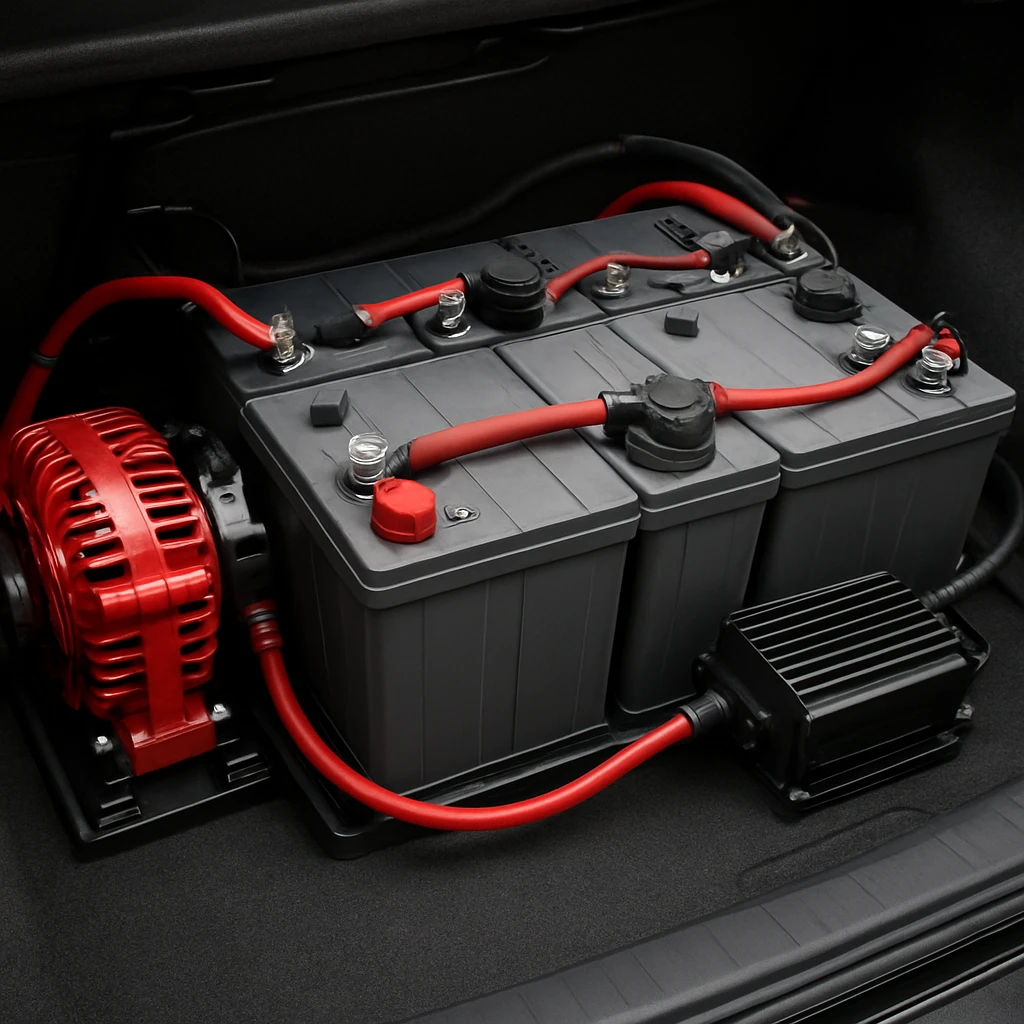
What it is: LTO (Lithium Titanate Oxide) SCiB (Super Charge ion Battery) banks accept charge rapidly, but they still need correct voltage and current limits. Many builders run 6S at 15.0–15.6 V for daily and up to 16.2 V for brief SPL (Sound Pressure Level) bursts, subject to amplifier ratings. External regulation and temperature-compensated control are recommended for high-output alternators.
Why it matters: Over-voltage risks amplifier damage; under-voltage leaves performance on the table. Because LTO (Lithium Titanate Oxide) has low internal resistance, charge current can spike; alternator temperature and belt slip must be managed. A properly regulated alternator shortens recovery time between bass hits.
Quick example: A 320 A high-efficiency alternator regulated at 15.2 V paired with a 45Ah 6S bank keeps a 10–12 kW system above 14.6 V on program music, measured at the amplifier inputs with a calibrated DMM (digital multimeter).
| Alternator Rating | Suggested Bank Size | Typical Charge Target (6S) | Notes |
|---|---|---|---|
| 180–240 A | 18–30Ah | 14.8–15.0 V | Daily driving, minimal system changes |
| 270–320 A | 30–45Ah | 15.0–15.4 V | External regulation helpful |
| 350–400 A+ | 60–90Ah | 15.2–15.6 V | Dual runs of cable, excellent cooling |
#7 Wiring, Busbars, and Fusing: Where Installs Win or Lose
What it is: High-current layouts demand copper busbars, short cable runs, correct cable sizing, quality distribution blocks, and proper fusing as close to the source as practical. Use tinned oxygen-free copper where possible and torque all terminals to spec.
Why it matters: At 400–800 A, small resistance creates large voltage drop and heat. A few milliohms across a long run can waste hundreds of watts. Good copper and solid mechanical joints reduce losses and improve reliability.
Quick example: Mount the LTO (Lithium Titanate Oxide) SCiB (Super Charge ion Battery) bank within 1–1.5 m of the amplifier rack, tie into a copper busbar manifold, run dual 1/0 AWG (American Wire Gauge) or larger to each amplifier, and place ANL fuses within 150–200 mm of the bank positive.
| Current (A) | Recommended Cable (AWG/area) | Fuse Strategy | Notes |
|---|---|---|---|
| Up to 250 | 1/0 AWG (American Wire Gauge) / ~53 mm² | ANL 200–250 A near source | Short runs under 2 m |
| 250–400 | 2/0 AWG (American Wire Gauge) / ~67 mm² | ANL 300–400 A near source | Consider dual runs |
| 400–700 | 4/0 AWG (American Wire Gauge) / ~107 mm² | Multiple ANL 300–400 A in parallel | Busbars and distribution blocks preferred |
#8 Practical Installation: Grounding, Layout and Voltage Drop Control
What it is: A star-ground or dual-bus layout reduces shared impedance. Keep positive and negative runs equal length, bond to chassis at a single, cleaned and protected point, and isolate signal grounds from high-current returns where possible.
Why it matters: Many “mystery” drops are ground-related. A 0.5 mΩ (milliohm) joint at 500 A wastes 0.25 V and 125 W as heat. Clean metal-to-metal connections, copper busbars and anti-oxidant compound maintain low resistance over time.
Quick example: Use a rear copper ground bar tied to frame with two 2/0 AWG (American Wire Gauge) bonds within 300 mm of the bank. Run identical gauge positives to the amplifier rack and measure voltage at the amplifier inputs while playing to confirm drop stays under 0.4 V peak-to-peak.
#9 Safety and Electrical Design Practices You Cannot Skip
What it is: Safety means correct fusing, abrasion protection, mechanical restraint, and cell balancing. External active balancers sized for 6S packs keep cells equalized; a BMS (Battery Management System) with high-current contactors is optional in many LTO (Lithium Titanate Oxide) builds but an external balancer and proper charge control are strongly advised.
Why it matters: A short at 15 V and 2,000 A can vaporize metal. Fusing within 150–200 mm of every energy source, grommets on bulkhead penetrations, and secure mounting that withstands crash forces protect people and gear.
Quick example: Fit a 6S, 5–10 A active balancer, an ANL or CNL fuse at the bank, individual amplifier fuses at each run, loom or braid for abrasion protection, and torque-check terminals after the first heat cycle and monthly thereafter.
#10 Real-World Pairings and Results
What it is: Turning theory into installs with tested pairings helps you set expectations. Below are three typical scenarios that NZ (New Zealand) and Australia enthusiasts build.
Why it matters: Seeing voltage behavior and component choices reduces risk. You can replicate outcomes with similar hardware and wiring quality.
Quick example:
– Daily driver demo, 3–4 kW RMS (root mean square): 5S 20Ah bank, OEM (original equipment manufacturer) alternator plus big three upgrade, dual 1/0 AWG (American Wire Gauge) runs, 14.0–13.6 V hold on music.
– Street demo, 8–12 kW RMS (root mean square): 6S 30–45Ah bank, 270–320 A alternator at 15.2 V, copper busbars, 14.8–14.4 V hold on peaks.
– SPL (Sound Pressure Level) competition, 15–20 kW RMS (root mean square): 6S 60–90Ah bank, 400 A+ or dual alternators at 15.4–15.6 V, shore charger between demos, 15.2–14.8 V during burps.
#11 Evolution Lithium: Cell Choices, Build Quality and Local Support
What it is: Evolution Lithium in NZ (New Zealand) designs custom-built LTO (Lithium Titanate Oxide) SCiB (Super Charge ion Battery) banks using genuine Toshiba cells in multiple capacities and discharge ratings, including 3Ah 75C, 10Ah 75C and 20Ah 35C. Banks are hand-assembled with attention to busbar geometry, compression and safe interconnects, and backed by responsive advice.
Why it matters: Sourcing cells and hardware piecemeal can introduce mismatches and unknown history. Evolution Lithium focuses on voltage stability, high burst current and rapid charging, with safety information referencing Toshiba’s LTO (Lithium Titanate Oxide) testing. They also offer amplifiers and accessories to complete the electrical system.
Quick example: Need a compact, lightweight bank for a 10 kW UTE build? A custom 6S 30–45Ah pack using 3Ah 75C or 10Ah 75C modules, matched to a 320 A alternator at 15.2 V, delivers instant current bursts with noticeably less voltage sag than equivalent AGM (Absorbent Glass Mat) weight.
#12 Shore Charging and Event Workflow
What it is: For demos or SPL (Sound Pressure Level) lanes, a regulated DC (direct current) supply maintains the bank near your target voltage between runs. LTO (Lithium Titanate Oxide) SCiB (Super Charge ion Battery) accepts high charge rates safely within datasheet limits, reducing downtime.
Why it matters: Fast top-offs improve consistency and protect alternators from sustained full-field loads at idle. Properly set voltage avoids overcharging while maximizing readiness for the next demo.
Quick example: A 6S bank charged at 15.2 V with a 30–60 A bench supply between demos recovers quickly, keeping voltage above 14.8 V for the next 15–20 second demo without stressing the alternator at idle.
How to choose the right option
Use this quick framework to select your LTO (Lithium Titanate Oxide) SCiB (Super Charge ion Battery) bank:
- Define amplifier power honestly using clamped or RMS (root mean square) data and estimate average current: I = P / (V × η).
- Confirm amplifier voltage rating; pick 5S (12–13.5 V) or 6S (14.8–15.6 V typical) accordingly.
- Match bank size using the comparison table; plan alternator output to at least 60–70 percent of average draw for daily drivers.
- Design wiring: copper busbars, short runs, appropriate AWG (American Wire Gauge), and fusing within 150–200 mm of sources.
- Add balancing and a safe charge strategy; consider shore charging for events.
- Engage Evolution Lithium for a custom build using genuine Toshiba SCiB (Super Charge ion Battery) cells and local support in NZ (New Zealand).
Additional Reference Tables
| Cell Type | Common C-Rate (capacity rate) | Strengths | Ideal Use-Case |
|---|---|---|---|
| 3Ah 75C | High pulse, high cycle life | Very low ESR (equivalent series resistance), compact builds | SPL (Sound Pressure Level) and compact demo banks |
| 10Ah 75C | High pulse with good sustained | Great balance of size and current | 8–14 kW daily/SPL (Sound Pressure Level) hybrids |
| 20Ah 35C | Moderate pulse, excellent cost/Ah | Stable, efficient, fewer parallel strings | 2–10 kW daily drivers and demo vehicles |
Practical Installer Tips
- Measure voltage at the amplifier inputs while playing; wire lengths can mask true drop if you only probe at the bank.
- Use serrated flange nuts and proper torque on busbars; re-torque after initial thermal cycles.
- Route positives and negatives together to reduce loop area and noise coupling into signal cables.
- Where possible, mount the bank close to the amplifiers to minimize cable length and ESR (equivalent series resistance).
- If mixing chemistries, isolate lead-acid from LTO (Lithium Titanate Oxide) via relays or DC (direct current)-DC (direct current) converters; avoid direct parallel under load.
- Conclusion
The best SCiB (Super Charge ion Battery) car audio bank is the one that keeps your voltage steady under your real current draw with safe charging and rock-solid wiring. Imagine demos where every hit is clean, loud, and repeatable because your electrical system simply does not flinch. In the next 12 months, more NZ (New Zealand) builds will move to compact LTO (Lithium Titanate Oxide) banks for exactly this reason.
Which combination of bank size, alternator and wiring will let your system breathe at full tilt and get the most from Scib car audio battery banks?
Additional Resources
Explore these authoritative resources to dive deeper into Scib car audio battery banks.
Power Your Build with Evolution Lithium
Get custom-built LTO SCiB lithium battery banks for car audio that deliver rapid bursts, stable voltage, fast charging, long life and less bulk for NZ enthusiasts.