
Alternator Upgrades for High-Power Car Audio Systems
If you are aiming for serious bass and clean headroom, the first step is confirming whether your build needs an alternator upgrade for car audio. The short answer: once your amplifiers’ continuous demand at idle exceeds what the factory alternator can supply, you need more generation plus a low-resistance energy buffer. Practically, that means pairing the right car audio batteries with rock-solid power delivery hardware and carefully matched battery solutions. For hard-hitting installs, lithium banks for car audio built on Lithium Titanate Oxide (LTO) Super Charge Ion Battery (SCiB) cells hold voltage steady while the alternator covers the sustained load.
This article answers what an upgrade is, why it matters, how the charging system works with Lithium Titanate Oxide (LTO) Super Charge Ion Battery (SCiB) banks, and how to design and install it safely. Along the way, you will see real numbers, wiring and fuse guidance, and proven installer practices used by Sound Pressure Level (SPL) competitors and daily drivers in New Zealand and Australia. We will also show where Evolution Lithium fits when you want compact, hand-assembled Lithium Titanate Oxide (LTO) Super Charge Ion Battery (SCiB) battery banks built for brutal current spikes.
What Is an Alternator Upgrade for Car Audio?
An alternator upgrade replaces the Original Equipment Manufacturer (OEM) unit with a high-output alternator that delivers more current at both idle and cruise. The alternator converts mechanical energy into Alternating Current (AC), rectifies it to Direct Current (DC), and maintains system voltage while charging the battery. For high-power audio, the goals are higher continuous current, better idle output, and thermal robustness under long demo sessions.
In a car audio context, an upgrade is rarely just one part. You typically combine a high-output alternator with an appropriately set regulator and pulley arrangement (sourced and installed through alternator specialists or professional fitters), the Big 3 wiring upgrade—using appropriately sized heavy-gauge cable—and a fast, low-resistance battery bank. Many teams now choose Lithium Titanate Oxide (LTO) Super Charge Ion Battery (SCiB) banks because they accept charge quickly and keep voltage flatter than Absorbent Glass Mat (AGM) batteries.
Installer checklist for an alternator-focused upgrade:
- Target continuous current based on amplifier Root Mean Square (RMS) (Root Mean Square) demand at 14.4 to 15.6 volts.
- Prioritize idle output; many demos happen at idle where airflow and alternator speed are lowest.
- Complete the Big 3 using appropriately sized heavy-gauge cable (commonly 1/0 or 2/0 AWG), with short, fused runs and clean grounds.
- Use a Lithium Titanate Oxide (LTO) Super Charge Ion Battery (SCiB) bank sized for burst current and capacity to ride out transients.
- Verify belt wrap and tension; overdrive pulleys need proper traction to avoid glaze and dusting.
| Use Case | Amplifier RMS (Root Mean Square) | Est. Continuous Current at 14.4 V (80 percent eff.) | Recommended Alternator | Suggested Battery Bank |
|---|---|---|---|---|
| Daily driver with strong mids/subs | 1 to 2 kW | 85 to 175 A | 240 to 270 A unit with good idle output | 3 Ah or 10 Ah SCiB modules, or a compact 10–20 Ah multi-module pack |
| Show/demo with frequent play | 3 to 5 kW | 260 to 435 A | 300 to 370 A unit, focus on idle curve | 20 Ah SCiB modules or assembled multi-module packs (e.g., 20–40 Ah) |
| SPL (Sound Pressure Level) burp/music | 8 to 12 kW | 695 to 1045 A | Dual alternators or 370+ A plus regulation strategy | Larger multi-cell configurations (examples: 60, 80, 100 or 120 Ah packs built to order) |
Why Does It Matter for High-Power Car Audio?
Voltage stability is everything. Amplifiers make their rated power only if supply voltage stays high and flat. A 5 kW RMS (Root Mean Square) monoblock at 14.4 volts with 80 percent efficiency draws roughly 5000 divided by (14.4 times 0.8), or 434 A, not counting fans, lights, and the Engine Control Unit (ECU) (Engine Control Unit). If system voltage sags to 12 volts, current demand rises, amplifier clipping increases, heat builds, and the bass loses control. That is why alternator output and low-resistance storage must be designed together.
Traditional lead-acid and Absorbent Glass Mat (AGM) batteries struggle with high internal resistance and limited charge acceptance. They sag harder on musical peaks and recover slower between hits, especially in cold weather. Lithium Titanate Oxide (LTO) Super Charge Ion Battery (SCiB) banks, in contrast, exhibit extremely low internal resistance and astonishing burst capability, so amplifiers see a stiffer rail during transients. The alternator then replenishes the Lithium Titanate Oxide (LTO) Super Charge Ion Battery (SCiB) bank between peaks, keeping average State of Charge (SOC) (State of Charge) high without overheating.
| Type | Voltage Sag Under 300 A Burst | Charge Acceptance | Cycle Life | Weight vs Capacity | Notes |
|---|---|---|---|---|---|
| Flooded lead-acid | High | Low to medium | 200 to 400 | Heavy | Inexpensive but weak for high-discharge audio |
| Absorbent Glass Mat (AGM) | Medium to high | Medium | 300 to 600 | Very heavy | Better than flooded, still sags on big hits |
| Lithium Iron Phosphate (LiFePO4) (Lithium Iron Phosphate) | Low | Medium | 1500 to 3000 | Light | Great for deep cycle; watch cold charge limits |
| Lithium Titanate Oxide (LTO) Super Charge Ion Battery (SCiB) | Very low | Very high | 5000+ | Very light | Exceptional burst current and fast charging, ideal for SPL (Sound Pressure Level) |
How Does It Work With Lithium Banks for Car Audio?
Think of the alternator as your continuous power plant and the Lithium Titanate Oxide (LTO) Super Charge Ion Battery (SCiB) bank as a shock absorber for current spikes. During a bass hit, amplifiers pull hundreds of amperes in milliseconds that no alternator can deliver instantly. The Lithium Titanate Oxide (LTO) Super Charge Ion Battery (SCiB) bank supplies that surge with minimal voltage drop, then the alternator recharges the bank over the next second of music. The result is cleaner bass, less amplifier clipping, and lower heat across the system.
Most high-power installs use a 6-cell Lithium Titanate Oxide (LTO) Super Charge Ion Battery (SCiB) configuration, nominally around 13.8 volts with typical charging between 14.4 and 15.6 volts to capitalise on the chemistry’s charge acceptance. A properly set regulator keeps the setpoint in this window so you are kind to amplifiers and still capitalise on the fast charge acceptance of Lithium Titanate Oxide (LTO) Super Charge Ion Battery (SCiB). Balancing is straightforward thanks to the chemistry’s stability, but a simple balancer harness or a conservative Battery Management System (BMS) (Battery Management System) is recommended for long life and peace of mind.
Charging Setpoints and Regulator Behavior
- Target 14.4 to 15.6 volts hot for 6-cell Lithium Titanate Oxide (LTO) Super Charge Ion Battery (SCiB). Many amplifiers are happiest at or below 15.0 volts.
- Understand alternator curves: many units deliver only 30 to 40 percent of peak at idle Revolutions Per Minute (RPM) (Revolutions Per Minute). Overdrive pulleys can raise alternator RPM (Revolutions Per Minute), but monitor belt slip and heat.
- A temperature-compensated regulator helps maintain voltage when the alternator housing is hot after long demos.
Wiring Topology, Busbars, and Distribution
- Use copper busbars or quality distribution blocks near the Lithium Titanate Oxide (LTO) Super Charge Ion Battery (SCiB) bank to minimize joint resistance.
- Run the alternator output to the front battery node, then a short, heavy main feed to the rear bank and amplifier rack.
- Keep return paths symmetrical. A dirty or thin ground is a common cause of voltage drop and amplifier protection triggers.
Recommended Cable and Fuse Sizing
| Cable Size | Cross-Section | Continuous Current (3 m run) | Typical Main Fuse | Notes |
|---|---|---|---|---|
| 4 AWG (American Wire Gauge) | ≈ 21 mm² | Up to 125 A | 125 to 150 A | Short auxiliary runs, not for main feed on big systems |
| 1/0 AWG (American Wire Gauge) | ≈ 53 mm² | Up to 300 A | 250 to 300 A | Common main feed for 2 to 5 kW builds |
| 2/0 AWG (American Wire Gauge) | ≈ 67 mm² | Up to 350 A | 300 to 350 A | Heavier demos, long runs, or hot engine bays |
| 4/0 AWG (American Wire Gauge) | ≈ 107 mm² | Up to 500 A | 400 to 500 A | Extreme SPL (Sound Pressure Level) or dual alternator systems |
What Practical Installation Considerations Should You Plan For?
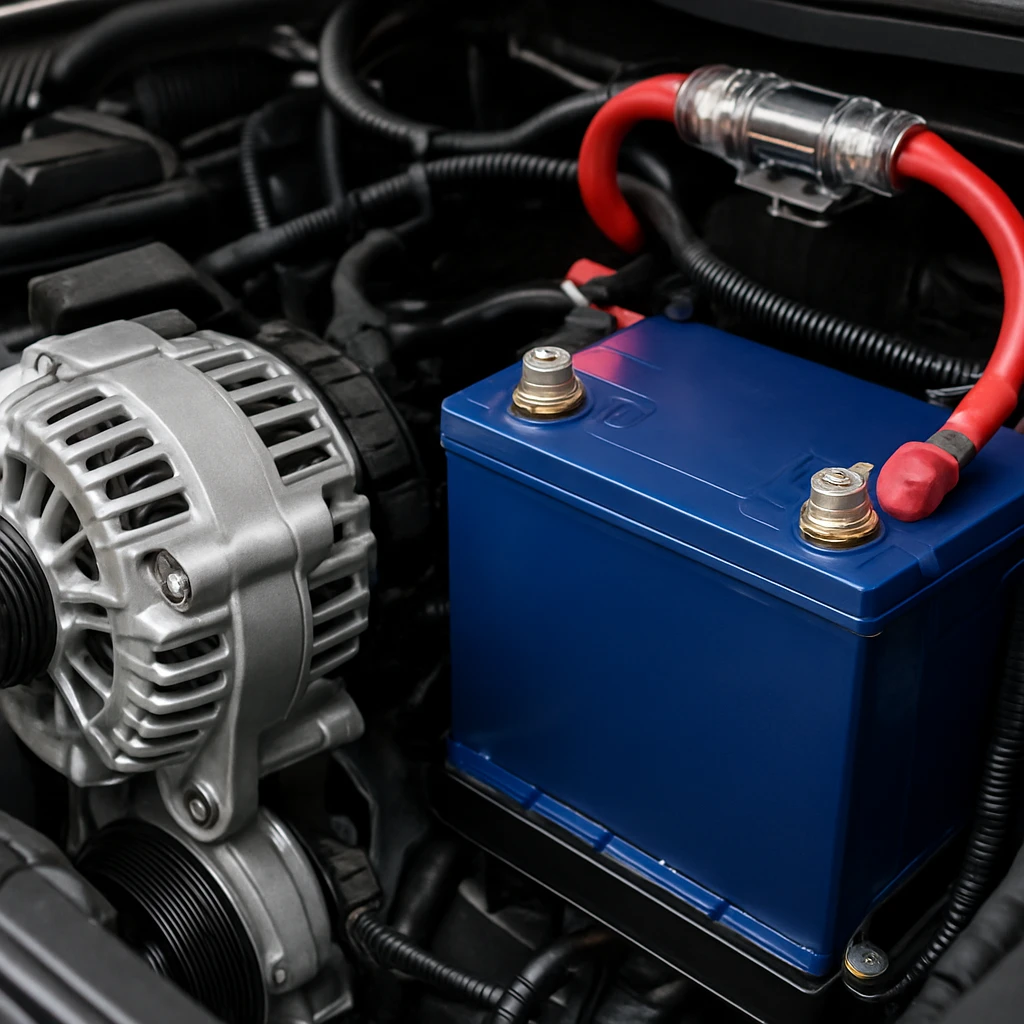
Start by mapping a current budget. Add amplifier Root Mean Square (RMS) (Root Mean Square) draw at your intended supply voltage and include 30 to 60 amperes for vehicle loads. Then select an alternator that can supply a large fraction of that figure at idle Revolutions Per Minute (RPM) (Revolutions Per Minute). Idle output is critical for street demos where airflow is low and thermal stress is high.
- Pulley ratio and belt wrap: Aim for 2.7 to 3.0 alternator to crank ratio for stronger idle output. Verify at least 120 degrees of belt wrap and use quality belts to prevent slip.
- Mounting and cooling: Solid brackets, correct belt alignment, and clear airflow paths significantly raise reliability during long sessions.
- Big 3 upgrade: Battery negative to chassis, engine block to chassis, and alternator positive to battery positive using heavy-gauge cable (commonly 1/0 AWG or larger), with short runs and tight terminations.
- Fuse protection: Install bolt-down high-current fuses within 200 to 300 millimetres of each battery positive and at amplifier feeds. Size fuses to protect the cable, not the device.
- Grounding: Grind to clean bare metal, use internal-tooth washers, and seal after assembly. Star-ground layouts reduce loop noise in multi-amp racks.
- Distribution: Copper busbars near the Lithium Titanate Oxide (LTO) Super Charge Ion Battery (SCiB) bank minimize resistance and simplify service.
Real-world example: A New Zealand daily-demo sedan running an 8 kW RMS (Root Mean Square) monoblock plus a 1.5 kW mids/highs rack uses a 370 A high-output alternator and a 6-cell, 60 Ah Lithium Titanate Oxide (LTO) Super Charge Ion Battery (SCiB) bank. At 14.4 volts hot, clamp readings during music hover around 380 to 420 A from the alternator with peaks of 700+ A absorbed by the Lithium Titanate Oxide (LTO) Super Charge Ion Battery (SCiB) bank. Observed voltage stays above 13.8 volts through sustained demos, with amplifier protection events eliminated after upgrading grounds and shortening the rear positive run by 0.8 metres.
What Safety and Electrical Design Practices Prevent Failures?
High-current audio is safe and reliable when you design for it. Heat and loose terminations cause most failures, so build for low resistance and predictable protection. If you are not certain a part can carry the current, upsize it or shorten the run. Testing with a clamp meter and a data-logging voltmeter will validate the choices you made on paper.
- Protect every positive lead leaving a battery within 200 to 300 millimetres. One battery, one fuse. One amplifier, one fuse.
- Terminate with proper lugs, hex-crimp or hydraulic-crimp, and seal with adhesive-lined heat-shrink. Avoid set-screw-only connections on main feeds.
- Support cables to prevent vibration fatigue and abrasion. Use grommets through bulkheads.
- Thermal management: If alternator case temperature climbs, voltage will often taper. A small duct, heat shield, or fan can be the difference during summer demos.
- Battery Management System (BMS) (Battery Management System): Lithium Titanate Oxide (LTO) Super Charge Ion Battery (SCiB) is tolerant, but conservative balancing keeps cell drift in check over thousands of cycles.
- Testing: Perform a 60-second sine or dynamic sweep at increasing volume while logging voltage at the alternator stud, front battery, rear bank, and amplifier inputs. More than 0.5 volts drop end-to-end means investigate joints or upsize cable.
Common Questions
Do I need a high-output alternator if I add more batteries?
Batteries deliver bursts; alternators sustain the average. If your average draw during music is 200 A and your alternator makes 120 A hot at idle, the bank will steadily discharge regardless of size. A high-output alternator sized to your average draw preserves voltage and battery health. Use the Lithium Titanate Oxide (LTO) Super Charge Ion Battery (SCiB) bank to handle the peaks your alternator cannot instantaneously supply.
Can a stock alternator charge a Lithium Titanate Oxide (LTO) Super Charge Ion Battery (SCiB) bank?
Yes, but it may run hot and undercharge during demos. Lithium Titanate Oxide (LTO) Super Charge Ion Battery (SCiB) accepts current aggressively, so a small alternator can be pinned at full field for long periods. That shortens alternator life. Either add a high-output unit, use smart regulation to cap current, or have a specialist increase alternator speed at idle with a pulley change performed by an experienced fitter.
What charging voltage should I run with 6-cell Lithium Titanate Oxide (LTO) Super Charge Ion Battery (SCiB)?
For car audio amplifiers rated for 12 to 14.4 volts systems, a hot setpoint of 14.4 to 15.6 volts is a recommended range. It keeps amplifiers happy while leveraging the fast charge acceptance and voltage stability of Lithium Titanate Oxide (LTO) Super Charge Ion Battery (SCiB). Some SPL (Sound Pressure Level) teams run higher for special amplifiers; confirm your hardware limits before increasing voltage.
How big should my Lithium Titanate Oxide (LTO) Super Charge Ion Battery (SCiB) bank be?
Start by sizing for burst current, then ensure enough ampere-hours for the length of your demos. As a rule of thumb, a 10 Ah Lithium Titanate Oxide (LTO) Super Charge Ion Battery (SCiB) module at 75 C-rate can deliver up to 750 A for short bursts. A pair of 20 Ah modules at 35 C-rate can comfortably support large monoblocks during musical peaks while remaining compact and light.
Will a Lithium Titanate Oxide (LTO) Super Charge Ion Battery (SCiB) bank damage my alternator?
Not if the system is designed correctly. Damage happens when the alternator is forced at maximum field for long periods without cooling. Match alternator output to your average draw, maintain airflow, and consider a regulator that temp-derates. The Lithium Titanate Oxide (LTO) Super Charge Ion Battery (SCiB) bank itself helps by absorbing peaks so the alternator does not see instant current spikes.
What about dual alternators?
Duals make sense above roughly 6 to 8 kW RMS (Root Mean Square) or when you want redundancy. Two smaller units often cool better than one giant alternator. Keep pulley ratios matched, isolate mounting vibrations, and split the load smartly across front-to-rear nodes with identical cable gauges and fuses.
How does Evolution Lithium help with the battery side?
Evolution Lithium builds custom Lithium Titanate Oxide (LTO) Super Charge Ion Battery (SCiB) battery banks for car audio in New Zealand, using genuine Toshiba cells referenced to Toshiba safety testing. Options include 3 Ah 75 C-rate, 10 Ah 75 C-rate, and 20 Ah 35 C-rate modules that are hand-assembled for low resistance and high burst discharge. The result is exceptional voltage stability with far less sag than lead-acid or Absorbent Glass Mat (AGM), rapid charging between hits, long cycle life, and a compact footprint. Evolution Lithium also supplies amplifiers and essential accessories to complete your power stage with matched parts and responsive support.
What tools and tests verify the upgrade worked?
- Clamp meter on alternator output and amplifier feeds during music and test tones.
- Voltage logs at alternator, front battery, rear bank, and amplifier inputs.
- Thermal checks with an infrared thermometer on alternator case, rectifier area, and belt.
- Short A/B comparisons with and without the Lithium Titanate Oxide (LTO) Super Charge Ion Battery (SCiB) bank to confirm voltage sag reduction and cleaner dynamics.
How Does Power Budgeting Translate Into Hardware Choices?
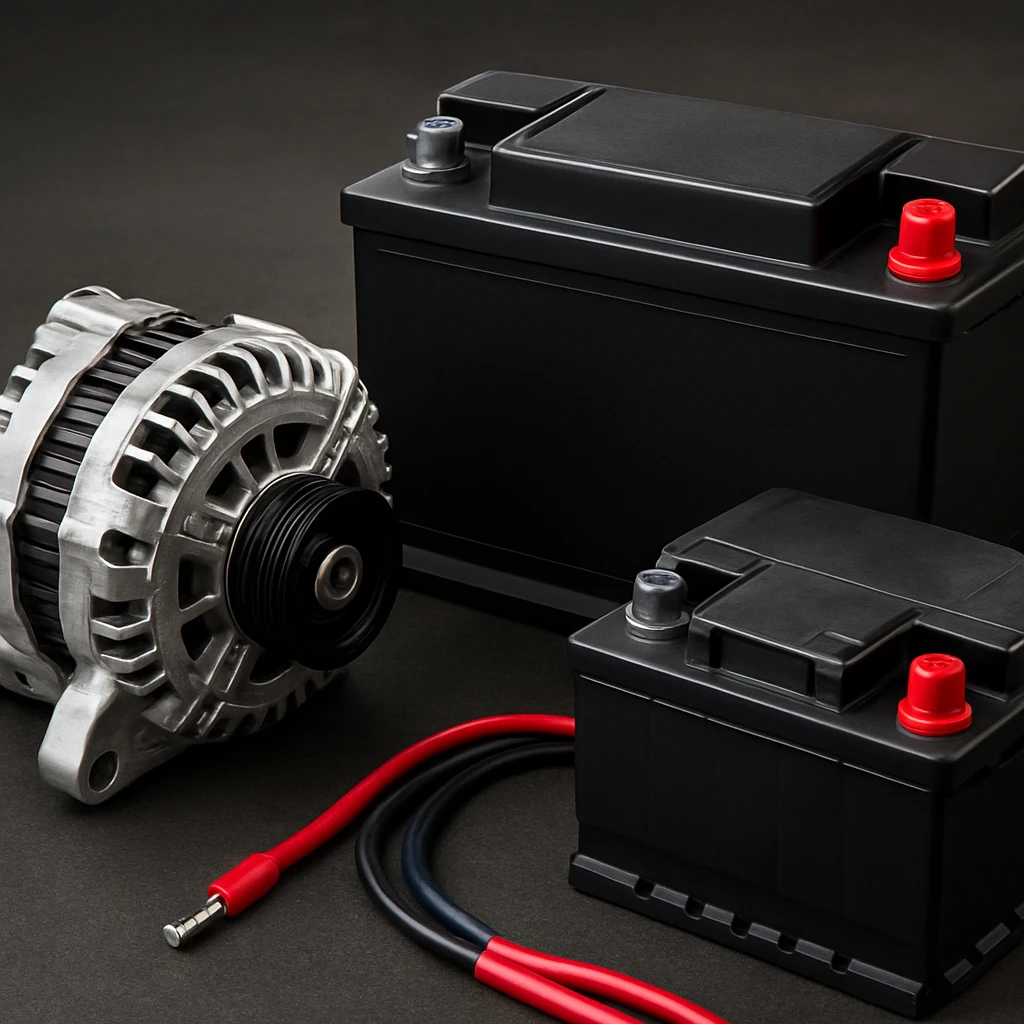
Use math to guide spending. Knowing the average and peak current makes decisions on alternator size, cable gauge, fuse ratings, and Lithium Titanate Oxide (LTO) Super Charge Ion Battery (SCiB) capacity straightforward. Below is a quick budgeting table based on typical efficiencies and 14.4 volts system targets.
| Amplifier RMS (Root Mean Square) | Est. Current at 14.4 V, 80 percent eff. | Vehicle Loads | Average Draw | Alternator Target | Suggested LTO/SCiB Bank |
|---|---|---|---|---|---|
| 2 kW | ≈ 173 A | + 40 A | ≈ 213 A | 240 to 270 A | 10 Ah or 20 Ah SCiB modules, or a 10–20 Ah assembled pack |
| 5 kW | ≈ 434 A | + 50 A | ≈ 484 A | 320 to 370 A | 20 Ah modules or multi-module packs (20–40 Ah) |
| 10 kW | ≈ 868 A | + 60 A | ≈ 928 A | Dual 250 to 320 A | Large multi-cell configurations (examples: 60, 80, 100 or 120 Ah) |
What Images Would Help Explain This Build?
Consider diagrams and photos that show real installs clearly:
- Front engine bay with high-output alternator, pulley, and Big 3 connections labeled.
- Rear rack with Lithium Titanate Oxide (LTO) Super Charge Ion Battery (SCiB) modules, copper busbars, and short amplifier feeds.
- Distribution layout annotated with fuse positions and cable gauges.
- Clamp meter and voltage logger screenshots during a demo to illustrate stability gains.
Where Does Evolution Lithium Fit Into This Plan?
For New Zealand and Australia builds, Evolution Lithium bridges the gap between engineering theory and parts you can actually install. Their custom-built Lithium Titanate Oxide (LTO) Super Charge Ion Battery (SCiB) battery banks use genuine Toshiba cells with safety characteristics referenced to Toshiba testing. With choices like 3 Ah 75 C-rate, 10 Ah 75 C-rate, and 20 Ah 35 C-rate modules, you get high burst-discharge capability for powerful amplifiers, rapid charging, exceptional voltage stability, and long cycle life. The compact, lightweight form factor reduces bulk compared to lead-acid or Absorbent Glass Mat (AGM) batteries, and hand-assembly with honest advice means you are not guessing about current paths or cell balance.
Beyond batteries, Evolution Lithium’s accessories and amplifiers simplify a matched power stage: copper lugs, reducers, proper fuse holders, and other essentials that align with best practices in wiring, fuse protection, and system layout. For SPL (Sound Pressure Level) competitors, installers, and hobbyists alike, that combination makes it easier to spec an alternator, choose distribution hardware, and finalize a charging setpoint that keeps voltage flat during the loudest passages.
Final Thoughts Before You Order Parts
Design from the load backward. Calculate amplifier Root Mean Square (RMS) (Root Mean Square) current, choose an alternator that carries your average draw at idle Revolutions Per Minute (RPM) (Revolutions Per Minute), and add a Lithium Titanate Oxide (LTO) Super Charge Ion Battery (SCiB) bank sized for burst current. Then lock in safe wiring, fuse protection, and grounding. A system built to this blueprint hits hard, stays cool, and keeps equipment safe.
Imagine your next demo: headlights steady, bass lines crisp, and the voltage log flat from the first drop to the last. In the next 12 months, expect more hairpin stator alternators with stronger idle curves and even denser Lithium Titanate Oxide (LTO) Super Charge Ion Battery (SCiB) modules that shrink racks further. What piece of the puzzle will you optimize first for your alternator upgrade for car audio, car audio batteries, power delivery, battery solutions, and lithium banks for car audio?
Additional Resources
Explore these authoritative resources to dive deeper into alternator upgrade for car audio, car audio batteries, power delivery, battery solutions, lithium banks for car audio.
Elevate Alternator and Battery Performance with Evolution Lithium
Custom-built Lithium Titanate Oxide (LTO) Super Charge Ion Battery (SCiB) banks deliver rapid bursts, stable voltage, fast charging, long life, and less bulk for demanding New Zealand car audio builds.