Ultimate Lithium-Titanate (LTO) Batteries Guide
If you run big amplifiers in car audio, the fastest path to clean, consistent power is Lithium titanate oxide (LTO) batteries. In plain terms, Lithium titanate oxide (LTO) batteries deliver very high current with minimal voltage sag, accept charge rapidly from a strong alternator upgrade for car audio, and last for tens of thousands of cycles. That is why many installers and Sound Pressure Level (SPL) competitors choose Lithium titanate oxide (LTO) batteries over traditional lead-acid or Absorbent Glass Mat (AGM) batteries. For New Zealand (NZ) builds chasing stable voltage under heavy bass hits, Evolution Lithium offers custom-built SCiB (Super Charge ion Battery) lithium battery bank car audio solutions that are hand-assembled, safety-informed, and designed to keep your amplifiers happy when demand spikes.
Here is the direct answer most readers want first: if your system routinely pulls more than 150 Ampere from the electrical system, Lithium titanate oxide (LTO) batteries are the most robust car audio battery technology to stabilize voltage, feed burst current, and recharge quickly between notes. They are compact compared with equivalent lead-acid capacity, run cool, and can be configured as a 6‑series bank for a 12‑Volt system with exceptional voltage stability. Paired with correct wiring, fuse protection, and an appropriately set alternator regulator, a properly sized SCiB (Super Charge ion Battery) battery bank from Evolution Lithium is designed to outperform conventional batteries in many daily music and SPL (Sound Pressure Level) power systems.
Lithium titanate oxide (LTO) batteries Fundamentals
Lithium titanate oxide (LTO) batteries are a lithium-ion chemistry that replaces the typical graphite anode with lithium titanate (Li4Ti5O12) spinel. This gives the cells a lower nominal cell voltage around 2.3 Volt, extremely low internal resistance, high C-rate (C-rate) capability for charge and discharge, and remarkable cycle life often quoted in the 10,000 to 20,000 cycle range at moderate Depth of Discharge (DoD). For 12‑Volt car audio systems, six cells in series (6S) produce a nominal pack voltage near 13.8 Volt, with a comfortable working range that aligns well with standard vehicle charging setpoints around 15.0 to 16.2v Volt. That alignment is a big reason Lithium titanate oxide (LTO) batteries integrate so cleanly into high-power mobile audio.
Compared with Absorbent Glass Mat (AGM) and Lithium Iron Phosphate (LiFePO4) alternatives, Lithium titanate oxide (LTO) batteries excel in three areas that matter for amplifiers: voltage stability under burst load, safe high-rate charging from a strong alternator, and longevity under frequent, deep current pulses. Lead-acid chemistries exhibit voltage sag as internal resistance rises under load, and Lithium Iron Phosphate (LiFePO4) can be limited by lower cold-temperature charge acceptance and lower allowable charge rates. By contrast, Lithium titanate oxide (LTO) batteries shrug off hundreds of Ampere transients with only small voltage droop, which keeps amplifier rail voltage steadier and distortion lower at the woofer cones.
Why it matters for high-power car audio
Every decibel at the meter or every clean note on the highway depends on supply rails that do not collapse. When the bass note hits, amplifiers can draw 2 to 4 times their average current for tens to hundreds of milliseconds. Lithium titanate oxide (LTO) batteries behave like a stiff capacitor bank with depth: low resistance curbs voltage sag, high charge acceptance recovers quickly between notes, and long cycle life tolerates daily abuse. This translates to tighter bass, fewer amplifier protection trips, and better SPL (Sound Pressure Level) scores when it counts.
| Attribute | Lithium titanate oxide (LTO) | Absorbent Glass Mat (AGM) | Lithium Iron Phosphate (LiFePO4) |
|---|---|---|---|
| Nominal cell voltage (Volt) | ~2.3 | ~2.0 | ~3.2 |
| 12‑Volt pack series count (cells) | 6 in series | 6 in series | 4 in series |
| Typical charge rate (C-rate) | Up to 5–10 C (C-rate) | ~0.1–0.3 C (C-rate) | ~0.5–1 C (C-rate) |
| Discharge capability (C-rate) | 10–80 C (C-rate) continuous; higher pulses | 1 C (C-rate) pulse | 10-20C (C-rate) continuous |
| Cycle life to ~80% capacity | 10,000–20,000 (per SCiB data) | ~300–500 | ~2,000–5,000 |
| Cold-weather performance (charge) | Good down to around −20 °C to −30 °C | Moderate | Limited below ~0 °C |
| Voltage sag under 300 Ampere burst | Very low | High | Low to moderate |
| Relative mass for given power | Low | High | Low to moderate |
Values above are representative; always consult the cell or module datasheet for definitive limits.
How it works
In a vehicle, the alternator produces Alternating Current (AC) that is rectified to Direct Current (DC) and regulated near 14 Volt. The job of the energy storage system is to buffer fast current swings the alternator and wiring cannot supply instantly. With Lithium titanate oxide (LTO) batteries configured as a 6‑series bank, you get a nominal 13.8 Volt pack that lives comfortably at common automotive charge setpoints. You connect the bank to the electrical backbone using short, wide copper busbars or heavy cable, secure it with bolt-down fusing close to the positive terminal, and distribute power to amplifiers via low-resistance blocks. Because internal resistance is very low, the bank can deliver huge transient current while holding voltage flatter than Absorbent Glass Mat (AGM) or Lithium Iron Phosphate (LiFePO4) under the same load.
Charging strategy is equally important. Many daily systems run a regulated alternator set around 15-16.2 Volt,well within conservative limits for long life per Toshiba SCiB (Super Charge ion Battery) references. For extreme SPL (Sound Pressure Level) builds with multiple alternators, a DC-DC (Direct Current to Direct Current) controller or adjustable external regulator helps cap peak voltage and avoid overcharge. Balancing can be handled by a passive balancer or an appropriately configured Battery Management System (BMS) that monitors each cell, although many car audio installers also succeed with periodic balance checks if the charging voltage is controlled tightly and the bank is built from matched SCiB (Super Charge ion Battery) cells.
System topologies and charging options
- Daily driver, 2–4 kilowatt Class D: 6S Lithium titanate oxide (LTO) bank near the amplifiers, stock or upgraded alternator, 14.2–14.6 Volt setpoint, passive balance harness or conservative Battery Management System (BMS).
- SPL (Sound Pressure Level) build, 5–10 kilowatt: Dual or large-case alternator upgrades, multiple parallel Lithium titanate oxide (LTO) banks on a common busbar, external regulator, meticulous fusing and distribution, cell monitoring during burps.
- Mixed chemistry setups: If retaining a front Absorbent Glass Mat (AGM) battery, isolate with a relay or DC-DC (Direct Current to Direct Current) charger and respect the different float voltages. Many installers prefer an all‑Lithium titanate oxide (LTO) path for simplicity and stability.
| Amplifier Output (RMS) (Root Mean Square) (Watt) | Estimated Peak Current at 13.8 Volt (Ampere) | Recommended LTO (Lithium titanate oxide) Bank Capacity (Ampere-hour) at 75 C (C-rate) | Minimum Alternator Rating for Music (Ampere) | Main Power Cable Size (mm² / AWG) (square millimetre / American Wire Gauge) | Main Fuse (Ampere) |
|---|---|---|---|---|---|
| 1,500 | ~145 | 10–20 | 160+ | 25 / 4 AWG (American Wire Gauge) | 150–200 |
| 3,000 | ~290 | 20–40 | 240–280 | 35–50 / 2 AWG to 1/0 AWG (American Wire Gauge) | 250–300 |
| 6,000 | ~580 | 40–80 | 320–370 (dual recommended) | 70 / 2/0 AWG (American Wire Gauge) | 400–500 |
| 10,000 | ~965 | 80–150 | 400–500+ (multi‑alt) | 2 x 70 / twin 2/0 AWG (American Wire Gauge) | 600–800 |
Assumes ~75 percent amplifier efficiency and music use; adjust for your class, duty cycle, and expected burst behavior. When in doubt, oversize the bank and wiring for headroom.
Evolution Lithium SCiB (Super Charge ion Battery) modules at a glance
| Module | Nominal Capacity (Ampere-hour) | C (C-rate) | Theoretical Discharge (Ampere) | Typical Use |
|---|---|---|---|---|
| SCiB 3 Ah (Ampere-hour) cell | 3 | 75 C (C-rate) | ~225 (pulse per cell) | Compact banks, mids/highs racks, space-constrained builds |
| SCiB 10 Ah (Ampere-hour) cell | 10 | 75 C (C-rate) | ~750 (pulse per cell) | Daily driver bass with strong transients, 2–6 kilowatt systems |
| SCiB 20 Ah (Ampere-hour) cell | 20 | 35 C (C-rate) | ~700 (continuous rate varies by datasheet) | Higher-capacity banks needing excellent voltage stability |
C (C-rate) ratings and pulse vs continuous limits vary by datasheet; Evolution Lithium sizes banks conservatively and provides honest advice on safe, real‑world discharge planning.
Best practices
Practical installation considerations
- Busbars and distribution: Use wide copper busbars or properly sized distribution blocks to parallel multiple Lithium titanate oxide (LTO) strings. Keep interconnects short to reduce inductance and resistance.
- Cable sizing: For main runs, 35–70 square millimetre cable or 1/0 to 2/0 AWG (American Wire Gauge) is typical above 3 kilowatt. Measure expected current and choose cable with thermal headroom.
- Terminations: Use tinned copper lugs, a calibrated hydraulic crimper, and adhesive heat-shrink. Verify pull strength. Torque battery and busbar hardware to the manufacturer’s spec.
- Fuse protection: Place a bolt-down high-current fuse within 200 millimetre of the positive post of each bank. Fuse each amplifier branch and each alternator output separately.
- Grounding strategy: Run a dedicated negative return of equal size to the positive cable or implement a star-ground to a single, clean chassis point. Avoid daisy-chaining grounds between amplifiers.
- Mounting: Rigidly mount the bank in a ventilated, protected enclosure. Allow service access for periodic checks, balance ports, and fastener retorque.
- Voltage setpoint: For 6S Lithium titanate oxide (LTO), target 15-16.2 Volt at the bank under normal driving. Confirm with a calibrated Digital Multimeter (DMM) (Digital Multimeter) at the terminals.
Safety and electrical design practices
- Battery Management System (BMS): For daily use, a conservative BMS (Battery Management System) with cell-level monitoring is recommended, or at minimum, passive balancing and regular checks. Use settings aligned with SCiB (Super Charge ion Battery) cell limits.
- Pre-charge: When connecting large banks to amplifiers or busbars, use a pre-charge resistor to limit inrush and protect contacts and capacitors.
- Alternator health: Upgraded wiring big‑three or big‑four, quality rectifier, and good belt wrap are mandatory for high current. Heat is the enemy; manage under-hood airflow.
- Isolation: If mixing chemistries, isolate with a relay or DC-DC (Direct Current to Direct Current) charger; do not hard‑parallel Absorbent Glass Mat (AGM) with Lithium titanate oxide (LTO) due to different voltage curves.
- Clearances and shielding: Keep high-current runs away from signal cables. Cross at right angles and use grommets through metal panels.
- Inspection: Build a checklist for monthly torque checks, balance voltage readings, and fuse integrity. Replace any heat‑stressed lugs immediately.
Real-world sizing example
Consider a 6 kilowatt subwoofer amplifier with an estimated peak current draw around 580 Ampere at 13.8 Volt (assuming roughly 75 percent efficiency). A practical starting point is a 6S Lithium titanate oxide (LTO) bank built from eight 10 Ah (Ampere-hour) 75 C (C-rate) SCiB (Super Charge ion Battery) cells in parallel per series position, yielding ~80 Ah (Ampere-hour) at the pack level. The theoretical pulse headroom from that array is several thousand Ampere, which translates in practice to very small voltage droop during kick drums and burps. Pair this with a 320–370 Ampere alternator upgrade for car audio, twin 70 square millimetre main runs to the trunk, and bolt‑down fusing at 400–500 Ampere. Measured at the amplifier rails, you should see less sag than an equivalent mass of Absorbent Glass Mat (AGM), quicker voltage recovery between notes, and cooler‑running power stages.
Common mistakes
- Confusing C (C-rate) ratings: Treat marketing C (C-rate) as a guide, not gospel. Always verify continuous and pulse limits in the SCiB (Super Charge ion Battery) datasheet and size for worst case.
- Poor fusing: Skipping the main fuse near the bank can turn a short into a fire. Use bolt‑down fuses sized to cable rating and expected current.
- Undersized grounds: A skinny return path strangles current just like a skinny positive. Size negative cables equal to positives and keep them short.
- Mixing chemistries without control: Hard‑paralleling Absorbent Glass Mat (AGM) and Lithium titanate oxide (LTO) invites imbalance. Use isolation or go all‑Lithium titanate oxide (LTO) for simplicity.
- Wrong series count: A 7S Lithium titanate oxide (LTO) bank can exceed amplifier voltage limits. Most 12‑Volt audio builds want 6S for equipment safety.
- No pre-charge: Slamming a large bank into a big amplifier without pre-charge can pit contacts and blow fuses. Use a resistor or a soft‑start block.
- Loose hardware: High current plus vibration will loosen poorly torqued connections. Use locking hardware and retorque on a schedule.
- Ignoring heat: Alternators and cables get hot under sustained load. Route for airflow, use abrasion sleeves, and respect component temperature ratings.
Tools/Resources
Essential tools for reliable installs
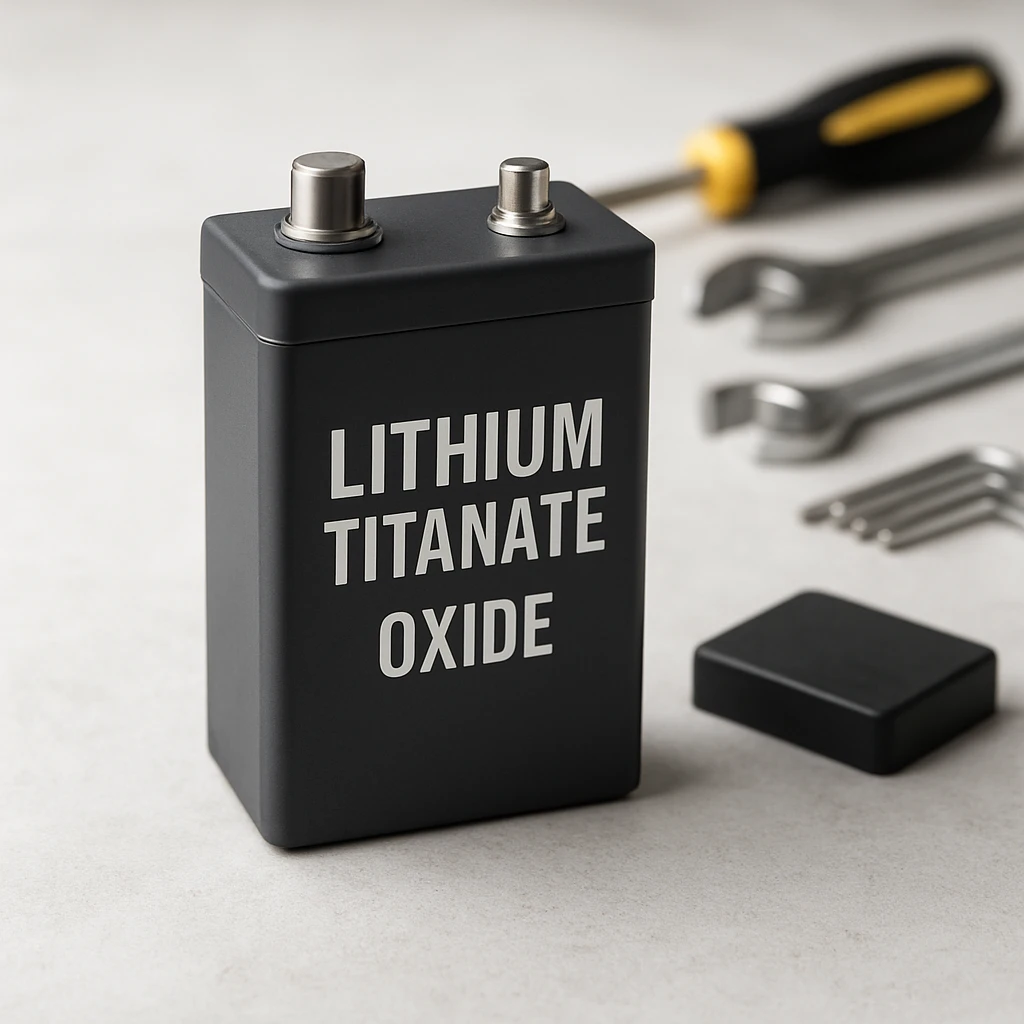
- Hydraulic hex‑die crimper and verified die sizes for your lugs.
- Torque wrench and torque screwdriver for battery and busbar hardware.
- Digital Multimeter (DMM) (Digital Multimeter) with true RMS (Root Mean Square) and a DC (Direct Current) clamp meter for current checks.
- Infrared thermometer for spotting hot connections under load.
- Quality copper busbars, distribution blocks, and adhesive heat‑shrink.
- Bolt‑down fuses and blocks rated for expected fault current.
- Balance leads and a Battery Management System (BMS) suitable for 6S Lithium titanate oxide (LTO).
Planning aids and references
- Power budget worksheet: List amplifier RMS (Root Mean Square), estimated efficiency, and compute peak current to size wiring, fuses, and the Lithium titanate oxide (LTO) bank.
- Alternator selection guide: Match idle output to musical duty cycle; look for strong rectifier design and good cooling.
- Manufacturer datasheets: Toshiba SCiB (Super Charge ion Battery) technical notes on cycle life, charge acceptance, and safety tests.
- Local standards awareness: Check relevant automotive electrical guidance in Australia (AU) and New Zealand (NZ) for safe cable routing and protection.
What Evolution Lithium brings to your build
Evolution Lithium is New Zealand (NZ)–based and supplies custom-built SCiB (Super Charge ion Battery) Lithium titanate oxide (LTO) battery banks matched to your amplifier power and space. Options include multiple capacities and discharge ratings such as 3 Ah (Ampere-hour) 75 C (C-rate), 10 Ah (Ampere-hour) 75 C (C-rate), and 20 Ah (Ampere-hour) 35 C (C-rate). Each bank is hand‑assembled, voltage‑balanced, and supported with honest advice on regulators, copper busbars, distribution, and fuse protection. The result is stable voltage, rapid current bursts for powerful amplifiers and SPL (Sound Pressure Level) builds, fast charging, long cycle life, and reduced bulk compared with Absorbent Glass Mat (AGM). Beyond batteries, the online shop also carries compatible amplifiers and accessories for a coherent system design.
Suggested images to include later
- A close-up of a 6S Lithium titanate oxide (LTO) SCiB (Super Charge ion Battery) bank with copper busbars and bolt‑down fuses.
- An amplifier rack showing short, parallel runs from a distribution block to monoblocks.
- A wiring diagram layout illustrating alternator, bank, fusing, and star-ground connections.
- A subwoofer enclosure and meter shot during an SPL (Sound Pressure Level) run, annotated with voltage traces.
Conclusion
Lithium titanate oxide (LTO) batteries give car audio systems the one thing amplifiers crave most: unwavering, low‑sag voltage under brutal transient loads. Imagine your next season with rails that barely flinch at 600 Ampere spikes, alternators that recover charge quickly between songs, and a bank that shrugs off years of daily punishment. What could your system achieve if every bass note arrived with the same rock‑solid supply from Lithium titanate oxide (LTO) batteries?
Additional Resources
Explore these authoritative resources to dive deeper into Lithium titanate oxide (LTO) batteries.
Power Car Audio With Evolution Lithium
Custom-built LTO (Lithium titanate oxide) SCiB (Super Charge ion Battery) banks deliver rapid bursts, stable voltage, fast charging, long life, and less bulk for NZ car audio enthusiasts, competitors, and installers.