No products in the cart.
No products in the cart.
Choose a car amplifier by matching its channels to your speakers, its continuous power to their power handling, and its supported impedance to the finished wiring. For a speaker upgrade, start with a full-range amplifier. For a dedicated bass system, start with a monoblock, then plan the battery, charging and cables around the intended output rather than the largest advertised wattage.
Start by drawing the speakers you want to amplify. Keep left and right signals separate for stereo playback, and identify whether the subwoofer needs its own output. This turns a broad product search into a clear system layout before brand names or power figures distract you. Separate amplification and frequency filtering let different drivers handle their intended parts of the music (active-system explanation).
A two-channel amplifier provides separate left and right outputs for a speaker pair. A four-channel layout gives you another pair of outputs, useful when front and rear speakers both need amplification. Choose channels for the actual connections you intend to make, rather than assuming every speaker cone needs a separate output. A component speaker set with its supplied passive crossover differs from an active system with dedicated amplification for each driver.
Bridging combines compatible amplifier channels to drive one load. It can make a supported multichannel amplifier useful for a different layout, but the permitted speaker load and terminals are specific to the amplifier. Treat a bridged rating as a separate operating specification, rather than carrying over the stereo-mode impedance rating (bridged connection guidance).
A monoblock has one amplification channel. For a bass-focused purchase, look for the intended subwoofer load, a suitable low-pass filter and output at that load. One channel does not mean one physical subwoofer: the finished speaker wiring determines the electrical load. Conversely, the word monoblock does not by itself establish a product's frequency range.
The buying consequence is straightforward: choose the speaker layout first. A dedicated bass amplifier does not replace the separate left and right amplification needed for stereo speakers. An active front system also needs its channel allocation planned alongside its crossover, because each directly driven speaker requires the correct frequency band.
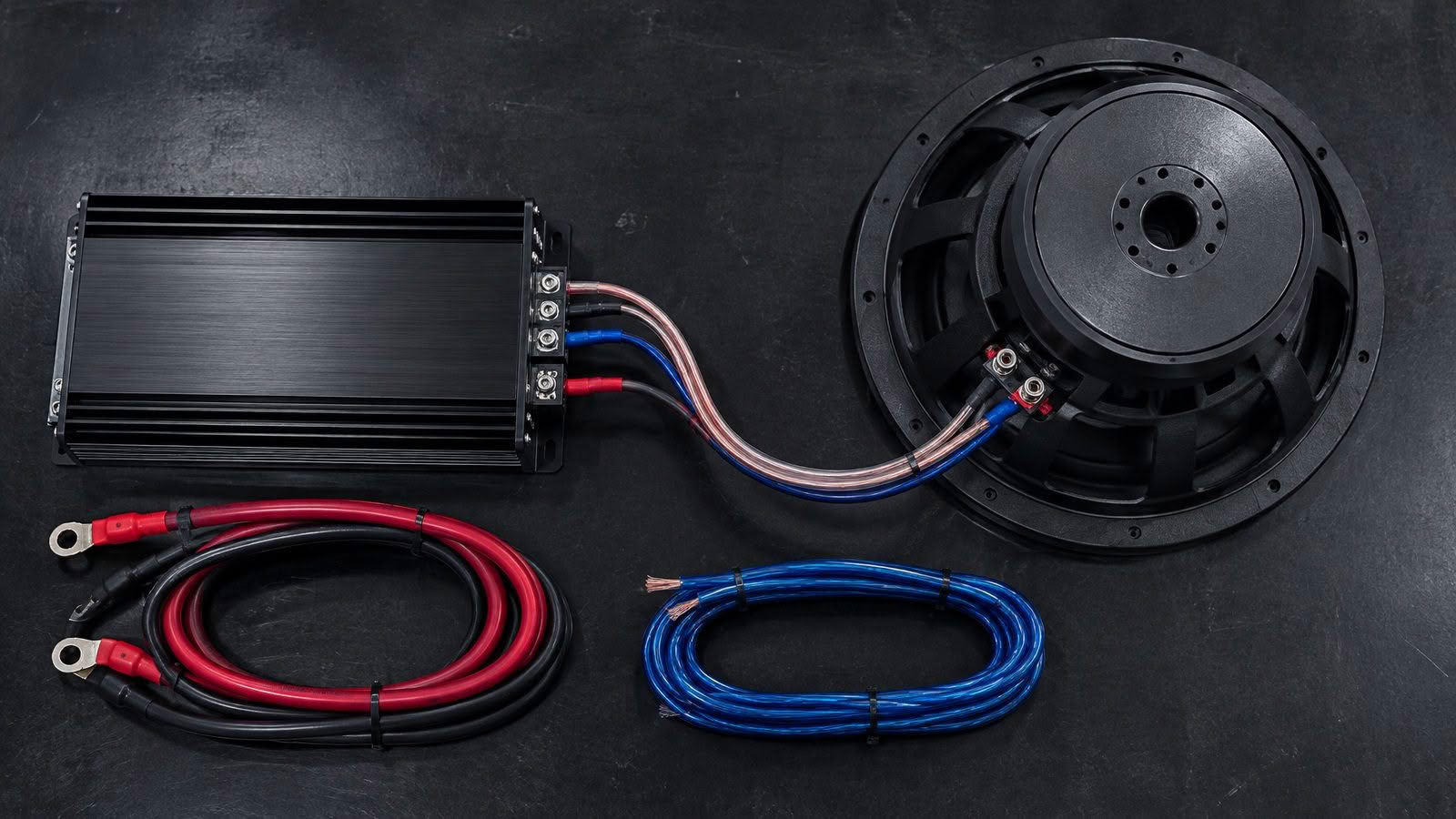
Use continuous output, commonly labelled RMS power, as your starting point. Peak, MAX and PMPO figures do not describe the same operating condition. Read the wattage together with the load impedance and test conditions, rather than treating the largest number as the buying verdict. Elliott Sound Products explains the distinction between meaningful output measurements and promotional power figures in its amplifier power guide.
For door speakers, compare output per channel with the speaker manufacturer's recommended amplifier range and continuous power handling. For subwoofers, use the rating at the final wired load. Keep the speaker and amplifier specifications beside each other: a total-output headline cannot tell you what reaches each connected driver (speaker-load guidance).
Impedance is the load presented to the amplifier, expressed in ohms, written Ω. Parallel connections lower the combined impedance; series connections raise it. Dual-voice-coil subwoofers add wiring choices, so select the coil version and wiring arrangement before choosing the amplifier's operating load. Do not use a lower load than the amplifier supports.
Avoid treating lower impedance as an automatic upgrade. The useful question is whether the amplifier can deliver the required output into your actual load within its rated conditions. A supported combination matters more than matching a model name to a speaker's peak-power label.
Before ordering a car amplifier, write down the source connection, speaker load, required frequency range and available mounting space. These details decide whether the unit belongs in your system. A power rating is only one part of that decision; amplifier behaviour also depends on its supply and the load it drives.
Source connection: establish whether your head unit supplies low-level RCA outputs or whether the installation needs a speaker-level connection or suitable interface. Input sensitivity must suit the signal feeding the amplifier. Do not assume that a factory stereo's speaker output can connect to any input, or that every amplifier accepts both connection types.
Filtering: a high-pass filter reduces frequencies below its setting, while a low-pass filter reduces frequencies above it. The available range must suit the driver and enclosure. An active speaker installation needs a deliberate crossover arrangement, not an assumption that an amplifier's channel count also provides all the required filtering (crossover design explanation).
Amplifier class: Class D describes a switching output design. Its efficiency can reduce heat loss compared with linear amplifier designs, but it is not a guarantee of a particular sound or a substitute for the product's frequency and distortion specifications. Analogue Devices explains these design tradeoffs in its Class D technical article.
Physical fit: allow room for the amplifier body, cable entry and access to connections. Plan the installation position before buying a long chassis. Check the amplifier's specified dimensions against the available mounting space; its footprint needs to fit the vehicle as well as the electrical design.
Evolution Lithium supplies car audio amplifiers and high-current SCiB LTO battery systems for car-audio builds (amplifier and system range). Use the channel layout to narrow your search, then read the chosen model's output, load and voltage specifications rather than interpreting its name as a complete specification.
Use these format differences to shortlist amplifiers for the connections you need:
| Amplifier format | Intended system | Compatibility check |
|---|---|---|
| Two-channel full-range | A left/right speaker pair | Output per channel at the speaker load |
| Four-channel full-range | Front and rear speaker pairs | Channel allocation and crossover needs |
| Monoblock for bass | Dedicated subwoofer system | Output at the final wired load and low-pass range |
Those are product specifications, not a prediction of output from your vehicle. Treat the matching power supply and speaker load as part of the purchase.
This is a high-output monoblock example, not a replacement for the separate stereo channels needed by cabin speakers. Its NZ price and ordering status are set out in the buying section below.
Keep the selection proportionate to the job. If you are amplifying cabin speakers, start with the required full-range channels and the speakers' ratings. If you are building a dedicated subwoofer system, start with its wired load and intended use. The electrical plan should follow the amplifier's rated operating conditions, including the other amplifiers sharing the supply.
A car amplifier draws electrical power from the vehicle, and some of that input becomes heat rather than speaker output. Class D efficiency helps, but does not remove the need for adequate supply current. Semiconductor designer Analogue Devices explains why efficiency, heat dissipation and output power need to be considered together.
Separate short bass peaks from sustained listening. A brief SPL test and a long demo can require different amounts of stored energy even when both demand high current. Battery capacity, current capability and alternator contribution answer different questions. Use the battery and alternator sizing guide to connect your intended playback with the electrical design.
Evolution Lithium offers SCiB LTO, Plannano LTO and EVE LiFePO₄ battery banks for car-audio systems. Select the exact bank and charging arrangement around the amplifier's voltage limits and the vehicle's connected equipment, rather than treating all lithium chemistries as interchangeable (battery bank range).
Measure supply voltage at the amplifier under load, not only at the battery with the system quiet. If the voltage differs between those points, investigate the power and return paths before assuming extra battery capacity is the answer. Increasing charging voltage also requires compatibility across connected equipment, rather than approval from the amplifier alone.
Choose power cable from expected current, conductor material, route length and installation conditions. Cable resistance causes voltage loss and heating; a short run still needs enough current-carrying capacity. Include the return path in the design, and avoid selecting cable solely because its insulation looks thick (power cable guidance).
Protect the supply cable with appropriately rated fusing close to its source. Where distribution changes to a smaller conductor, that branch needs protection appropriate to the smaller wire. An amplifier's onboard fuse does not protect an unfused cable upstream. Incorrect protection can allow a shorted cable to overheat and cause a fire (fuse protection principles).
Evolution Lithium offers car audio installation accessories. Browse the car-audio installation accessories once the conductor and protection requirements are established, so the hardware follows the design rather than determining it.
For a high-current installation, include professional cable routing, secure mounting and commissioning in the purchase plan. Ask for the installation scope to include loaded voltage measurements and the finished speaker load. These are useful acceptance points because a system can power on without delivering the intended voltage at its amplifier terminals.
Gain is the amount by which an amplifier scales its input signal. Raising it changes the relationship between source level and output; it does not create extra supply voltage or change the amplifier's rated operating limits. Begin with the correct source connection and input range, then follow the model's adjustment procedure (gain explanation).
Clipping occurs when the requested signal exceeds the available output swing. More gain can bring that point closer rather than provide more clean output. Establish the source's usable output and set the amplifier accordingly, using the manufacturer's procedure and suitable measurement equipment (clipping and supply explanation).
Set crossover behaviour around the actual drivers. Door speakers and subwoofers have different jobs, while a directly amplified tweeter needs its intended frequency protection. There is no universal crossover setting that suits every speaker and enclosure. Keep the speaker manufacturer's crossover requirements central to the setup.
Allow for the amplifier, delivery, installation, power cable, protection and any required signal interface. For a high-current build, include the charging and battery work in the same decision. Comparing only the amplifier ticket price can leave essential parts outside the budget (online buying guidance).
The linked 20K purchase details were checked for price and availability on 10 November 2026. Confirm the price, shipping charge and expected dispatch timing before ordering.
Arrange installation around the product's delivery status rather than assuming a pre-order is ready for immediate dispatch. For personal purchases from a New Zealand business, Consumer Guarantees Act protections apply independently of a store warranty, including acceptable quality and matching the description (New Zealand consumer guarantees).
Choose the channel layout that serves your speakers, then buy only as much output as your load and electrical design can support. Browse the car amplifier range to select the appropriate format for your build.
A change of mind does not automatically give you a Consumer Guarantees Act remedy. A retailer's returns policy may offer additional options; rights for faulty goods are separate.
The seller is responsible when it arranges delivery. Goods must arrive within the agreed timeframe, or within a reasonable time when none was agreed, and in acceptable condition (delivery responsibilities).
A bigger battery adds reserve but does not increase the alternator's generating capacity. The alternator still needs enough surplus output to recharge the bank between periods of demand.