No products in the cart.
No products in the cart.
Choose a 2 channel amp when you want separate left and right outputs for a speaker pair, or a bridged mono output that the amplifier explicitly supports. Buy on continuous RMS power at your speakers’ impedance, with suitable inputs and filtering. A larger peak-watt figure is not a reason to choose it.
Start with where the amplifier will work. Car, home stereo and commercial audio products can all have two channels, but that does not make their power supplies or speaker connections interchangeable. For a vehicle installation, narrow your search to car audio equipment and its documented operating voltage. CTA maintains a separate in-vehicle amplifier measurement standard for this category.
Write down what each output will drive before shopping. A front speaker pair needs separate stereo outputs. A subwoofer installation has different routing and filtering needs. If your plan includes independently amplified front and rear speakers, or several actively filtered drivers, decide the channel layout first rather than trying to stretch a stereo purchase into another job (amplifier channel guide).
Use the speaker manufacturer’s recommended amplifier range as your starting point. Record whether the rating applies to an individual speaker or a complete set. Then look for continuous output per channel at the intended load, rather than a combined system total. Continuous power, load resistance and distortion are linked in the CTA’s amplifier power measurement guidance.
The useful specification is a complete statement: watts per channel, speaker impedance, supply voltage and distortion conditions. THD+N means total harmonic distortion plus noise. A rating measured with more distortion is not directly comparable with one measured under stricter conditions. Keep those conditions beside the wattage while narrowing your shortlist.
For your 2 channel amp shortlist, favour an output specification that matches the speakers you actually own. Do not substitute the amplifier’s lower-impedance output for its rating at your intended load. Likewise, do not compare a speaker’s peak handling figure with amplifier continuous output. The car amplifier installation guide explains why continuous RMS ratings and final impedance belong together.
Impedance, measured in ohms, is the electrical load presented by the speaker. Amplifier output depends on that load and the available output voltage. It is therefore possible for the same amplifier to have different power ratings at different impedances; the number is not independent of the connection (audio amplifier gain calculations).
Keep a written connection plan beside the specifications. Identify the speaker load attached to each channel and use the matching output rating. If you intend to change the speaker arrangement later, treat that as a new compatibility decision. The relevant question is whether the amplifier supports the final wired load, not whether its headline wattage appears sufficient.
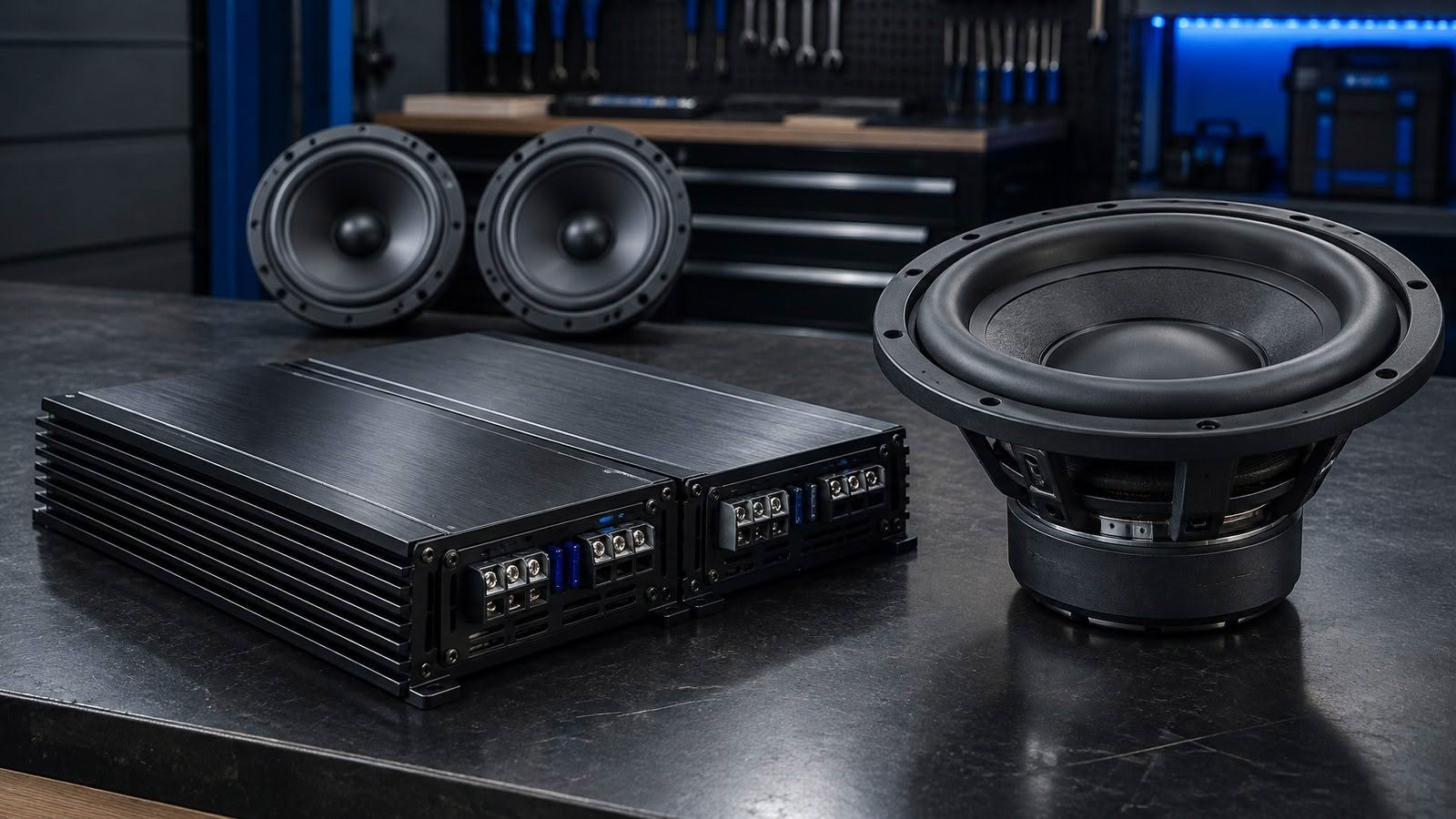
Bridging connects a speaker between amplifier outputs rather than between one output and ground. The arrangement increases the voltage swing available across that speaker. Analog Devices explains the electrical principle in its bridge-tied load definition.
For a car installation, buy a bridgeable model only when its manual gives the required wiring and permissible speaker load. Use its published bridged output rating, rather than assuming that stereo ratings predict the result. Bridging uses the channels together for a mono output, so you give up the separate left and right speaker feeds.
Choose stereo operation for your speaker pair. Consider bridged operation when the intended job is one mono load and the specifications support it. That decision should come before comparing wattage: a powerful mono connection does not meet a requirement for independent stereo playback.
Class D uses switching output devices to reduce power lost as heat. Class AB uses a different output-stage arrangement and has different efficiency characteristics. Neither label, by itself, tells you the usable output into your speakers or the complete noise and distortion performance (audio amplifier basics).
When mounting space and heat management matter, give efficiency a place in the buying decision. Still allow the cooling arrangement the manufacturer requires. Class D reduces dissipation; it does not remove it. Analog Devices’ Class D design explanation covers the relationship between output power, efficiency and heat.
Do not pay for a class label alone. Compare the output, distortion and noise specifications that matter to the installation. For a daily driver, a suitable mounting position with ventilation can matter more than an amplifier topology preference unsupported by the rest of the specification.
Trace the signal from your head unit to the amplifier before choosing connectors. Include any processor in that path. Make input compatibility part of your shortlist, alongside the high-pass or low-pass filtering needed for the speakers’ role. Plan routing and tuning together rather than buying cables after the amplifier arrives.
RCA inputs accept line-level outputs from a head unit or processor. If the head unit provides only amplified speaker outputs, choose compatible speaker-level inputs or a suitable converter. High-pass filtering reduces bass sent to smaller speakers; low-pass filtering limits upper frequencies sent to a subwoofer. Check the available crossover adjustment against the speaker manufacturer’s guidance.
For example, a front speaker pair with RCA source outputs calls for stereo operation, matching RCA inputs, continuous output within the speakers’ recommended range at their impedance, and suitable high-pass filtering, not the amplifier’s bridged rating.
Gain is the amount of signal amplification, not an extra reserve of rated power. Excessive gain also amplifies unwanted noise and reduces useful dynamic range. Choose a 2 channel amp with an input range suited to the source, then set gain as part of the complete signal chain.
A low gain setting is not evidence that you bought too much amplifier. A stronger source signal can require less amplification. Judge the setting by clean output and the source signal, rather than the knob’s position.
Evolution Lithium supplies car audio installation accessories, including cable and connection hardware, for planning the power path alongside the amplifier (installation accessories range). Include mounting, cable routing and circuit protection in the purchase plan, not only the amplifier itself.
For a larger build, Evolution Lithium’s Battery Bank Calculator and Alternator Calculator estimate battery needs and compare alternator output with amplifier demand (system design resources). Account for every amplifier in the vehicle, including an existing subwoofer amplifier. The battery and alternator sizing guide explains how amplifier demand, vehicle loads and listening patterns affect the electrical system.
A battery upgrade is a separate decision from speaker matching. More reserve energy cannot change the amplifier’s supported speaker load. Start with measured electrical demand and voltage under load rather than adding a battery because the amplifier has a large output figure.
For a New Zealand purchase, weigh the installed cost and the seller’s support alongside the specification match. Your consumer rights apply independently of a written store warranty when the Consumer Guarantees Act covers the purchase. Products must meet guarantees including acceptable quality and fitness for purpose (Consumer Guarantees Act guidance).
Choose the 2 channel amp that meets the speaker load, continuous output and signal requirements you have written down. Keep stereo for a speaker pair and use bridging only for a supported mono configuration. With that specification ready, browse the car audio amplifier range.
No. Music, extended bass demonstrations and continuous test signals have different average current demands. Rated output is a specification for defined conditions, not a statement that every song draws that power throughout playback.
Yes, when the set’s passive crossover and speaker load suit the amplifier. The crossover divides frequencies between drivers, while each amplifier channel supplies its side of the stereo system. Follow the set’s wiring arrangement rather than treating every driver as an independent amplifier load.
No. Power rating alone does not establish that damage will occur. Clipping and speaker over-excursion need attention during tuning; increasing gain is not a remedy for an amplifier reaching its clean output limit.