No products in the cart.
No products in the cart.
LiFePO4 battery life can extend through thousands of cycles, but usable years depend on temperature, charging, discharge depth and the job the battery must do. A cycle rating is a test result, not a replacement date. US Sandia research found substantial differences in degradation even among cells operated within their manufacturers' specifications (battery ageing research).
LiFePO4 means lithium iron phosphate, often shortened to LFP. It is a lithium-ion chemistry with demonstrated long cycling life. In a US laboratory study, tested LFP cells accumulated roughly 2,500 to 9,000 equivalent full cycles across different conditions; most had not reached the study's 80% capacity threshold when testing ended. Those results describe the tested cells, not every finished battery (commercial cell cycling study).
For years of service, the application matters. New Zealand's EECA advises that a solar battery should last 10 years or more, depending on type, quality and use. That is home-storage guidance, not a lifespan promise for a high-current car-audio bank (home solar technology guide).
For a daily bass system, prioritise the exact bank's charging limits, continuous current capability and installation environment over a chemistry-wide lifespan headline. A battery that retains useful energy may still stop meeting your particular listening needs as it ages. Define those needs before interpreting a laboratory endpoint.
Cycle life describes endurance through repeated charging and discharging. Calendar life describes ageing with elapsed time, including when the battery is idle. Runtime means how long one charge powers a particular load. These are different questions: infrequent use reduces cycling, but it does not stop calendar ageing (lithium-ion battery handbook).
An equivalent full cycle measures cumulative discharged capacity relative to nominal capacity. It is not necessarily one listening session or one connection to a charger. When comparing LiFePO4 battery life claims, distinguish equivalent full cycles from repeated cycles through a stated discharge window.
For engine-off listening, use stored energy and average electrical demand rather than the number of cycles remaining. Evolution Lithium's car-audio runtime guide explains why amp-hours alone cannot predict playtime. Keep runtime planning separate from replacement planning: a short session can reflect a demanding load rather than a worn-out battery.
Depth of discharge is the portion of capacity removed before recharging. A wider operating window generally creates more cycling stress. Researchers discussing their cycling experiments explain that expanding the state-of-charge range generally increases degradation across lithium-ion chemistries (battery degradation discussion).
For parked demos, choose a usable operating window that leaves the reserve your system needs. Do not make reaching the battery's protective shutdown the normal endpoint of each session. Battery management can restrict exposure to deep discharge, but its operating limits must suit the chemistry and application.
A shallower discharge also gives less runtime from the same bank. Treat that as a practical tradeoff rather than chasing the highest possible cycle count. Compare ratings at the same discharge depth, temperature, current and remaining-capacity endpoint; otherwise, the larger number may describe a different test.
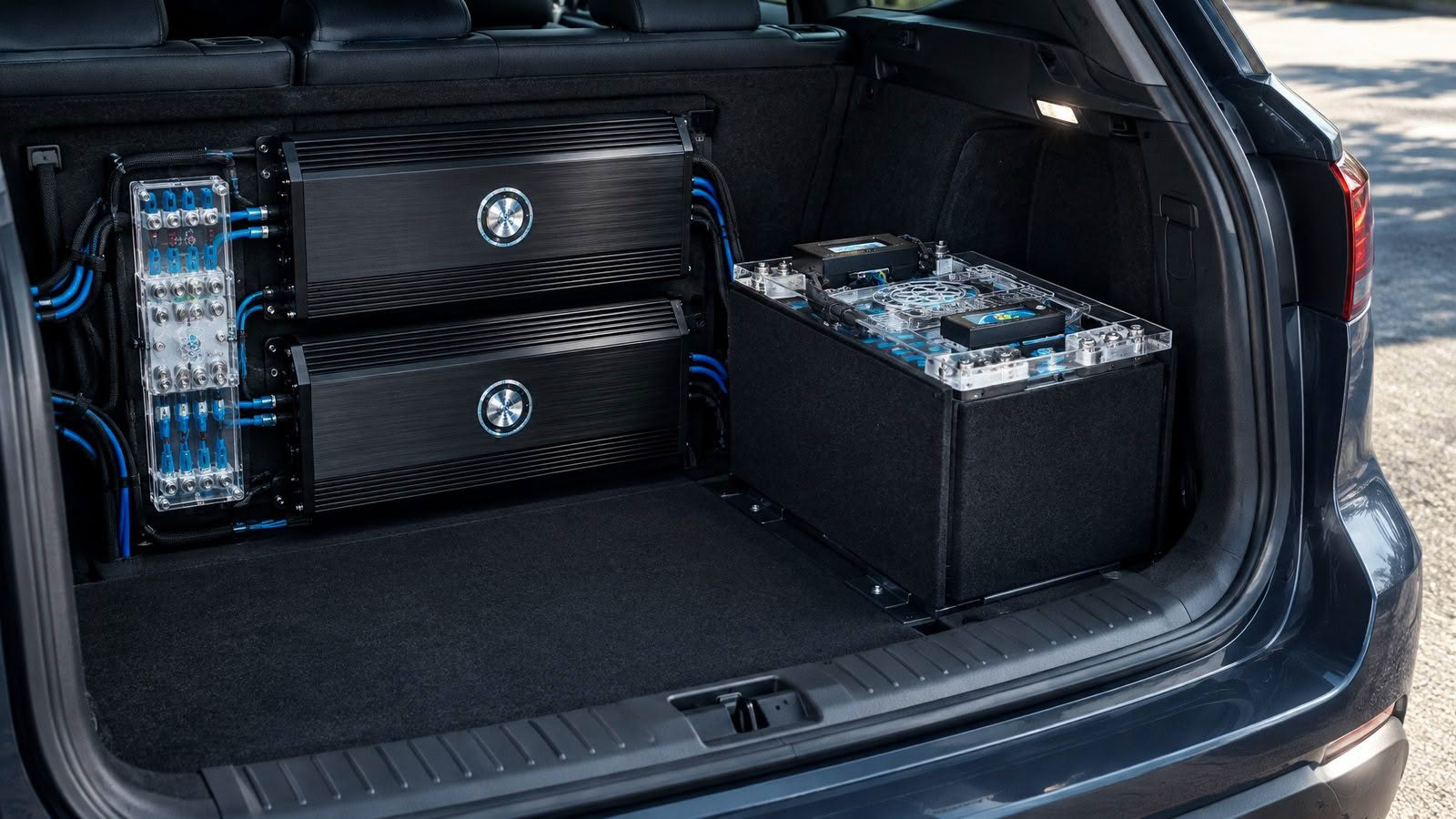
Heat matters even while a battery sits unused. Research modelling LiFePO4/graphite cells against storage-test data found that temperature and state of charge interact in calendar degradation. Keeping a bank fully charged in a hot environment therefore deserves attention alongside how deeply you discharge it (LFP storage ageing study).
For a vehicle, think about where the battery spends its time between listening sessions as well as during them. Avoid an installation plan that considers only the temperature while driving. Storage conditions remain part of LiFePO4 battery life even if the vehicle is used only occasionally.
Check the bank's specified maximum charging voltage before choosing charging equipment. Use those bank-specific requirements rather than transferring settings from another lithium chemistry.
C-rate expresses current relative to battery capacity. Charge and discharge rates influence ageing, but they are not interchangeable limits. Sandia's handbook explains that high discharge rates increase heating and mechanical stress, while excessive charging rates can promote lithium plating at the negative electrode.
For car audio, separate a brief bass peak from sustained demo demand and from the current used to recharge afterwards. A burst discharge specification is not permission to charge at the same rate. Cold charging also requires particular care because temperature affects lithium-plating behaviour.
Match the charging arrangement to the exact bank instead of applying a universal lithium voltage or temperature rule. Check the bank's documented cell configuration, intended system voltage and recommended charging range before connecting it to an automotive charging system.
Use Evolution Lithium's car amplifier guide to establish the speaker load and amplifier requirements before planning the electrical supply. For longevity, the useful target is a compatible system operating within its documented conditions, not the largest amplifier headline.
Make maintenance specific enough that you can repeat it. These checks turn temperature, discharge depth and current from abstract specifications into operating habits:
For storage, avoid assuming that leaving a battery full is automatically best. The interaction between elevated temperature and high state of charge can accelerate degradation. Use the storage instructions for the actual bank rather than borrowing an arbitrary percentage from another product.
Keep cell balance distinct from lifespan. An active balancer helps manage differences between cell-group voltages. That is a specific maintenance-related mechanism, rather than a stated number of usable years.
A New Zealand home battery may store daytime solar generation for evening use. EECA's decade-or-more guidance concerns that application. A car-audio installation needs its own operating assessment because laboratory cycling results change with temperature, discharge depth and current.
For a calculation only, assume a rating of 2,500 equivalent full cycles under conditions matching your use. At one equivalent full cycle daily, 2,500 ÷ 365 is about 6.8 years; at half an equivalent full cycle daily, 2,500 ÷ 182.5 is about 13.7 years. These are cycle-budget estimates, not service-life predictions: calendar ageing continues, and different operating conditions can change the result.
Do not translate rated cycles directly into guaranteed years. Any estimate needs a usage pattern and a matching cycle definition, while calendar ageing continues independently. For occasional listening, elapsed time may matter before the advertised cycle allowance is used; frequent demos make cycling conditions more prominent.
For a compatible conventional 12 V build, browse the EVE LiFePO4 battery banks with your charging range and intended listening demand in mind.
No. An 80% capacity endpoint is a measurement threshold, not automatic failure. Research has examined continued operation beyond that point. Whether the remaining capacity serves your application is a separate question.
No. Self-discharge reduces stored charge that can be replenished. Calendar ageing is an irreversible loss of capacity from reactions that occur over time, including while the battery is unused.
No. The whole cell design affects cycle life, including the negative electrode and other design choices. A chemistry name alone cannot establish the service life of a particular cell or finished bank.