No products in the cart.
No products in the cart.
Picture this: you’ve just installed a killer subwoofer, your speakers are pristine, and you’re ready to blast your favorite tunes—only to discover your car audio amplifier can’t deliver the punch you expected. Or worse, your alternator starts wheezing like it just ran a marathon. Choosing the right amplifier isn’t just about watts and channels; it’s about understanding how monoblock and multi-channel amps work, what they demand from your electrical system, and which one will turn your ride into a mobile concert hall without draining your battery faster than a teenager drains their phone.
| Point | Details |
| Monoblock vs multi-channel | Monoblocks excel at powering subwoofers, while 5 channel amps handle full systems in one compact unit. |
| Power draw calculations | Amplifiers pull significantly more current from your alternator than their rated output suggests, often 1.5-2x the RMS wattage. |
| Electrical system demands | High-wattage systems require upgraded alternators, proper wiring, and often secondary batteries to prevent voltage drops. |
| Installation complexity | 5 channel amps simplify wiring and save space, while separate monoblocks offer more flexibility for custom setups. |
| Budget considerations | Multi-channel amps typically cost less upfront but monoblocks allow incremental upgrades as your system grows. |
A car audio amplifier takes the weak signal from your head unit and boosts it to levels that can properly drive speakers and subwoofers. Think of it as the muscle behind your music—your stereo provides the instructions, but the amp delivers the actual power. Without adequate amplification, even the best car audio subwoofer nz enthusiasts can find will sound about as impressive as a whisper in a wind tunnel.
The amplifier market offers countless options, but two configurations dominate car audio discussions: monoblock amplifiers (single-channel designs optimized for subwoofers) and multi-channel amps like 4 or 5 channel units that power your entire system. Each has distinct advantages depending on your goals, available space, and how much you enjoy explaining to your mechanic why your alternator keeps dying.
Modern vehicles come with factory head units that output roughly 15-20 watts RMS per channel—barely enough to power a decent conversation, let alone a party. Quality aftermarket speakers typically handle 50-100 watts RMS, while subwoofers can demand anywhere from 300 watts to well over 2,000 watts for competition setups. The gap between what your stereo provides and what your speakers need is where amplifiers earn their keep.
Beyond raw power, amplifiers also improve sound quality. They reduce distortion, provide better frequency control through built-in crossovers, and give you the headroom to play music at higher volumes without clipping. If you’ve ever heard a factory system crackle and distort when you turn it up, you’ve experienced what happens when you ask too much from too little amplification.
Monoblock amplifiers are purpose-built bass machines. These single-channel amps are designed specifically to power subwoofers, with circuitry optimized for the low-frequency range where subs operate (typically 20-200 Hz). When car audio enthusiasts discuss monoblock amp vs 4 channel setups, they’re usually debating whether to dedicate separate components to bass duties or consolidate everything into one unit.
The appeal of monoblocks lies in their focused engineering. Because they only handle one channel, manufacturers can pack more power into a relatively compact chassis without worrying about thermal management across multiple channels. Many monoblocks are also bridgeable or can handle extremely low impedance loads (down to 1 ohm or even 0.5 ohm), giving you flexibility to wire multiple subwoofers for maximum output.
First, power efficiency: a monoblock rated at 1,000 watts RMS will typically deliver closer to its advertised output than a multi-channel amp trying to split power across five channels. Second, upgrade flexibility: you can start with a modest monoblock for your subs and add a separate 4-channel amp for speakers later without replacing your entire amplification setup. Third, sound quality: dedicated bass amplification reduces crosstalk and interference with your mid and high frequencies.
The trade-off? More equipment means more space, more wiring, and more complexity. You’ll need separate power and ground runs for each amp, additional RCA cables, and enough room in your trunk or under seats to mount everything. For serious bass heads running multiple kilowatts, though, monoblocks are practically mandatory—and yes, your car amp battery will need to be up to the challenge.
Enter the 5 channel amp: the Swiss Army knife of car audio amplification. These versatile units pack four channels for your front and rear speakers plus a dedicated subwoofer channel, all in one chassis. For many enthusiasts, a quality 5 channel amp represents the perfect balance between performance and practicality, especially in vehicles where space is at a premium (we’re looking at you, hatchback and coupe owners).
Modern 5 channel amps have evolved considerably. Many now feature Class D amplification across all channels, dramatically improving efficiency and reducing heat generation. Some models pack impressive power—we’re talking 75 watts RMS × 4 for speakers plus 500-600 watts for a subwoofer, all while consuming less current than older Class A/B designs half their size. That’s enough to satisfy most daily drivers and weekend warriors without requiring a complete electrical system overhaul.
If you’re building your first serious system or upgrading from factory audio, a 5 channel amp deserves serious consideration. The installation is cleaner (one power wire, one ground, one set of RCA inputs), you’ll save money on wiring and installation labor, and you’ll have more trunk space for groceries—or additional subwoofers, we don’t judge. These amps shine in full-system builds where you want good bass without necessarily rattling license plates three blocks away.
The limitation? Power. While some high-end 5 channel amps can deliver impressive numbers, they can’t match dedicated monoblocks for sheer subwoofer output. If you’re planning to run multiple large subs or compete in sound pressure level competitions, you’ll eventually outgrow a 5 channel amp’s bass capabilities. Additionally, if one channel fails, you’re sending the entire unit in for repair rather than just swapping out one dedicated amp.

Here’s where the rubber meets the road—or more accurately, where your amplifier meets your alternator’s limitations. The power ratings you see advertised on amplifiers represent their output, not their consumption. Due to efficiency losses (heat, conversion, and other electrical gremlins), amplifiers typically draw 1.5 to 2 times their rated RMS output from your electrical system. That 1,000-watt monoblock? It’s pulling around 150-170 amps from your alternator at full tilt.
This matters because most factory alternators in passenger vehicles produce 80-150 amps total, and that capacity is already shared with your engine computer, lights, climate control, and all the other electrical systems keeping your car running. Add a serious amplifier system, and you can quickly exceed your alternator’s capacity, leading to voltage drops, dimming lights, and that awkward moment when your bass hits and your headlights pulse like a budget nightclub.
To determine whether your factory electrical system can handle your amplifier ambitions, start with a simple calculation. Add up the RMS wattage of all your amplifiers at maximum expected output. Divide by your vehicle’s electrical voltage (typically 12-14.4 volts; use 13 for a conservative estimate). Multiply by 1.6 to account for efficiency losses. The result is your approximate current draw in amps.
For example, a system with a 1,000-watt monoblock and a 400-watt 4-channel amp (1,400 watts total) draws roughly (1,400 ÷ 13) × 1.6 = 172 amps at full power. If your factory alternator maxes out at 120 amps, you’ve got a problem. The good news? You have solutions: upgrade to a high output alternator car audio nz specialists recommend, add a car battery for car audio as a secondary power reservoir, or consider more efficient amplifier technology.
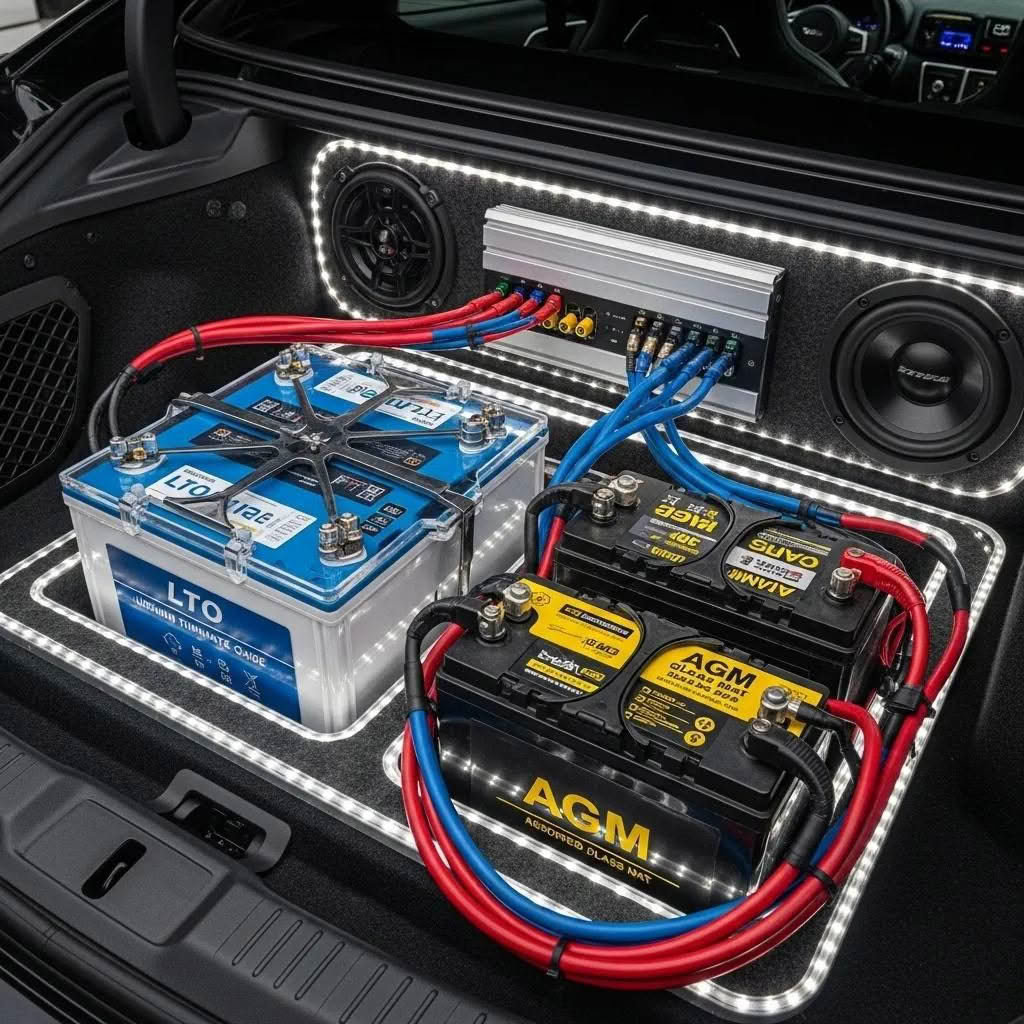
Once you’ve calculated your power demands, it’s time to ensure your vehicle can deliver. For modest systems (under 1,000 watts total), your factory alternator and battery can usually cope, though upgrading to a quality best lithium battery car audio nz options offer can provide additional headroom and faster voltage recovery during bass transients.
Medium-powered systems (1,000-2,500 watts) typically benefit from a secondary battery or lithium battery banks configuration. These act as power reservoirs, supplying current during musical peaks while your alternator handles average loads. Lithium batteries excel here because they can supply enormous current bursts without voltage sag—something lead-acid batteries struggle with. The car audio battery calculator can help determine exactly what capacity you need based on your amplifier configuration.
Systems exceeding 2,500 watts almost always require an upgraded alternator for car audio applications. High-output alternators ranging from 200 to 400+ amps ensure your electrical system can sustain high power levels without draining batteries or causing voltage drops. Yes, they’re expensive, but they’re also insurance against fried electronics and the indignity of your lights dimming every time the bass drops.
Don’t forget about wiring, either. Adequate gauge power and ground cables are critical—undersized wiring creates resistance, wastes power as heat, and can even pose fire hazards. As a rule of thumb, 4-gauge wire handles up to 1,500 watts, 1/0 gauge up to 3,000 watts, and anything beyond that calls for 4/0 or even multiple runs. And yes, your ground wire matters just as much as your power wire, as explained in this guide on car stereo ground wire best practices.
So, monoblock or 5 channel amp? The answer depends on your priorities, budget, and future plans. If you’re building an all-around system with good bass but not competition-level output, want simplified installation, and appreciate having more trunk space, a quality 5 channel amp is tough to beat. It delivers the most bang for your buck and keeps installation complexity to a minimum—perfect for first-time upgraders or anyone who values practicality.
On the other hand, if bass is your religion and you plan to expand your system over time, starting with a monoblock for subs and adding a separate multi-channel amp for speakers offers maximum flexibility. This modular approach lets you upgrade components independently, provides better power distribution, and gives you the option to add more bass without replacing your entire amplification setup. Just be prepared for more complex wiring and the need for robust power supplies like those detailed in guides about car audio battery wiring diagram configurations.
Budget matters, too. A good 5 channel amp typically costs less than buying separate monoblock and 4-channel amplifiers of equivalent quality. You’ll also save on wiring kits, since you only need one power distribution setup. However, monoblocks often offer better value per watt for subwoofer power specifically, so if bass is your priority and you’re content running factory speakers temporarily, a monoblock-first approach can deliver more boom for your dollar.
Space constraints are real. Smaller vehicles, particularly hatchbacks and coupes, may not have room for multiple amplifiers. Modern 5 channel amps are remarkably compact—some measure less than 15 inches long—making them viable even in tight installations. Conversely, if you drive a truck or SUV with ample space, spreading out your amplifiers can improve heat dissipation and make future upgrades easier. For installation guidance, check out resources on car audio installation guide techniques.
Think about where your system might go in the future. Many enthusiasts start with modest goals only to catch the upgrade bug after experiencing truly great sound. A 5 channel amp is essentially a complete solution—once you outgrow it, you’re replacing the whole thing. Separate amplifiers let you upgrade incrementally: add more powerful monoblocks for subs, replace just your speaker amp, or expand to multi-amp configurations without redundancy.
That said, modern amplifier technology from quality manufacturers at retailers like Amazon has improved dramatically. Many of today’s 5 channel amps deliver power levels that would have required separate components just a few years ago. Unless you’re planning a truly extreme system, a good 5 channel amp can serve you for years. Just make sure you’ve got the electrical foundation to support it—proper batteries, adequate alternator capacity, and quality wiring separate good-sounding systems from ones that make you wonder why you bothered.
A monoblock amplifier has one channel designed specifically for powering subwoofers with maximum efficiency and power output, while a 5 channel amp includes four channels for speakers plus a dedicated subwoofer channel, allowing you to power your entire car audio system from a single unit. Monoblocks excel at pure bass power, whereas 5 channel amps prioritize convenience and space savings.
Amplifiers typically draw 1.5 to 2 times their rated RMS output due to efficiency losses. To calculate current draw, divide your total RMS wattage by 13 volts and multiply by 1.6. For example, a 1,000-watt system draws approximately 123 amps at full power, which can exceed factory alternator capacity in many vehicles and may require an upgrade.
Yes, absolutely. A 5 channel amp works perfectly well with factory speakers, though you may not realize the full potential of the amplifier’s power until you upgrade to aftermarket speakers that can handle higher wattage. This setup is common for budget-conscious builds where the subwoofer is the priority upgrade and speaker replacement comes later.
For systems under 1,000 watts, your factory battery may suffice, though a quality aftermarket battery improves performance. Systems exceeding 1,500 watts typically benefit from adding a secondary battery or upgrading to a high-performance lithium battery that can supply the high current demands without voltage sag, especially during bass-heavy passages when power draw spikes dramatically.
A 5 channel amp is generally better for beginners because it simplifies installation with fewer wiring runs, takes up less space, and costs less than buying separate amplifiers. It provides a complete system solution that’s easier to troubleshoot and delivers good all-around performance. Once you’ve gained experience and determined your specific priorities, you can always expand or upgrade to separate components later.