Car Audio Battery Playtime: How to Estimate Runtime
Car audio battery playtime depends on stored energy, average electrical demand and whether the alternator is contributing. Amp-hours are useful, but Ah alone cannot compare banks at different voltages or predict how long an amplifier system will play.Quick answer: convert the bank to watt-hours, apply a realistic usable-energy allowance, estimate the average DC load and divide usable energy by the power the battery must supply. Treat the result as a planning estimate and confirm it with measured current and voltage in the finished vehicle.
Understand Ah, Wh, Current and C-Rate
These specifications answer different questions. Keeping them separate prevents the most common runtime mistakes.| Term | What it describes | Use in runtime planning |
|---|---|---|
| Amp-hours (Ah) | Charge capacity | Useful only when voltage and usable range are also known |
| Watt-hours (Wh) | Stored energy | Best starting point for comparing runtime at a known load |
| Amps (A) | Current at a moment in time | Used for cable, fuse, alternator and current-delivery checks |
| C-rate | Current relative to Ah capacity | Checks whether the bank can safely supply the required current |
Stored energy (Wh) = nominal voltage (V) x capacity (Ah) Rated current (A) = capacity (Ah) x C-rate
Battery University’s energy and power explanation makes the same distinction: watt-hours describe energy, while watts describe the rate at which energy is used.Use Average DC Demand, Not Amplifier RMS Alone
Amplifier RMS output is not the same as power drawn from the battery. The electrical input must also cover amplifier losses. Music is dynamic, so the long-term average draw can be much lower than a continuous test tone at the same volume setting. Estimated amplifier DC input (W) = amplifier output (W) / efficiency Total battery load (W) = amplifier DC input + other electrical loads
Use the amplifier’s measured or documented efficiency where available. If the listening profile is unknown, calculate more than one scenario rather than hiding uncertainty behind one runtime number.| Scenario | Demand pattern | Planning approach |
|---|---|---|
| Normal music | Dynamic, with frequent low-demand periods | Use measured average current over representative listening |
| Parked demo | Higher sustained average demand | Use a conservative measured average and shorter reserve interval |
| SPL test | Very high but short-duration demand | Check current capability, voltage and recovery separately from long runtime |
Calculate Engine-Off Battery Playtime
When the engine is off, the battery bank must supply the audio system and any vehicle accessories that remain active. Use nominal bank voltage to estimate stored energy, then apply the usable fraction approved for the exact bank and operating limits. Usable energy (Wh) = nominal voltage x Ah x usable fraction Estimated runtime (hours) = usable energy / average total load
Worked example: 60Ah 6S LTO bank
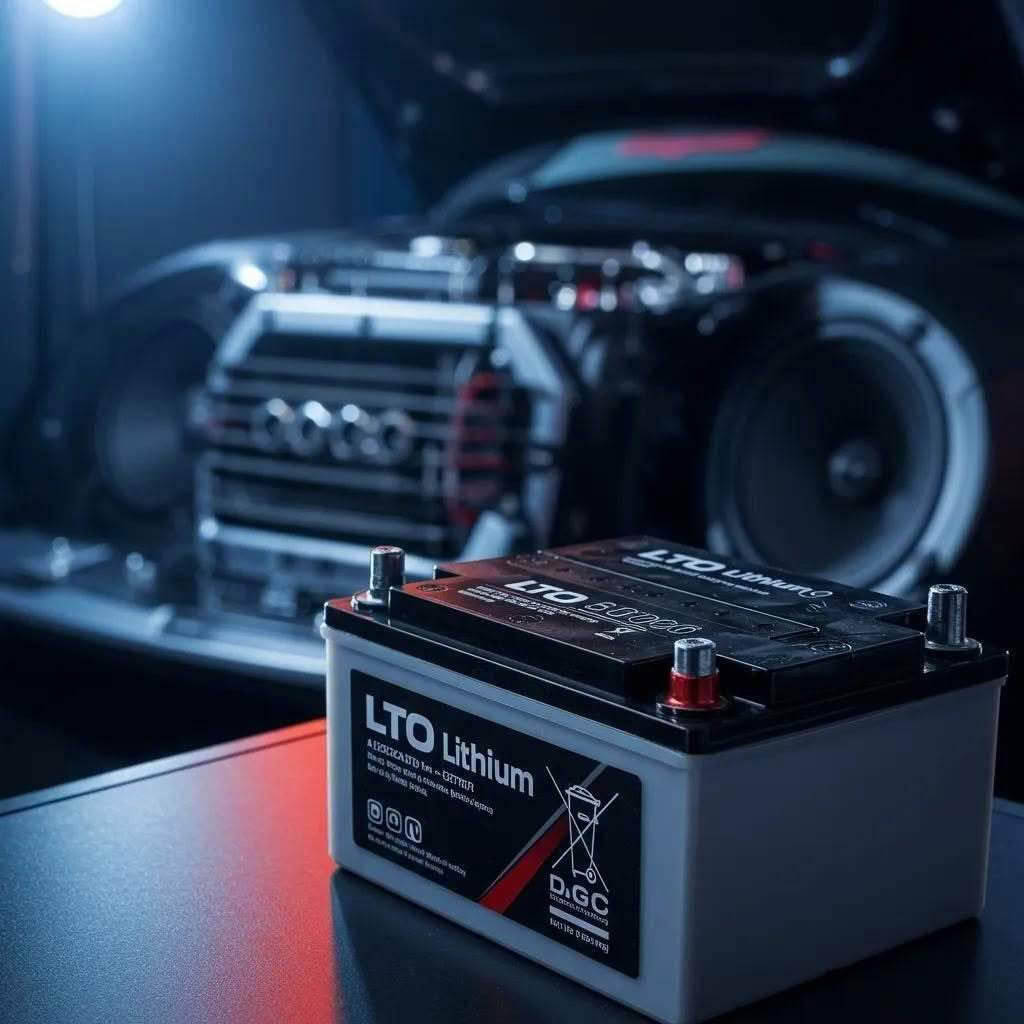
This example uses a 14.4V nominal bank, an assumed 80% usable-energy allowance, 800W average amplifier DC input and 10A of other vehicle load at 14.4V. The 80% allowance is an example only; use the limits supplied for the actual bank.- Stored energy: 14.4V x 60Ah = 864Wh.
- Usable energy: 864Wh x 0.80 = 691Wh.
- Vehicle load: 14.4V x 10A = 144W.
- Total average load: 800W + 144W = 944W.
- Estimated runtime: 691Wh / 944W = 0.73 hours, or about 44 minutes.
This is not a performance guarantee. The result changes with listening material, volume, amplifier efficiency, voltage, temperature, cell condition, wiring loss and the point at which the system must be stopped.
Calculate Runtime with the Engine Running
With the engine running, estimate the power the alternator actually contributes after normal vehicle loads. Do not use the alternator nameplate rating as if it were fully available at every engine speed and temperature. Net battery load (W) = total average system load – measured alternator contribution Estimated runtime (hours) = usable battery energy / net battery load
Using the previous 944W total load, suppose measurements show that the alternator contributes 600W at the engine speed and temperature used. The battery supplies the remaining 344W. The same 691Wh usable-energy estimate would then give about 2.0 hours. If measured alternator contribution equals or exceeds the average load, the simple division no longer predicts a fixed discharge time. Battery state of charge can stabilise or recover, but short bass peaks, idle output, heat and charging voltage still need to be checked. See the high-output alternator sizing guide for those limits.Use the Evolution Lithium Calculator with the Correct Inputs
The current car audio lithium battery and alternator calculator provides two planning tools. The Bank Builder asks for total amplifier RMS power, measured charging voltage, alternator rated output and whether the system is used for daily music, sustained demos or SPL peaks. The separate sizing calculator exposes fields for subwoofer amplifier RMS, mids and highs amplifier RMS, vehicle electrical load, battery-bank Ah, cell continuous C-rate and charging voltage. Its outputs include estimated current, bank energy and demo time.Calculator limit: results are estimates based on the values entered and the calculator’s assumptions. Use measured average current when runtime matters, and verify that the selected bank’s voltage and current limits suit every connected component.
Why the Real Playtime Can Be Shorter or Longer
- Music and volume: a changing signal produces a different average load from a continuous tone.
- Amplifier efficiency: electrical input rises as efficiency falls.
- Vehicle accessories: fans, lighting, ignition and other loads use part of the available energy.
- Alternator conditions: output changes with engine speed, temperature and regulation.
- Operating limits: the system must stop before cells or connected equipment leave their approved voltage range.
- Temperature and age: available energy and resistance can change with condition and environment.
- Connections: undersized cable, poor grounds and loose lugs turn energy into heat and voltage drop.
Check Current Capability Separately from Runtime
A bank can store enough energy for the desired session but still be unable to supply the required peak or continuous current. Conversely, a high-power bank can support a large short-duration load without providing long engine-off runtime. Compare the calculated current with the documented cell and finished-bank limits. Toshiba’s current high-power SCiB specifications list rated capacity, nominal voltage and test-conditioned output data for the 2.9Ah and 10Ah cells. Use the exact cell model and bank configuration rather than applying one figure to every LTO bank.Measure Actual Runtime Safely
A controlled test is the best way to refine the estimate. Fully charge the bank according to its supplied instructions, confirm individual cell behaviour and record starting voltage and temperature. Play a representative session at the intended level while logging current, bank voltage and amplifier voltage.- Set a conservative stop point based on the bank and equipment instructions.
- Keep the vehicle in a safe, ventilated location and monitor connection temperature.
- Stop immediately if a cell diverges, a connection heats abnormally, voltage leaves the approved range or equipment enters protection.
- Record energy or average current over the test, not only the highest peak.
- Recharge after the session and compare the measured result with the estimate.