

Alternator Upgrades for High-Power Car Audio Systems
If you run big amplifiers, the fastest way to stop headlight dimming and voltage sag is an alternator upgrade for car audio combined with the right car audio batteries and power delivery design. In plain terms, your music peaks draw more current than the factory alternator can supply continuously, so you need better battery solutions and, ideally, lithium banks for car audio that can absorb and release high current with minimal voltage drop. For most systems above roughly two to three kilowatts of continuous amplifier power, a high-output alternator plus a properly sized lithium titanate bank keeps voltage stable, protects amplifiers, and preserves sound quality.
Here is the quick answer you can act on today: match alternator capacity to your average music current draw at cruise or idle, then use a fast, low-resistance lithium titanate bank to cover short peaks. Complete the upgrade with correct cable sizing, bolt-down fusing, and clean grounds. Evolution Lithium, a New Zealand specialist, builds custom Lithium Titanate Oxide (LTO) banks using Toshiba Super Charge ion Battery (SCiB) cells that excel at this exact job: rapid burst current, exceptional voltage stability, fast charging, and long cycle life in demanding Sound Pressure Level (SPL) builds and daily drivers.
What is an alternator upgrade for car audio?
An alternator upgrade for car audio replaces or supplements the Original Equipment Manufacturer (OEM) alternator with a higher output unit designed to sustain the continuous current your amplifiers and vehicle loads need while maintaining regulated charging voltage. A performance unit typically delivers higher amperes across the whole engine speed range, features improved cooling, and sometimes uses an adjustable external regulator for precise voltage control. The goal is simple: reduce how often your system relies on the battery for energy so your voltage remains steady during real music, not just on the test bench.
In a high-power installation, the alternator, the battery bank, and the wiring function as a single power plant. The alternator handles average demand; the battery bank handles short peaks; the wiring delivers current with minimal loss. Lead-acid Absorbent Glass Mat (AGM) batteries can support systems to a point, but they suffer voltage sag due to higher internal resistance and limited discharge rates. Lithium Titanate Oxide (LTO) banks built with Toshiba Super Charge ion Battery (SCiB) cells, such as those supplied by Evolution Lithium, offer extremely low internal resistance and very high burst current capability, which is why many installers treat them as the preferred backbone for SPL (Sound Pressure Level) power systems and serious daily setups.
Why does it matter for high-power car audio?
Amplifiers make power by converting electrical energy into acoustic output. When voltage falls below about thirteen to fourteen volts, most class D amplifiers reduce output, distort earlier, and run hotter. Every half-volt drop at the amplifier’s input can shave noticeable headroom. For example, a five-kilowatt subwoofer amplifier at fourteen point four volts can lose hundreds of watts when the supply dips to thirteen volts. That loss does not just sound softer; it changes cone control and dynamics, which you hear as loose, uneven bass. Stable voltage preserves damping factor, keeps protection circuits quiet, and lets you use the power you paid for.
This is where battery chemistry and wiring matter. Traditional Absorbent Glass Mat (AGM) lead-acid batteries have internal resistance in the milliohm range that rises as they discharge and heat up, causing sag during transients. Lithium Iron Phosphate (LFP) lithium-ion chemistries can be lighter but do not like extremely high burst rates at low temperatures. Lithium Titanate Oxide (LTO) Toshiba Super Charge ion Battery (SCiB) cells, by contrast, accept and deliver very high currents, recharge rapidly from the alternator, and hold voltage flatter across a wide temperature range. In practice, that means your peaks hit harder, lights stay steady, and the alternator does not fight a deeply sagging bank after every drop.
| Chemistry | Typical Bank Voltage Range | Burst Current Capability | Voltage Stability Under Load | Charging Behavior | Temperature Tolerance | Use Case Fit |
|---|---|---|---|---|---|---|
| Absorbent Glass Mat (AGM) Lead-Acid | About 12.0 to 14.4 volts | Moderate | Moderate to Poor with heavy transients | Accepts charge slowly as State of Charge (SOC) rises | Good heat tolerance | Budget daily systems; supplemental only |
| Lithium Iron Phosphate (LFP) Lithium-Ion | About 12.8 to 14.6 volts | Moderate to High | Good if sized generously | Faster than lead-acid; may need Battery Management System (BMS) | Performance drops in cold | Daily music; weight-sensitive builds |
| Lithium Titanate Oxide (LTO) Toshiba Super Charge ion Battery (SCiB) | About 13.2 to 16.2 volts for six cells | Very High | Excellent, very low internal resistance | Very fast; thrives on frequent partial cycling | Wide temperature window | High-discharge, SPL (Sound Pressure Level), and demanding daily systems |
How does it work with amplifiers, car audio batteries, and lithium banks for car audio?
Your electrical system revolves around voltage regulation and current flow. The alternator produces alternating current that is rectified to direct current (DC) and held at a target voltage by a regulator, often controlled by the Engine Control Unit (ECU). The battery bank acts as a buffer. When amplifier demand briefly exceeds alternator output, the bank supplies the difference. When demand falls, the alternator recharges the bank. The system only works well when resistance is low end-to-end: thick copper cable, short runs, solid grounds, and clean connections reduce loss and heat so more power reaches the amplifiers.
Evolution Lithium’s custom Lithium Titanate Oxide (LTO) Toshiba Super Charge ion Battery (SCiB) banks are built specifically for this cycle. With capacities such as three ampere-hour at seventy-five C-rate, ten ampere-hour at seventy-five C-rate, and twenty ampere-hour at thirty-five C-rate, they can deliver several hundred to many hundreds of amperes in short bursts, yet recover quickly from the alternator. In practice, that means a reasonably sized high-output alternator handles your average music draw, while the Lithium Titanate Oxide (LTO) bank covers peaks cleanly. Because Lithium Titanate Oxide (LTO) cells exhibit exceptional voltage stability, amplifiers see a flatter supply rail during kick drum hits, and your system sounds more consistent at any volume.
System flow at a glance
- Alternator: Provides continuous current at regulated voltage; output varies with Revolutions Per Minute (RPM) and temperature.
- Regulator: Keeps the target voltage; an external adjustable unit can fine-tune Lithium Titanate Oxide (LTO) charging.
- Battery bank: Buffers transients; Lithium Titanate Oxide (LTO) delivers high current with minimal sag.
- Wiring and busbars: Low resistance paths via copper cable and copper busbars keep losses and heat down.
- Amplifiers: Convert electrical power into sound; sensitive to input voltage stability and ground integrity.
How do you size your alternator and lithium bank for real music?
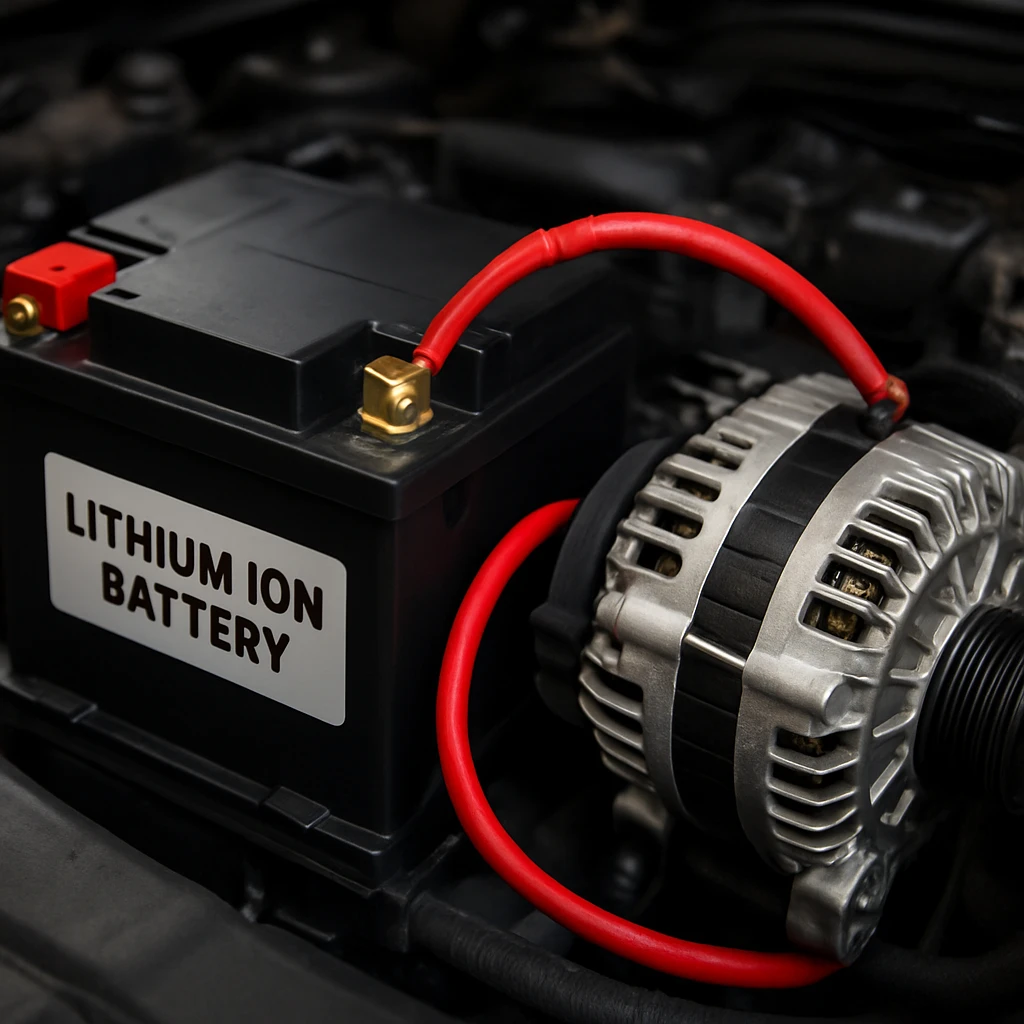
The best sizing method is to calculate average current draw for the music you play, then add headroom for vehicle loads and real-world idle output. First, estimate amplifier input power using rated continuous power and an efficiency assumption. Class D subwoofer amplifiers are often about seventy-five to eighty-five percent efficient at hard use. Divide amplifier input power by charging voltage to find current, then multiply by your typical music duty cycle. Many daily drivers see twenty-five to forty percent average duty, while SPL (Sound Pressure Level) burps may reach much higher briefly. Finally, add the vehicle’s base electrical load, commonly thirty to sixty amperes with lights and climate systems.
Because alternators rarely deliver their full rating at idle, target an alternator that covers the average current at the engine speeds you use most. Then, spec the Lithium Titanate Oxide (LTO) bank to comfortably deliver peaks without excessive voltage sag. Evolution Lithium’s ten ampere-hour at seventy-five C-rate bank, for example, supports bursts on large monoblocks, while a twenty ampere-hour at thirty-five C-rate configuration offers strong peak capability and longer reserve. For SPL (Sound Pressure Level) or multi-amplifier layouts above eight kilowatts of continuous rating, installers often parallel multiple modules using copper busbars to spread current evenly and keep resistance low.
| Amplifier Power (continuous) | Efficiency Assumption | Average Music Duty | Estimated Average Current | Vehicle Load Allowance | Recommended Alternator Range | Suggested Lithium Titanate Oxide (LTO) Capacity |
|---|---|---|---|---|---|---|
| Two to three kilowatts | Seventy-eight percent | Thirty percent | About sixty to ninety amperes | Forty amperes | One hundred eighty to two hundred forty amperes | Ten to twenty ampere-hour total at high C-rate |
| Five to eight kilowatts | Seventy-eight percent | Forty percent | About one hundred eighty to three hundred amperes | Fifty amperes | Two hundred forty to three hundred seventy amperes | Twenty to forty ampere-hour at high C-rate |
| Twelve to twenty kilowatts (competition) | Seventy-five percent | Short bursts | Very high peak currents | Fifty-plus amperes | Dual alternators three hundred to five hundred amperes combined | Forty to sixty-plus ampere-hour; parallel modules on busbars |
Installer insight: test, do not guess. Use a clamp meter and a logging voltmeter or a handheld oscilloscope to measure current and voltage at the amplifier inputs during your loudest tracks. If voltage dips below thirteen point five volts at the amplifier during peaks, increase alternator capacity, reduce voltage drop in wiring, or add Lithium Titanate Oxide (LTO) capacity. Evolution Lithium’s Toshiba Super Charge ion Battery (SCiB) banks charge rapidly, so once the alternator meets average draw, the bank stays topped and voltage bounce-back between peaks is fast.
What are the practical installation considerations and best practices?
Great components still fail if the install lets them down. Prioritise low resistance, clean regulation, and robust protection. Use the Big Three upgrade with oversized copper: alternator positive to battery positive, engine block to chassis, and chassis to battery negative. For most systems above three kilowatts, one slash zero American Wire Gauge (AWG) or larger oxygen-free copper is appropriate for main runs, with short, straight paths and crimped, heat-shrunk lugs. Place bolt-down fuses within about twenty to thirty centimetres of every battery positive and within similar distance from the alternator output to the first distribution point. Size fuses to protect the cable, not to chase amplifier ratings.
- Alternator drive: Ensure belt wrap and tension are correct; consider an overdrive pulley only if the manufacturer approves to avoid high-speed bearing wear.
- Regulation: Many high-output units offer an adjustable external regulator. Set modestly for daily use, often around fourteen point four to fourteen point eight volts at the bank for Lithium Titanate Oxide (LTO), unless your vehicle electronics dictate lower.
- Distribution: Use copper busbars or high-current distribution blocks. Keep all amplifier positives and negatives landed in a true star configuration to minimise circulating currents and reduce Radio Frequency Interference (RFI).
- Grounding: Sand paint to bare metal, use serrated washers, and verify continuity to the alternator case. A poor ground adds heat and noise, and makes voltage stability impossible.
- Balancing: For six-cell Lithium Titanate Oxide (LTO) banks, use an active six-channel balancer to keep cell voltages even. Evolution Lithium offers compatible accessories for this task.
- Isolation: If you park with the system playing, a manual battery switch or a rated contactor can isolate the bank to protect the starter battery and prevent unexpected discharge.
- Thermal management: High-output alternators get hot. Keep them clear of heat shields, verify airflow, and consider a temperature-compensated regulator profile for durability.
- Monitoring: Add a visible voltmeter at the driver position and, ideally, a current shunt with a display near the bank to catch issues before they become failures.
Real-world example from New Zealand: a daily-driven ute with a five-kilowatt monoblock and a small front-stage amplifier measured about two hundred amperes average draw on bass-heavy tracks at cruise. A three hundred twenty-ampere alternator, one slash zero American Wire Gauge (AWG) copper everywhere, and a twenty ampere-hour Lithium Titanate Oxide (LTO) Toshiba Super Charge ion Battery (SCiB) bank from Evolution Lithium held voltage between fourteen point three and fourteen point six volts at the amplifier inputs. Before the upgrade, the same system on dual Absorbent Glass Mat (AGM) batteries dipped to twelve point eight volts on peaks, tripping amplifier protection after a few minutes.
Common questions about alternators, Lithium Titanate Oxide (LTO), and Toshiba Super Charge ion Battery (SCiB)
Do I still need extra batteries if I install a huge alternator?
Yes. The alternator should meet your average demand, but music is dynamic. A Lithium Titanate Oxide (LTO) bank buffers peaks so the voltage rail stays flat and your amplifiers behave predictably. Without a buffer, even a large alternator can let voltage dip during transients at idle or cruise.
Will Lithium Titanate Oxide (LTO) banks damage my vehicle electronics?
No, provided you regulate within your vehicle’s safe range. Many late-model vehicles prefer around fourteen point two to fourteen point eight volts. Avoid charging to sixteen volts unless every component in the chain is specified for that level. An adjustable regulator makes this straightforward.
Should I run a Battery Management System (BMS) with Lithium Titanate Oxide (LTO)?
For competition and daily setups, an active cell balancer and conservative voltage limits are often sufficient because Lithium Titanate Oxide (LTO) is inherently robust. A full Battery Management System (BMS) adds protections such as over-voltage and under-voltage cutoffs; it is optional but recommended if the vehicle sees unattended charging or extreme use.
How does Lithium Titanate Oxide (LTO) compare with Lithium Iron Phosphate (LFP) for bass?
Lithium Titanate Oxide (LTO) generally wins for very high burst current and low temperature performance. Lithium Iron Phosphate (LFP) is lighter per watt-hour and works well for moderate discharge rates. For hard-hitting bass peaks and quick recharge between notes, Lithium Titanate Oxide (LTO) tends to hold voltage flatter.
Do I need copper busbars?
For multi-module banks or when currents exceed a few hundred amperes, copper busbars provide consistent, low-resistance connections and simplify equal-length lead routing. They also make inspection easier and keep heat out of cable junctions during long demos or Sound Pressure Level (SPL) burps.
Where should fuses go, and how big?
Place a bolt-down fuse close to every energy source: the alternator output and each battery positive terminal. Size the fuse to protect the specific cable section, not the downstream device. For example, a one slash zero American Wire Gauge (AWG) run commonly pairs with a three hundred to four hundred ampere bolt-down fuse.
Why does my high-output alternator show less output at idle?
Alternator output is proportional to shaft speed and temperature. At idle, many units make forty to sixty percent of their headline rating. Proper pulley ratios, healthy belt grip, and realistic expectations ensure you still meet average current needs in traffic and at cruise.
Is a capacitor bank still useful if I have Lithium Titanate Oxide (LTO)?
Not usually. Lithium Titanate Oxide (LTO) cells behave like a very large, low-resistance capacitor with far more energy storage and better voltage stability. Most installers skip supercapacitors when a well-sized Lithium Titanate Oxide (LTO) bank is present.
Can I mount Lithium Titanate Oxide (LTO) under the bonnet?
Lithium Titanate Oxide (LTO) tolerates heat better than many chemistries, but life improves if you keep cells away from exhaust manifolds and radiant heat. Many installers mount banks in the cabin or boot and run properly fused cables forward.
What products does Evolution Lithium offer for this use case?
Evolution Lithium supplies custom-built Lithium Titanate Oxide (LTO) Toshiba Super Charge ion Battery (SCiB) banks in multiple capacities and discharge ratings, hand-assembled with genuine cells, plus amplifiers and installation accessories. Their strengths are rapid charging, exceptional voltage stability, and responsive support for New Zealand customers who want evidence-based guidance rather than hype.
What is an alternator upgrade plan I can follow this weekend?
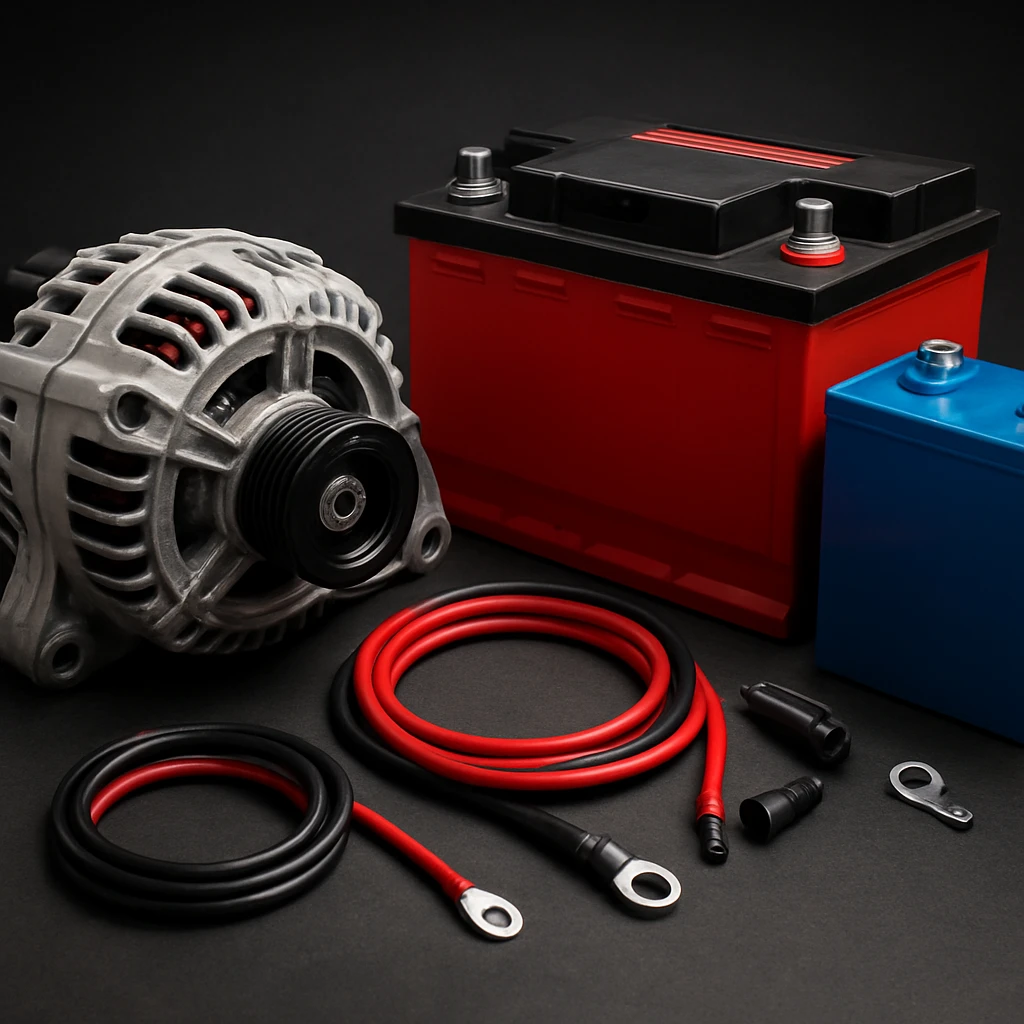
Use this checklist to move from guesswork to a reliable, testable result. First, measure your baseline with a voltmeter at the amplifier inputs while playing your three loudest tracks; note minimum voltage and average current with a clamp meter. Second, select a high-output alternator that covers your measured average, allowing margin for headlights, climate fans, and an idle derating factor. Third, specify a Lithium Titanate Oxide (LTO) Toshiba Super Charge ion Battery (SCiB) bank sized to support your peak current for the length of your typical transients, with an active six-cell balancer for maintenance.
- Upgrade the Big Three with one slash zero American Wire Gauge (AWG) copper or larger; keep grounds short and clean.
- Install bolt-down fuses within about twenty centimetres of every positive source, and at each step-down to smaller cable.
- Use copper busbars or a star-ground block for all amplifier returns to minimise ground loops and Radio Frequency Interference (RFI).
- Set regulator voltage to a conservative daily value that your vehicle electronics accept, often around fourteen point four to fourteen point eight volts at the bank.
- Verify belt alignment and tension; recheck after the first drive as belts bed in.
- Re-test voltage and current at the amplifiers; if minimums sit at or above thirteen point eight volts under your loudest use, you are in the safe zone.
Suggested visuals to include in your build log
- Close-up of copper busbars linking Lithium Titanate Oxide (LTO) modules with even-length leads and bolt-down fuses.
- Alternator bracket and belt wrap photo showing proper alignment and tension.
- Amplifier rack layout with star-ground and distribution blocks for clear serviceability.
- Wiring diagram indicating cable sizes, fuse ratings, and measurement points.
If you prefer a proven route, Evolution Lithium’s custom banks using Toshiba Super Charge ion Battery (SCiB) cells come in three ampere-hour at seventy-five C-rate, ten ampere-hour at seventy-five C-rate, and twenty ampere-hour at thirty-five C-rate modules. These options cover daily drivers through serious Sound Pressure Level (SPL) builds, with compact footprints and responsive local support. Combined with a correctly sized alternator, they deliver the fast, stable power that makes big systems sound effortless.
Bottom line: the alternator handles the average, the Lithium Titanate Oxide (LTO) bank handles the peaks, and quality wiring ensures both can do their jobs. With thoughtful design, the upgrade is predictable, measurable, and repeatable. If you are in New Zealand or Australia and you want honest, technically grounded advice, Evolution Lithium focuses precisely on this space and can guide you through current delivery, voltage stability, and safe installation practices that last.
From an engineering standpoint, stable supply rails are non-negotiable at high power. Resist the urge to oversize amplifiers while undersizing the power plant that feeds them. Spending on the alternator, Lithium Titanate Oxide (LTO) bank, and wiring first is how you get the sound you wanted all along—cleaner hits, cooler gear, and fewer failures. That is how you convert electrical theory into everyday reliability and competition-ready confidence.
Final thoughts before you choose parts
Strong alternators, low-resistance wiring, and Lithium Titanate Oxide (LTO) Toshiba Super Charge ion Battery (SCiB) banks are the trio that unlocks consistent performance from today’s amplifiers. Evolution Lithium’s hand-assembled modules and accessories simplify the path by pairing genuine cells with practical advice, letting you scale from a tidy daily setup to an event-ready Sound Pressure Level (SPL) rig without redoing the foundation. Whether you chase sixty-second demos or all-day cruising, design for voltage stability first, then let the rest of the system shine.
Conclusion
Voltage stability and current delivery make or break high-power car audio, and the right alternator paired with a fast lithium titanate bank keeps both locked in.
In the next twelve months, more New Zealand and Australia builds will move to Lithium Titanate Oxide (LTO) with adjustable regulation as installers prioritise measurable performance over capacity alone. Imagine clean, unwavering rails no matter the bass line, with gear that runs cooler and lasts longer.
What part of your electrical plan needs the most attention right now—the alternator upgrade for car audio, the car audio batteries, the power delivery wiring, smarter battery solutions, or finally stepping into lithium banks for car audio?
Additional Resources
Explore these authoritative resources to dive deeper into alternator upgrade for car audio, car audio batteries, power delivery, battery solutions, lithium banks for car audio.
Elevate Car Audio Power With Evolution Lithium
Get custom-built LTO SCiB banks delivering rapid current bursts, stable voltage, fast charging, long life, and less bulk for demanding New Zealand car audio builds.