 Skip to content

Do I Need 2 Batteries for Car Audio?
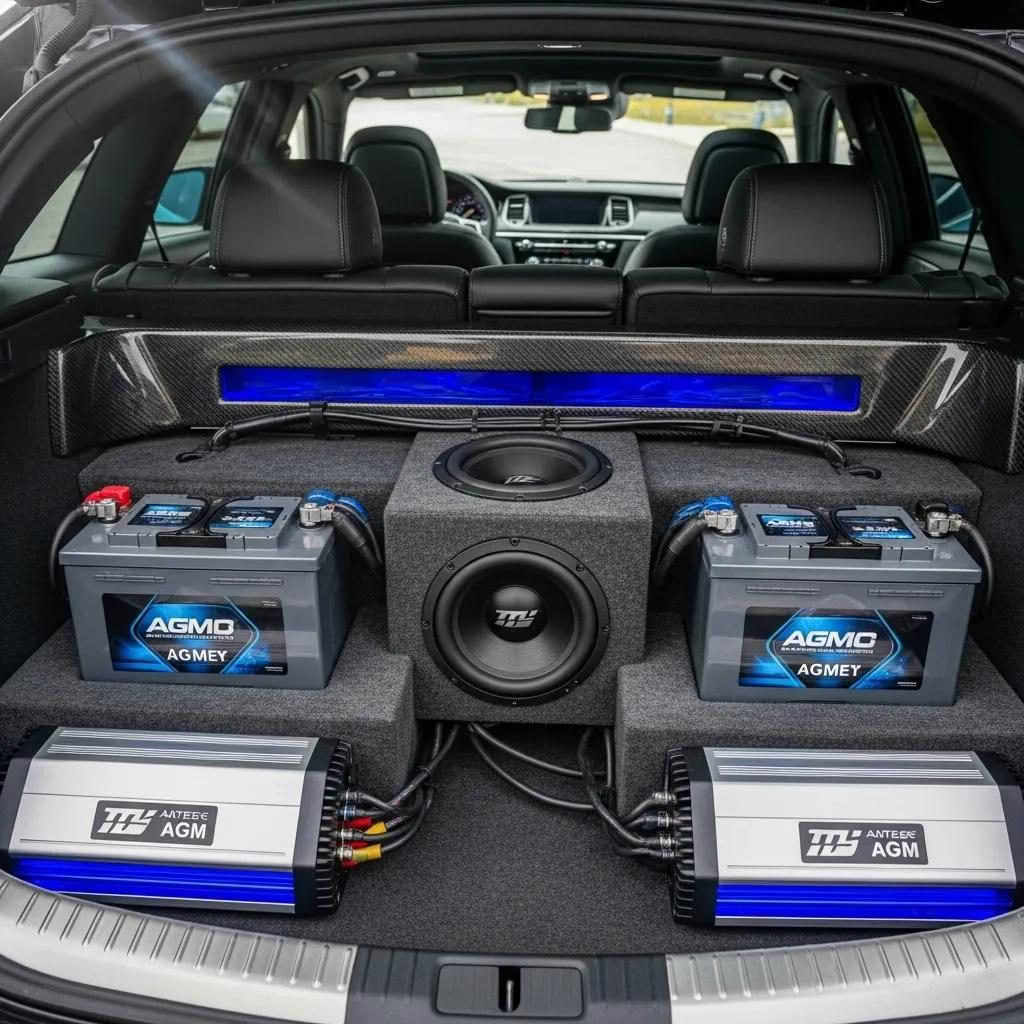
A second battery for a car audio system is an auxiliary battery dedicated to powering audio loads so the starter battery and charging system remain stable under heavy or prolonged use. This guide explains when a second battery becomes necessary, how it prevents voltage sag and protects your starter, and the practical trade-offs between adding reserve capacity versus upgrading charging components. You will learn decision thresholds based on amplifier wattage and continuous amp draw, the realistic runtime gains you can expect from different battery chemistries, and step-by-step installation and wiring best practices. The article also compares AGM, LiFePO4, and conventional lead-acid batteries with measurable specs, presents EAV-style tables for quick selection, and walks through troubleshooting for symptoms like headlight dimming and amp protect mode. Read on for calculation examples, required components (isolator, relay, DC-DC charger), and a decision tree to choose the most cost-effective path—second battery, alternator upgrade, or wiring improvements.
When Is a Second Battery Necessary for Car Audio Systems?
A second battery becomes necessary when your audio system’s reserve capacity or charging rate cannot meet transient or sustained current demands, causing voltage sag, amplifier clipping, or starter battery drain. This happens either from high continuous draw (long-duration listening with the engine off) or frequent high-current transients (powerful subwoofers and multiple amplifiers) that exceed what the alternator and wiring can supply. Adding an auxiliary battery provides immediate reserve energy for transients and engine-off playback, but it must be paired with proper charge management and wiring to be effective. Before installing a second battery, measure system amp draw, check alternator output, and rule out wiring bottlenecks; if charging is insufficient, the second battery will only delay symptoms rather than fix them. The next subsections translate amplifier wattage to amp draw thresholds and explain how to diagnose voltage sag and headlight dimming so you can decide whether an auxiliary battery is the right solution.
What Power Levels and Amplifier Wattage Require a Second Battery?
Power thresholds for adding a second battery depend on sustained RMS wattage and how often high current is drawn. Convert amplifier wattage to DC amps with the formula ; for 12V systems assume 12.6–13.8V and amplifier efficiency around 70–85%. For example, a amplifier at draws roughly during sustained output, which is a substantial continuous demand. As a practical guideline, systems with sustained or frequent draws above about 80–100 A warrant strong consideration for auxiliary capacity or alternator upgrades. To translate this into real setups, a single 1000W subwoofer amp, a multi-amp split system totaling 1500W, or repeated engine-off listening sessions are typical triggers. Run the math for your gear to estimate continuous draw, then compare against alternator spare capacity and wiring limits before deciding on a second battery.
How Do Voltage Sag and Headlight Dimming Indicate Battery Needs?
Voltage sag is the drop in system voltage under load when the electrical system cannot instantly supply demanded current; this manifests as headlight dimming, amplifier protect mode, or audible clipping. A healthy static battery voltage is roughly 12.6–12.8V at rest and 13.8–14.6V with the engine running and the alternator charging; under heavy audio load you may see transient dips below 12V, which indicate insufficient supply. Diagnose sag by measuring voltage at rest, at idle with the audio system off, and under full audio load using a multimeter at the battery and at the amplifier power terminals. If voltage falls substantially under load but alternator output remains normal, the issue may be wiring or reserve capacity—wiring upgrades and an auxiliary battery can help; if alternator output is low under load, consider alternator testing and potential replacement. These diagnostic steps inform whether reserve capacity (second battery) or improved charging (alternator/wiring) is the correct next step.
What Are the Benefits of Adding a Second Battery to Your Car Audio?
A second battery provides reserve energy that stabilizes voltage during transients, extends engine-off playback time, and protects the starter battery from deep discharge, improving reliability. By supplying transient current locally, the auxiliary battery reduces the likelihood of amplifier clipping and protect mode events, resulting in cleaner, more consistent sound during peak demands. It also allows longer listening sessions when the engine is off—useful for tailgating, camping, or car shows—provided the battery chemistry and AH rating match the intended runtime. However, the benefit is contingent on correct integration: charge isolation, appropriate wiring gauge, and matched battery health; without these, a second battery can mask charging problems without solving them. The next sections break down how voltage stability translates to improved audio, and how realistic runtime estimates are calculated from AH ratings.
A second battery improves audio voltage stability in three practical ways:
- It supplies rapid transient current near the amplifier, reducing voltage drop in long power runs.
- It buffers the starter battery, preventing deep discharges that risk vehicle start reliability.
- It evens charge-discharge cycles when a proper isolator or DC-DC charger manages charging, preserving battery life.
How Does a Second Battery Improve Voltage Stability and Sound Quality?
An auxiliary battery stabilizes voltage by acting as a local reservoir of current available for fast transients that an alternator cannot instantly supply, reducing voltage droop at amplifier input terminals. When a subwoofer hits a low-frequency transient, the amplifier demands a burst of current; a nearby deep-cycle or LiFePO4 auxiliary battery can deliver that burst without the voltage falling enough to push the amp into protect mode or clipping. Improved voltage stability maintains amplifier headroom and dynamics, which translates to cleaner bass impact and more consistent loudness. Proper wiring and low-impedance connections are essential; otherwise, the battery’s benefits are limited by series resistance. Understanding this mechanism helps prioritize wiring and charge management alongside the battery itself.
Can a Second Battery Extend Listening Time with the Engine Off?
Auxiliary battery runtime depends on amp hours (Ah), continuous amp draw, and allowable depth-of-discharge (DoD) based on battery chemistry. For example, a 100 Ah deep-cycle battery delivering a conservative usable 50% DoD yields about 50 Ah usable; at a 50 A continuous draw this equates to roughly 1 hour of runtime (). LiFePO4 batteries can typically use 80–90% DoD safely, so a 100 Ah LiFePO4 could provide 80–90 Ah usable—about 1.6–1.8 hours at the same 50 A draw. These calculations must include inverter and amplifier inefficiencies and realistic listening patterns (transients vs continuous RMS). Use these math examples to set realistic expectations and to select battery AH ratings that match your desired engine-off listening time.
Which Types of Batteries Are Best for Car Audio Second Battery Setups?
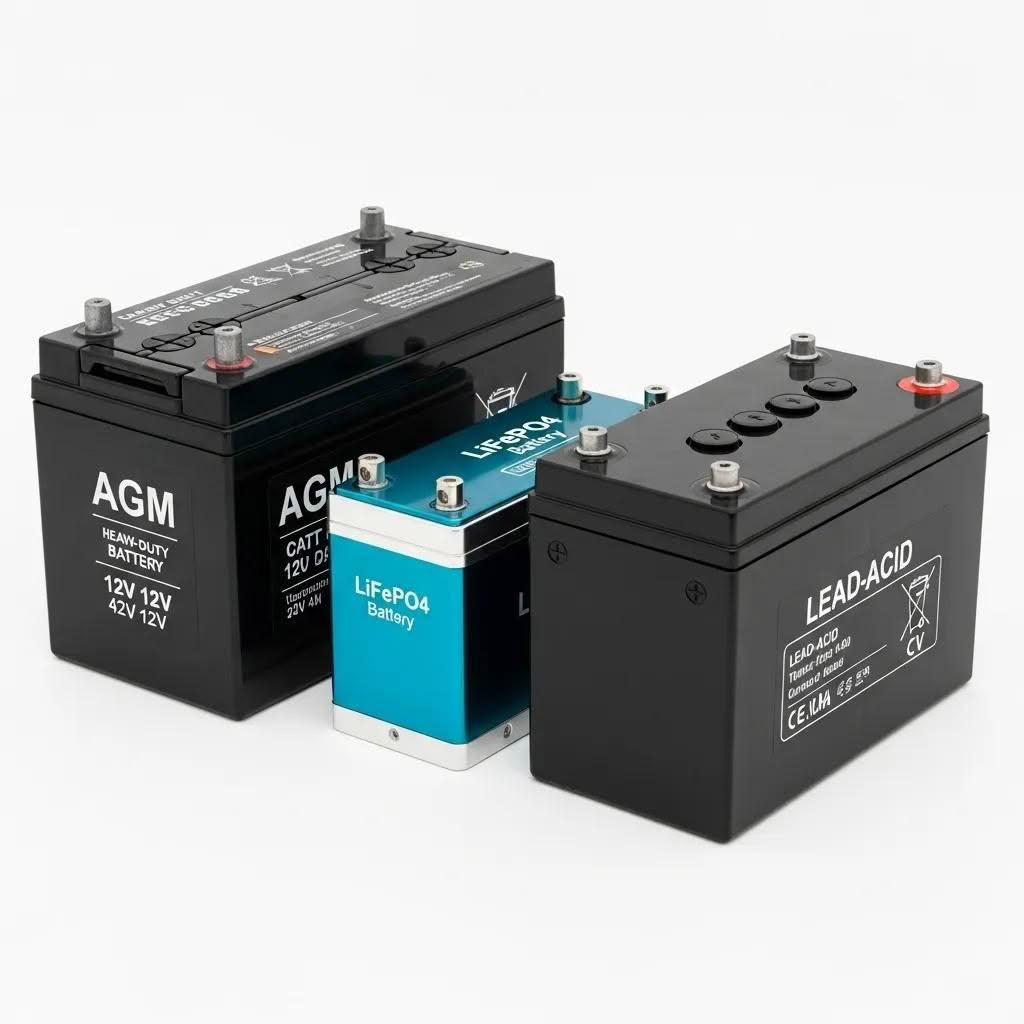
Choosing the right battery chemistry hinges on cycle life, usable capacity (DoD), weight, cost, and charging requirements; deep-cycle AGM, LiFePO4, and traditional flooded/gel lead-acid each have tradeoffs. AGM offers robust startup current, lower maintenance, and better deep-cycle performance than standard starter batteries, making it a common auxiliary choice for budget builds. LiFePO4 delivers superior cycle life, higher usable DoD, lighter weight, and stable voltage under load but requires compatible charging profiles and a BMS. Conventional flooded lead-acid is the cheapest per unit but heavy, short-lived when cycled deeply, and requires ventilation. The table below compares typical attributes side-by-side to help select the best fit for specific audio use cases.
Introduction to battery comparison table: This table summarizes practical specs and suitability for car audio auxiliary use, focusing on capacity, cycles, weight, and ideal use cases.
Summary: LiFePO4 leads for long-term cycle life and usable capacity, AGM is a cost-effective compromise for many audio builds, and flooded lead-acid is the least favorable for frequent deep cycling.
What Are the Differences Between Deep Cycle AGM, Lithium, and Lead-Acid Batteries?
Deep-cycle AGM, LiFePO4, and flooded lead-acid batteries differ in chemistry, usable capacity, recharge characteristics, and cycle durability. AGM stores energy in absorbent glass mat separators with sealed construction, tolerates higher vibration, and requires moderate charging voltages; it’s a good compromise for many auxiliary roles. LiFePO4 (lithium iron phosphate) offers higher energy density, far greater cycle life (thousands of cycles), and stable voltage under load, but it needs a compatible charging profile and BMS to prevent overcharge or undervoltage. Flooded lead-acid is inexpensive per unit but heavy and poorly suited to repeated deep discharges, requiring maintenance and ventilation. Choosing among them depends on weight constraints, expected cycle count, and whether you can provide proper charging management; the next subsection explains why LiFePO4 is increasingly popular despite higher upfront cost.
Why Are Lithium Batteries Increasingly Preferred for Car Audio?
LiFePO4 batteries are favored in modern car audio for their high usable capacity, light weight, and long cycle life, which translate to better performance and lower lifetime cost in demanding setups. Because LiFePO4 supports deeper discharge with minimal capacity loss, a smaller lithium battery can often replace a larger AGM while providing equal or greater usable amp hours and reducing vehicle weight. Their flat discharge curve maintains voltage stability under load, improving amplifier headroom and consistency. The trade-offs are higher upfront cost and the need for a charger/BMS that supports LiFePO4 charge voltages and balancing; those requirements are manageable in most installations and often justified by long-term reliability and performance gains.
How Do You Properly Install a Second Battery for Car Audio?
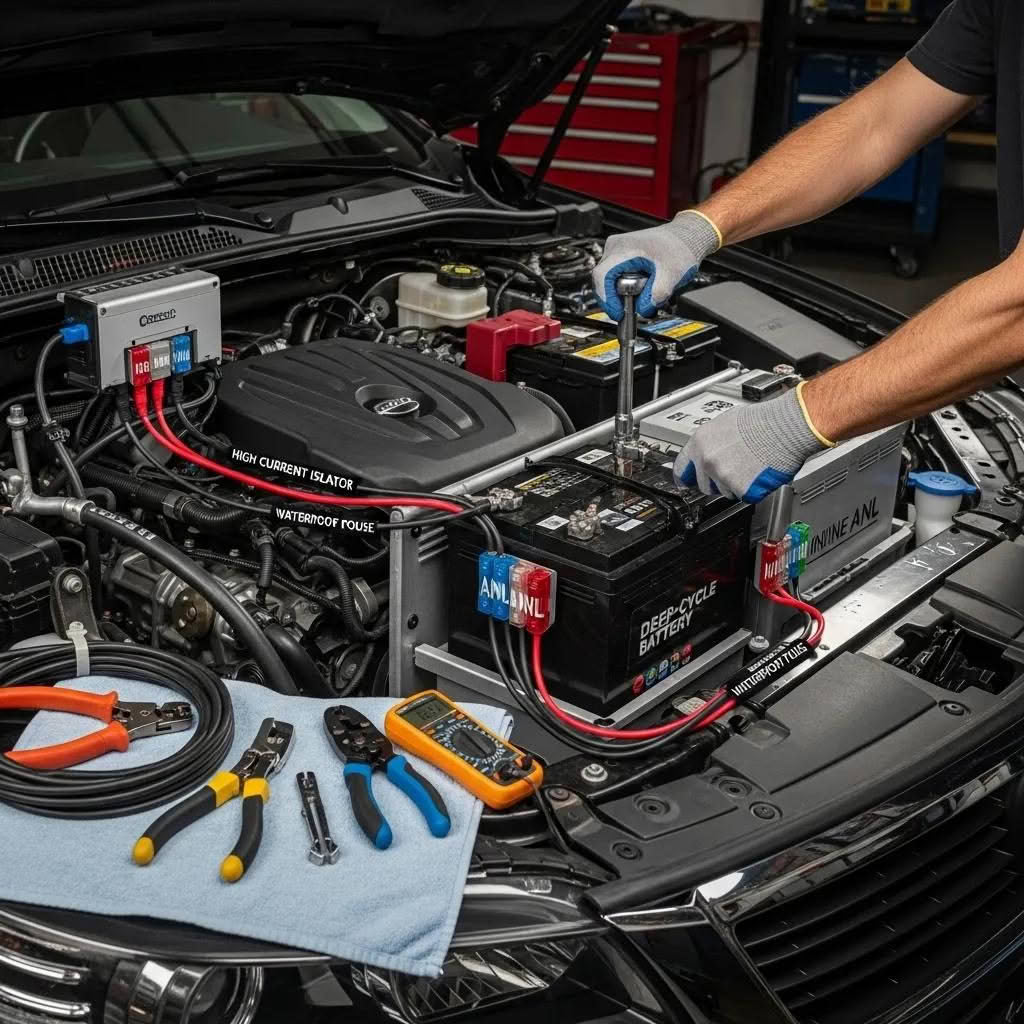
Proper installation requires correct component selection (battery, isolator/relay/DC-DC charger), heavy-gauge power and ground wiring, appropriate fusing, and secure mounting; the goal is low impedance and safe charge management. Install a battery isolator or smart relay to separate the starter and auxiliary battery while allowing charging when the engine is running; for modern vehicles with CAN networks or alternator load management, a DC-DC charger is often the safest choice to control charge profiles and protect vehicle electronics. Grounding should use short, thick straps to a clean chassis point; power runs require appropriately sized cable and fuses close to the battery to protect against shorts. The subsections below define component roles and provide wiring, fusing, and matching best practices to ensure a reliable installation.
Before the detailed wiring checklist, here is a component selection list explaining roles and common choices:
- Battery isolators and smart relays separate charging and prevent starter drain in simple systems.
- DC-DC chargers provide controlled charging profiles and are recommended for vehicles with smart alternators.
- Distribution blocks centralize power feeds for multiple amplifiers and simplify fusing and wiring paths.
What Components Are Needed: Battery Isolators, Relays, and Distribution Blocks?
Key components include the auxiliary battery itself, a charge management device (isolator, smart relay, or DC-DC charger), heavy-gauge power cable, distribution block, and appropriate fuses or circuit breakers. Battery isolators split alternator output to charge both batteries but can introduce voltage drop; smart relays (automatic charging relays) connect batteries when the vehicle has sufficient charging voltage. DC-DC chargers are ideal for vehicles with smart alternators because they regulate charge voltage and current specifically for the auxiliary battery chemistry, ensuring full, safe charging. Distribution blocks provide neat power distribution to multiple amplifiers and simplify fusing; always place fuses as close to the battery positive terminals as possible to protect wiring. Knowing the function of each part guides correct selection for your vehicle and audio demands.
What Are the Best Practices for Wiring, Fusing, and Battery Matching?
Follow wiring best practices: choose cable gauge to match maximum expected amp draw, keep power runs short, and ground with the shortest possible strap to clean metal. Use a wire gauge chart to select cable—for example, runs up to 50 A can use 6–8 AWG, while 100 A+ requires 1–2 AWG depending on length; always consult rated ampacity and account for temperature. Fuse the positive lead at the battery with a fuse or breaker sized slightly above expected continuous draw to protect against short circuits, and place the fuse within 6–12 inches of the battery positive terminal. Avoid mixing different battery chemistries on the same bus without proper charge management; if mixing is unavoidable, use a DC-DC charger or isolator to manage charge profiles and prevent imbalance. These wiring and matching practices maximize safety and the effectiveness of your auxiliary battery.
How Can You Troubleshoot and Optimize Your Car Audio Electrical System?
Troubleshooting requires a stepwise diagnostic approach: measure battery and alternator voltages at rest and under load, inspect wiring and grounds for high resistance, and observe symptom patterns like clipping or dimming to map to root causes. Start with simple checks—clean terminals, tighten ground straps, and measure voltage at the amplifier while playing audio—before moving to alternator load tests or component swaps. Optimizing performance often involves complementary upgrades like Big Three wiring, improved grounding blocks, higher-output alternators, or capacitors/DC-DC chargers depending on whether the problem is supply, delivery, or reserve capacity. The subsections below lay out a diagnostic flow and recommended upgrade priorities to resolve common issues efficiently.
The troubleshooting process begins with baseline measurements and visual inspection to identify the most likely causes before component replacement.
How to Identify and Fix Voltage Sag and Headlight Dimming Problems?
Diagnose sag by measuring battery voltage at rest (12.6–12.8V), at idle with the engine running (13.8–14.6V), and while playing audio under heavy load; large drops under load indicate supply or wiring problems. Inspect and tighten battery terminals, clean corrosion, ensure solid chassis and engine grounds, and measure voltage at the amplifier to detect voltage drops across wiring; often fixing grounds and upgrading conductor size resolves dimming. If alternator output falls under load, perform an alternator bench or load test and consider alternator replacement or a higher-output unit. Prioritize low-cost fixes first—terminals, grounds, wire runs—before expensive alternator replacements, and use a systematic test sequence to avoid unnecessary parts swaps.
What Complementary Upgrades Enhance Dual Battery Performance?
Complementary upgrades improve the system’s ability to deliver and manage current: Big Three wiring increases alternator-to-battery and chassis ground conductor capacity, reducing voltage drop; high-output alternators supply more continuous current for prolonged high-draw systems. Capacitors can help with very short transients but offer limited benefit for sustained demands compared to a properly sized auxiliary battery or alternator. DC-DC chargers improve charging quality for auxiliary batteries, especially LiFePO4, and distribution blocks with proper fusing simplify safe power routing. Prioritize wiring and grounding upgrades first for best ROI, then consider alternator or DC-DC charger additions based on measured deficits and usage patterns.
What Are the Key Considerations Before Upgrading to a Second Car Audio Battery?
Before adding a second battery, evaluate system amp/watt needs, alternator spare capacity, available space and weight allowance, battery chemistry tradeoffs, and total cost versus benefit; a clear calculation and decision tree helps choose among second battery, alternator upgrade, or wiring improvements. Consider how often you will run the system with the engine off, the acceptable depth-of-discharge for your battery type, and the charging method required by your vehicle’s alternator. Match battery AH to expected runtime using conservative DoD values, and prefer charge management (DC-DC or isolator) that fits your vehicle’s charging system. The following table helps map common scenarios to recommended auxiliary AH and alternator guidance.
Intro to scenario table: This table helps translate common system profiles into estimated amp draw and recommended auxiliary battery AH or alternator action.
Summary: Match estimated amp draw to usable AH while maintaining conservative DoD limits; when continuous draw exceeds alternator spare capacity, prioritize alternator upgrade.
How to Calculate Your Car Audio Power Requirements Accurately?
Calculate power needs by converting amplifier RMS wattage into current draw using and then determine AH required for desired runtime by . Include amplifier efficiency (typically 70–85%) and use alternator voltage (13–14.5V) for conversions; for a amp at 80% efficiency, expected draw ≈ . To size battery AH for one hour of engine-off listening at that draw with 50% DoD, you’d need ≈ 94 Ah (). Add safety margins for peaks and inefficiencies, and account for multiple amplifiers or accessories. These formulas and worked examples make it straightforward to pick a battery size or decide if alternator/wiring upgrades are more cost-effective.
When Is an Alternator Upgrade More Effective Than a Second Battery?
An alternator upgrade is usually more effective when the system’s problem is continuous high draw while the engine is running rather than short transients or occasional engine-off use. If your system draws large continuous current for long durations (e.g., sustained high volume on multiple amplifiers during driving), increasing charging capacity ensures the battery bank remains topped up and prevents chronic undercharge. Alternator upgrades are costlier and more invasive than adding a battery, but they solve persistent charging shortfalls and reduce cycling stress on batteries. Use the decision criteria: if measured continuous draw regularly exceeds alternator spare capacity, invest in alternator or Big Three wiring upgrades; if issues are transient or engine-off focused, an auxiliary battery with proper charge management is usually the better first step.
A balanced decision considers usage pattern, cost, and vehicle constraints; when in doubt, perform measurements and prioritize wiring/ground fixes before expensive alternator swaps, using the calculations above to guide the choice.