

Alternator Upgrades for High-Power Car Audio Systems
If you are planning an alternator upgrade for car audio, reviewing car audio batteries, optimizing power delivery, comparing battery solutions, and considering lithium banks for car audio, you are in the right place. High-power amplifiers demand stable voltage and serious current, and factory charging systems are rarely designed for sustained audio loads. In the next few minutes, you will learn how alternators, battery chemistry, wiring, and protection work together so your system hits harder, runs cooler, and stays reliable on daily drives and Sound Pressure Level (SPL) competitions. We will also show where Evolution Lithium fits with Lithium Titanate Oxide (LTO) Super Charge Ion Battery (SCiB) banks that hold voltage when it matters.
What Is an Alternator Upgrade for Car Audio?
An alternator upgrade for car audio is the move from a stock original equipment manufacturer (OEM) alternator to a high-output unit that delivers more continuous current at cruising and idle revolutions per minute (RPM). In simple terms, it is a larger current pump feeding your amplifiers and battery bank so your voltage does not collapse on bass notes. While a battery can buffer transient peaks, the alternator is the only continuous energy source when the engine is running, which is why its capability sets the ceiling for sustained play time and amplifier power.
Upgrades often include three linked changes: a higher-output alternator, improved charging setpoint and control, and a “Big 3” wiring refresh. The “Big 3” means larger-gauge positive from alternator to battery, engine block to chassis ground, and battery negative to chassis ground. When combined with a low-resistance battery bank and tight wiring, the alternator maintains system voltage closer to 14.4 volt under load, which protects amplifiers, reduces clipping, and keeps lights from dimming. If you plan multi-kilowatt (kW) amplifiers, the alternator upgrade is the foundation of a dependable build.
Why Does It Matter for High-Power Audio?
Amplifiers convert electrical energy into acoustic energy. A 3 kilowatt (kW) subwoofer amplifier drawing at 70 percent efficiency can require more than 300 ampere average with peaks well beyond that number. Stock charging systems are engineered around vehicle loads, not multi-kilowatt (kW) bass hits. If the alternator cannot supply the current, voltage falls, the amplifier clips earlier, heat rises, and reliability drops. Over time, this stresses rectifiers, bearings, and wiring. A properly sized alternator stabilizes voltage, shortens recharge time after bass transients, and improves system efficiency.
Equally important is battery chemistry. Traditional lead-acid and Absorbent Glass Mat (AGM) batteries have higher internal resistance and suffer voltage sag under high discharge. Lithium Iron Phosphate (LFP) offers improved performance, but Lithium Titanate Oxide (LTO) Super Charge Ion Battery (SCiB) banks excel at very high discharge with exceptional cycle life and cold-weather performance. This means fewer batteries, less weight, and faster recovery after each hit. In practice, a tight alternator-and-LTO pairing reduces dimming, keeps the amplifier in its efficient voltage window, and unlocks cleaner, louder output for longer sessions.
| Scenario | Alternator Rating | Likely Idle Output | Vehicle Loads | Net Available to Audio | Comments |
|---|---|---|---|---|---|
| Stock sedan | 120 ampere | 60 to 80 ampere | 25 to 40 ampere | 20 to 55 ampere | Ok for modest systems, weak for multi-kilowatt (kW) |
| Upgraded daily | 240 ampere | 120 to 160 ampere | 30 to 50 ampere | 70 to 130 ampere | Good for 1 to 2 kilowatt (kW) systems if wiring is strong |
| SPL (Sound Pressure Level) build | 320 to 370 ampere | 160 to 220 ampere | 35 to 60 ampere | 100 to 180 ampere | Still needs a robust battery bank for peaks |
Numbers vary by pulley ratio, temperature, and alternator design, but the pattern holds: more real current at the voltage your amplifiers expect equals a louder, safer system.
How Does It Work With Amplifiers and Batteries?
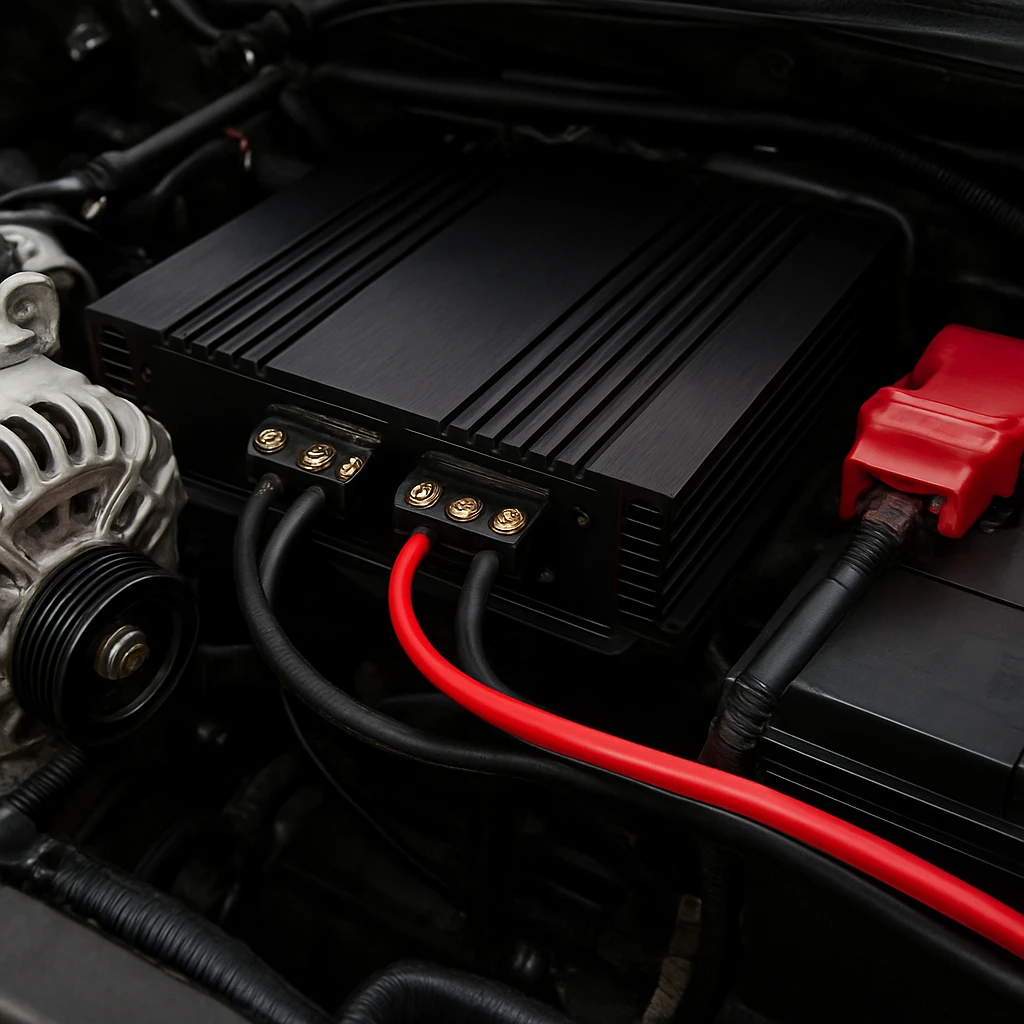
The alternator converts mechanical energy into electrical energy. A regulator targets a system voltage, typically around 14.0 to 14.8 volt depending on the vehicle and tuning. The battery bank buffers transients and sets the voltage “stiffness” during rapid current spikes. Your amplifiers care most about instantaneous voltage at their terminals. Low resistance connections, short cable runs, and a battery chemistry with very low internal resistance enable the alternator-and-battery team to keep voltage flat when bass demands current.
Charging Path and Current Flow
- Alternator rotor spins with the engine, inducing electrical energy that is rectified to direct current.
- The regulator holds a target voltage; higher load draws more current up to the alternator’s thermal and electrical limits.
- Current flows through main charge cable to the battery positive busbar and distribution blocks, then to amplifiers.
- On big bass transients, the battery bank supplies the deficit between amplifier demand and alternator output, then the alternator recharges the bank as demand falls.
Why LTO (Lithium Titanate Oxide) SCiB (Super Charge Ion Battery) Banks Shine
- Extremely low internal resistance reduces voltage sag under high discharge.
- High C-rate (capacity rate) tolerance supports massive burst currents for subwoofer hits.
- Outstanding cycle life handles daily charge-discharge without rapid capacity loss.
- Excellent cold-weather performance suits New Zealand and southern Australia mornings.
With LTO (Lithium Titanate Oxide) SCiB (Super Charge Ion Battery), you can run fewer cells for the same real-world performance compared with many AGM (Absorbent Glass Mat) batteries, and you recover faster between notes. The result is tighter bass, less headlight dip, and amplifiers operating in a healthier voltage band.
Which Car Audio Batteries and Battery Solutions Actually Perform Best?
Battery solutions determine how well your system handles peaks and how quickly it recovers. Below is a high-level comparison of common chemistries used as car audio batteries and in lithium battery bank car audio builds. Values are typical and vary by brand and model, but they capture practical differences that installers feel during real demos.
| Chemistry | Nominal Cell Voltage | Typical C-Rate (capacity rate) | Cycle Life | Voltage Sag Under Load | Cold Performance | Weight for Equivalent Output |
|---|---|---|---|---|---|---|
| Flooded Lead-Acid | ~2.1 volt per cell | Low to moderate | Few hundred | High | Good cranking, poor deep cycle | High |
| AGM (Absorbent Glass Mat) | ~2.1 volt per cell | Moderate | Few hundred to 1,000 | Moderate to high | Decent | High |
| LFP (Lithium Iron Phosphate) | ~3.2 volt per cell | Moderate to high | 2,000 to 4,000 | Low to moderate | Fair, capacity reduces in cold | Low |
| LTO (Lithium Titanate Oxide) SCiB (Super Charge Ion Battery) | ~2.3 volt per cell | High to very high | 10,000+ in favorable conditions | Very low | Excellent | Very low |
Evolution Lithium in New Zealand builds custom LTO (Lithium Titanate Oxide) SCiB (Super Charge Ion Battery) banks specifically for high-discharge car audio. Options include 3 Ah (ampere-hour) 75 C (capacity multiple) cells, 10 Ah (ampere-hour) 75 C (capacity multiple), and 20 Ah (ampere-hour) 35 C (capacity multiple) modules. The high C-rate (capacity rate) and low internal resistance provide the burst current your amplifiers demand while holding voltage flatter than most lead-acid or AGM (Absorbent Glass Mat) solutions. Units are hand-assembled with genuine Toshiba cells, supported with practical safety guidance, and sized to fit daily drivers through large SPL (Sound Pressure Level) builds. Evolution Lithium also supplies complementary amplifiers and accessories so your charging and load gear are matched.
What Practical Installation Considerations Should You Plan For?
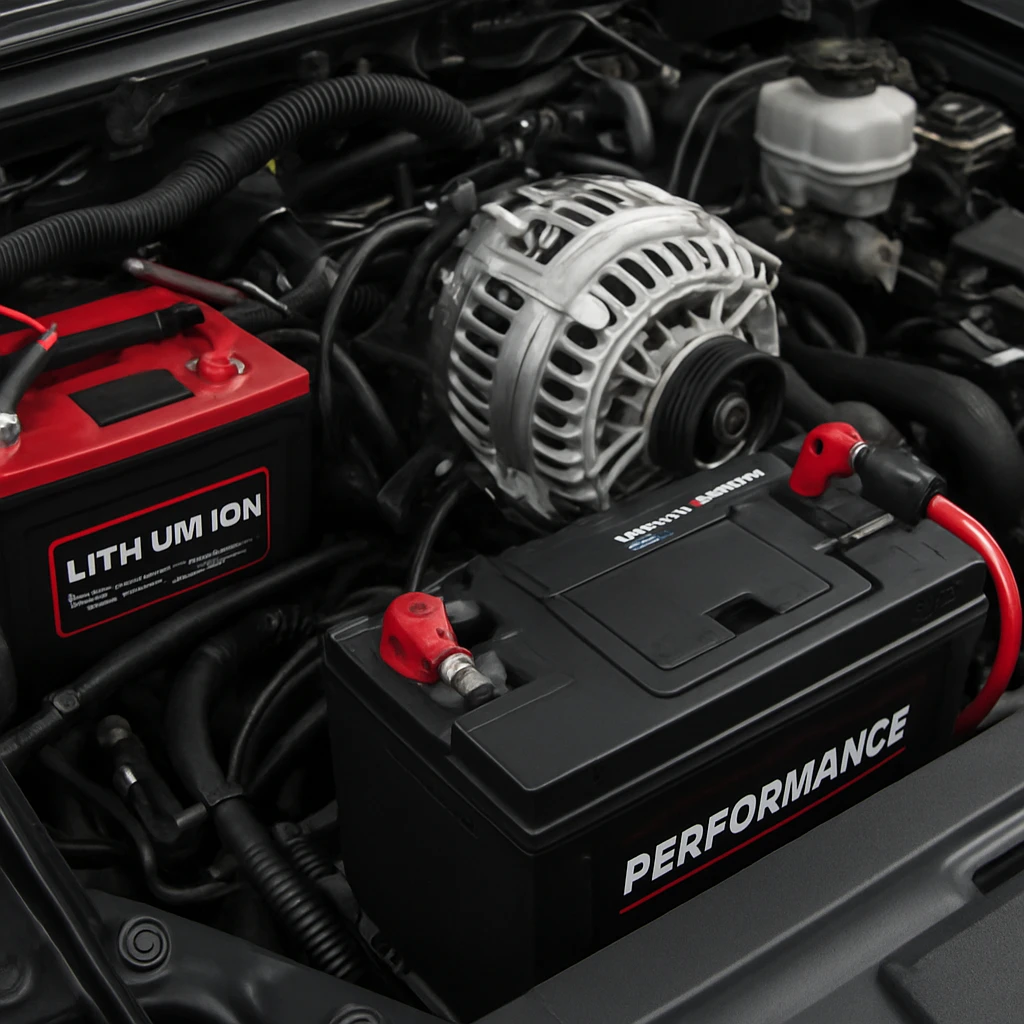
Strong parts underperform if installed poorly. Treat your electrical like a performance brake upgrade: every connection, conductor, and fuse must be correct. Below are key practices used by experienced installers across New Zealand and Australia to keep voltage high and resistance low.
Wiring and Layout
- Run the “Big 3” with oversized copper. Many builds use 1/0 AWG (American Wire Gauge) or 2/0 AWG (American Wire Gauge) oxygen-free copper for main charge and grounds.
- Use copper busbars for short, rigid connections between battery cells and to distribution blocks. This minimizes joint resistance and keeps service tidy.
- Keep amplifier grounds short to a shared star point or busbar near the battery bank. Avoid scattered random chassis grounds.
- Secure all conductors, protect against abrasion, and maintain service loops to reduce stress on lugs.
Fuse Protection
- Fuse as close to the source as practical. The alternator output should be fused at the alternator or within 200 millimetres of the connection if the design allows.
- Each battery positive leaving a bank gets a fuse or circuit breaker sized to cable ampacity and expected load.
- Amplifier power leads get their own fuses near the distribution block. Choose ratings to protect wire, not to chase peak power numbers.
| Cable Size | Cross-Section | Typical Continuous Current (short run, engine bay) | Common Fuse Size Range | Notes |
|---|---|---|---|---|
| 2 AWG (American Wire Gauge) | ~33 mm² | 125 to 150 ampere | 125 to 175 ampere | Short alternator leads on smaller upgrades |
| 1/0 AWG (American Wire Gauge) | ~53 mm² | 200 to 300 ampere | 200 to 300 ampere | Popular for “Big 3” and trunk runs |
| 2/0 AWG (American Wire Gauge) | ~67 mm² | 275 to 350 ampere | 300 to 350 ampere | Useful for >300 ampere alternators |
Values are conservative and assume high-quality copper, short runs, and good ventilation. When in doubt, step up one size and use proper lugs and hydraulic crimping with adhesive heat-shrink.
Regulation and Setpoints
- Many performance alternators support external regulation for precise control. Keep target voltage compatible with your battery chemistry.
- LTO (Lithium Titanate Oxide) SCiB (Super Charge Ion Battery) banks comfortably operate in the 13.8 to 14.8 volt system range. Confirm limits with your supplier.
- Avoid chronic overvoltage. It creates heat, accelerates wear, and can stress amplifier power supplies.
Safety and Electrical Design Practices
- Mount batteries securely in ventilated locations with solid brackets. Movement fatigue is a hidden enemy in utes and hatchbacks.
- Isolate high-current positive runs with abrasion-resistant loom and grommets through metal panels.
- Label disconnects. A bright, accessible master switch helps in maintenance and emergencies.
- Plan serviceability. Leave access to fuses, regulators, and balance leads for periodic checks.
- For lithium banks, follow supplier guidance on balancing and, where used, Battery Management System (BMS) configuration.
Common Questions About Alternator Upgrades and Lithium Banks for Car Audio
How big should my alternator be for a 3 to 5 kilowatt (kW) system?
As a starting point, estimate average amplifier draw as amplifier watts divided by efficiency and then divided by system voltage. A 3 kilowatt (kW) sub amplifier at 70 percent efficiency on 14 volt draws about 300 ampere on heavy use. Add vehicle loads and some headroom. Many daily builds in this class use 240 to 320 ampere alternators plus an LTO (Lithium Titanate Oxide) SCiB (Super Charge Ion Battery) bank to cover peaks. If you demo long and loud, lean toward the higher end.
Will a bigger alternator replace the need for a battery bank?
No. Alternators provide continuous current but respond slowly to fast transients. Battery banks with low internal resistance supply instantaneous peak current while the alternator catches up. The best results pair a correctly sized alternator with a low-resistance bank such as LTO (Lithium Titanate Oxide) SCiB (Super Charge Ion Battery).
Can I run mixed chemistries together?
Mixing chemistries is risky because resting voltages, charge acceptance, and internal resistance differ. This can cause unbalanced current sharing and stress. If you must mix, isolate banks with proper relays or dedicated charge paths and consult the chemistry vendor. Most serious installers standardize on one chemistry, increasingly LTO (Lithium Titanate Oxide) for peak performance.
Do I need a Battery Management System (BMS) with LTO (Lithium Titanate Oxide) SCiB (Super Charge Ion Battery)?
LTO (Lithium Titanate Oxide) SCiB (Super Charge Ion Battery) cells are robust and tolerate abuse better than many chemistries, but balance and monitoring are still smart. Many competition-oriented banks run passive balancing with periodic checks. Discuss your use case with Evolution Lithium for cell count, balancing strategy, and recommended accessories.
How do I prevent belt slip with high-output alternators?
Use a quality belt, correct tension, and appropriate pulley sizes. Multi-rib serpentine belts with good wrap angle reduce slip. In extreme cases, an overdrive pulley increases alternator speed at idle, but watch high-RPM (revolutions per minute) limits.
What about engine control unit (ECU) smart charging?
Modern vehicles may vary voltage to improve fuel economy. Many high-output alternators offer plug-and-play regulator strategies or external regulation to maintain stable voltage during audio use. Work with your alternator supplier to match the solution to your vehicle’s ECU (Engine Control Unit) behavior.
How do Evolution Lithium banks compare in real demos?
Installers report flatter voltage during 30 to 60 second demos and notably quicker recovery between hits. A typical 10 Ah (ampere-hour) 75 C (capacity multiple) SCiB (Super Charge Ion Battery) module series can replace multiple AGM (Absorbent Glass Mat) batteries in some builds, cutting mass and freeing space. Evolution Lithium hand-assembles banks, provides honest sizing advice, and references Toshiba testing data for the SCiB (Super Charge Ion Battery) technology so you know the cells’ capabilities are genuine.
What images would help explain this to clients or friends?
- Close-up of copper busbars and distribution blocks showing short, direct paths.
- Alternator to battery “Big 3” upgrade with properly crimped lugs and heat-shrink.
- Amplifier rack with labeled fusing and star-ground layout.
- LTO (Lithium Titanate Oxide) SCiB (Super Charge Ion Battery) bank mounted securely with balance leads accessible.
- Annotated diagram of charging path from alternator to amplifiers.
Conclusion
A correctly sized alternator, low-resistance wiring, and the right battery chemistry unlock clean, repeatable output from serious car audio systems. When these parts work together, everything sounds better and lasts longer.
Imagine next-season meets where your voltage barely wavers and the bass line stays razor-sharp from the first demo to the last. With smart planning and proven components, that scenario is straightforward rather than mythical.
Where will you invest first to build a charging system that matches your alternator upgrade for car audio, car audio batteries, power delivery, battery solutions, and lithium banks for car audio?
Additional Resources
Explore these authoritative resources to dive deeper into alternator upgrade for car audio, car audio batteries, power delivery, battery solutions, lithium banks for car audio.
Elevate Alternator Power With Evolution Lithium
Custom-built LTO SCiB lithium battery banks for car audio deliver rapid current bursts, stable voltage, fast charging and long life for NZ bassheads, SPL competitors, installers and daily drivers.