
Do I Need an Alternator Upgrade When Running a Lithium Car Audio Battery Bank?
If you are weighing an alternator upgrade for car audio, lithium banks for car audio, power delivery, voltage stability, car audio battery questions, here is the short answer: you need an alternator upgrade when your system’s average current draw at cruise exceeds what your factory alternator (Original Equipment Manufacturer) can supply with headroom for the vehicle and charging the bank. Lithium Titanate Oxide (LTO) banks such as Toshiba SCiB (Super Charge ion Battery) units massively reduce voltage sag and provide high burst current, but they do not create energy. If your amplifiers’ Root Mean Square (RMS) demand over time is higher than your alternator (Original Equipment Manufacturer) output at real engine speeds, plan an upgrade. For Sound Pressure Level (SPL) burps or short demos, a properly sized LTO (Lithium Titanate Oxide) bank may carry you without an alternator change, but for daily music at several kilowatts, a high-output alternator (Original Equipment Manufacturer) or dual alternators is the reliable path.
This checklist helps you decide with data, not guesswork. You will size current draw, compare against alternator (Original Equipment Manufacturer) curves, plan wiring and fuse protection, validate with instruments, and correct common issues. Evolution Lithium supplies custom-built LTO (Lithium Titanate Oxide) SCiB (Super Charge ion Battery) battery banks engineered for voltage stability in demanding installs across New Zealand and Australia, and the steps below reflect proven field practice.
Pre-work Checklist: alternator upgrade for car audio, lithium banks for car audio, power delivery, voltage stability, car audio battery
Understand How the System Works
- Map the energy flow: alternator (Original Equipment Manufacturer) supplies charging current to your lithium battery bank car audio, which then buffers transient peaks for amplifiers; the battery covers peaks, the alternator covers the average.
- Quantify average vs peak: compute continuous load from amplifier RMS (Root Mean Square) power and efficiency, and distinguish it from short burst current that the LTO (Lithium Titanate Oxide) bank will handle.
- Check alternator (Original Equipment Manufacturer) output at operating rpm (revolutions per minute): review the alternator curve, not just the headline amperage, because output at idle can be 40 to 60 percent of rated peak per manufacturer data.
- Clarify voltage targets: set charging voltage appropriate for LTO (Lithium Titanate Oxide) SCiB (Super Charge ion Battery) banks, typically 13.8 to 15.0 volts window per cell chemistry guidance, while respecting amplifier voltage limits.
Why It Matters for High-Power Car Audio
- Prioritize voltage stability: amplifiers deliver cleaner, more efficient power at 13.8 to 14.8 volts; sag below 12.5 volts triggers clipping, heat, and reduced output.
- Exploit LTO (Lithium Titanate Oxide) strengths: extremely low internal resistance and high C (Capacity) rate reduce sag and recover fast between hits, ideal for SPL (Sound Pressure Level) and demo vehicles.
- Avoid heat stress: undersized alternators (Original Equipment Manufacturer) run hot when asked to deliver continuous high current, shortening lifespan and causing belt slip.
- Right-size from the start: a well-sized alternator (Original Equipment Manufacturer) plus a proper LTO (Lithium Titanate Oxide) bank prevents the upgrade spiral of band-aid batteries and unreliable performance.
Estimate Your Current Budget
- Calculate amplifier input current: use Current ≈ Power ÷ (Voltage × Efficiency). For Class D (Direct Current) sub amps at 75 to 85 percent efficiency, be conservative at 75 percent.
- Add vehicle base load: include 30 to 60 amperes for lights, HVAC (Heating, Ventilation, and Air Conditioning), ECU (Engine Control Unit), fuel pump, and infotainment on modern vehicles.
- Apply duty cycle: daily music rarely drives continuous full power; use 30 to 60 percent of total rated amp power for average draw unless you run sustained sine sweeps.
- Compare to alternator (Original Equipment Manufacturer) curve: ensure your average draw stays below about 60 to 70 percent of alternator capacity at cruise for thermal headroom.
| Amplifier RMS (Root Mean Square) Power | Assumed Efficiency | Avg Music Duty Cycle | Estimated Average Current at 14.4 V | Suggested Alternator (Original Equipment Manufacturer) Rating |
|---|---|---|---|---|
| 1,500 W | 75 percent | 40 percent | 1,500 × 0.4 ÷ (14.4 × 0.75) ≈ 55 A | 150 to 180 A factory is often sufficient |
| 3,000 W | 75 percent | 40 percent | 3,000 × 0.4 ÷ (14.4 × 0.75) ≈ 111 A | 220 to 250 A recommended |
| 5,000 W | 75 percent | 40 percent | 5,000 × 0.4 ÷ (14.4 × 0.75) ≈ 185 A | 300 to 370 A high-output |
| 8,000 W | 75 percent | 50 percent | 8,000 × 0.5 ÷ (14.4 × 0.75) ≈ 370 A | Dual alternators or > 370 A unit |
Installer insight: many modern Original Equipment Manufacturer alternators are 120 to 220 amperes but only deliver 60 to 120 amperes at idle per manufacturer graphs. If your demo style is long idling, oversize the alternator (Original Equipment Manufacturer) or add a second unit.
Select the Right LTO (Lithium Titanate Oxide) Bank Capacity
- Match C (Capacity) rate to your burst needs: Evolution Lithium offers genuine Toshiba SCiB (Super Charge ion Battery) cells in configurations like 3 Ah (Ampere-hour) 75 C (Capacity), 10 Ah (Ampere-hour) 75 C (Capacity), and 20 Ah (Ampere-hour) 35 C (Capacity); multiply Ah (Ampere-hour) by C (Capacity) to estimate peak amperes.
- Plan for demo time: larger Ah (Ampere-hour) extends time at low rpm between recharges while preserving voltage stability.
- Account for charge acceptance: LTO (Lithium Titanate Oxide) banks accept high charge current, so alternator (Original Equipment Manufacturer) capacity must cover both audio load and recharge rate during music pauses.
Suggested image: a simplified electrical diagram showing alternator (Original Equipment Manufacturer), LTO (Lithium Titanate Oxide) SCiB (Super Charge ion Battery) bank, fusing, busbars, and amplifiers.
Execution Checklist
Design the Charging and Distribution Path
- Upgrade the Big Three: reinforce alternator positive to battery positive, chassis to battery negative, and engine ground to chassis using 1/0 AWG (American Wire Gauge) or 2/0 AWG (American Wire Gauge) oxygen-free copper.
- Install copper busbars: centralize high-current connections with tinned copper busbars for low resistance and tidy serviceability.
- Use quality distribution blocks: split feeds close to amplifiers; keep runs short and symmetrical to minimize voltage drop.
- Fuse every source: place a main fuse or breaker within 200 mm of the alternator (Original Equipment Manufacturer) and battery bank, sized to cable ampacity and system fault current.
| Cable Size | Typical Continuous Rating | Recommended Fuse Range | Notes |
|---|---|---|---|
| 1/0 AWG (American Wire Gauge) | 250 to 300 A | 200 to 300 A ANL (Automotive National Laboratories) or MEGA (MEGA-fuse) | Short runs, high strand count preferred |
| 2/0 AWG (American Wire Gauge) | 300 to 400 A | 250 to 400 A ANL (Automotive National Laboratories) or MEGA (MEGA-fuse) | Ideal for > 300 A alternators (Original Equipment Manufacturer) |
| 4 AWG (American Wire Gauge) | 100 to 150 A | 80 to 150 A MIDI (Medium Duty Ignition) or ANL (Automotive National Laboratories) | Use for amplifier branches |
Set Safe Charging for LTO (Lithium Titanate Oxide) SCiB (Super Charge ion Battery)
- Target a 13.8 to 15.0 volt system: many amplifiers are comfortable up to 15.0 volts; verify your model’s limits to avoid protection trips.
- Consider adjustable regulators: high-output alternators (Original Equipment Manufacturer) with external regulation help fine-tune charging to your chemistry.
- Include a BMS (Battery Management System): even with robust LTO (Lithium Titanate Oxide), use a balance and protection layer appropriate for your pack configuration.
Practical Installation Considerations
- Mount banks securely: use non-conductive cradles and isolate from vibration; LTO (Lithium Titanate Oxide) cells are tough but terminals must not be stressed.
- Vent and protect: route cables away from heat and moving parts; grommet every firewall pass-through and support runs at 300 mm intervals.
- Plan service access: orient fuses, busbars, and meters where you can inspect under show conditions.
- Keep grounds short: star-ground to a single cleaned, paint-free chassis point with serrated washers for lasting low impedance.
Integrate Evolution Lithium Components
- Choose the right SCiB (Super Charge ion Battery) module: Evolution Lithium offers hand-assembled packs using genuine Toshiba LTO (Lithium Titanate Oxide) cells with options such as 3 Ah (Ampere-hour) 75 C (Capacity), 10 Ah (Ampere-hour) 75 C (Capacity), and 20 Ah (Ampere-hour) 35 C (Capacity) to match amplifier burst demands.
- Exploit compact form factor: reduce weight and space versus AGM (Absorbent Glass Mat) while increasing voltage stability under load.
- Add complementary gear: pair with Evolution Lithium amplifiers and accessories for a known-good electrical ecosystem and responsive local support in New Zealand.
Suggested image: rear quarter install with copper busbars, dual 1/0 AWG (American Wire Gauge) runs, and an Evolution Lithium LTO (Lithium Titanate Oxide) SCiB (Super Charge ion Battery) bank near the amplifiers.
Validation Checklist
Instrument Your System
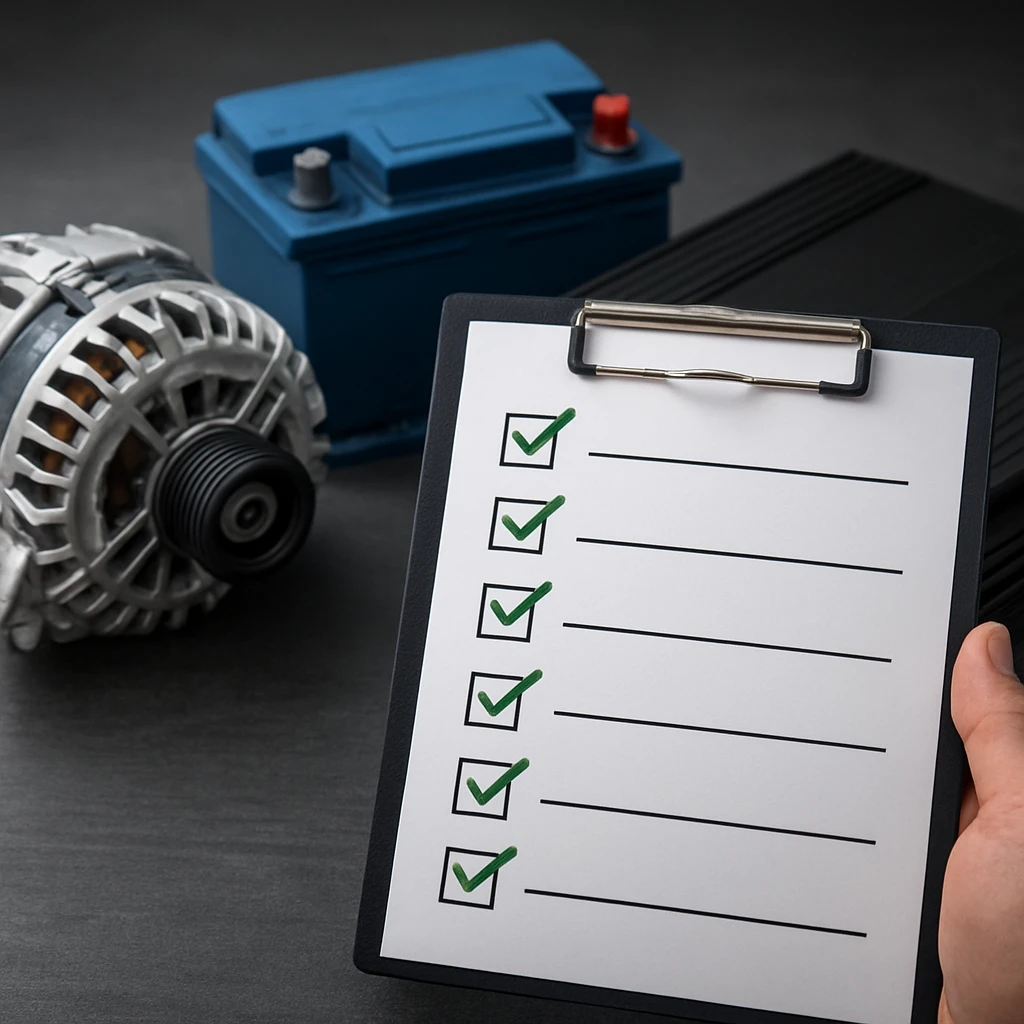
- Use a DMM (Digital Multimeter): log voltage at the bank and at amplifier inputs at idle, 2,000 rpm, and demo rpm to capture drop across wiring.
- Clamp current at the alternator (Original Equipment Manufacturer): measure charge current into the LTO (Lithium Titanate Oxide) bank and system draw during musical peaks and averages.
- Add in-car logging: many DSP (Digital Signal Processor) or amplifier platforms offer telemetry; otherwise, use a shunt and data logger.
Test Scenarios and Targets
- Run a 40 to 60 second music demo: average voltage should stay above 13.4 volts at the amplifier, and never dip below your amp’s minimum spec.
- Observe recharge behavior: voltage should rebound quickly between notes; slow recovery suggests alternator (Original Equipment Manufacturer) deficit or excessive wiring resistance.
- Evaluate idle performance: if voltage collapses below 13.0 volts at idle while playing, consider a higher output alternator (Original Equipment Manufacturer) or raising idle speed per tuner guidance.
| Condition | Bank Voltage Target | Amp Input Voltage Target | Notes |
|---|---|---|---|
| Engine Off, Rest | 13.2 to 13.6 V | ≈ Bank Voltage | Depends on pack state of charge |
| Engine On, Idle | 13.8 to 14.6 V | Within 0.1 to 0.2 V of bank | Higher is fine if within amp spec |
| Full Tilt, Cruise RPM | 13.6 to 15.0 V | >= 13.4 V preferred | Brief dips acceptable; watch averages |
Decide on the Alternator (Original Equipment Manufacturer) Upgrade
- Upgrade if average current draw exceeds 60 to 70 percent of alternator (Original Equipment Manufacturer) output at cruise; this threshold preserves thermal margin per alternator manufacturer recommendations.
- Upgrade if sustained demo time depletes the LTO (Lithium Titanate Oxide) bank faster than it recharges, causing creeping voltage sag over minutes.
- Upgrade if idle behavior is critical: delivery apps, show lanes, or long queues benefit from enhanced idle output or dual units.
Real-world example: a daily 3,000 watt system on a 180 ampere factory alternator (Original Equipment Manufacturer) measured 120 amperes average draw at 2,000 rpm. Voltage hovered at 13.0 to 13.2 volts with AGM (Absorbent Glass Mat), then 13.7 to 13.9 volts after switching to an Evolution Lithium LTO (Lithium Titanate Oxide) SCiB (Super Charge ion Battery) bank. Adding a 250 ampere alternator (Original Equipment Manufacturer) pushed demo voltage to 14.2 volts with cooler amplifier heat sinks.
Common Misses
- Skipping alternator (Original Equipment Manufacturer) curve data: relying on peak amperes misleads; always verify idle and cruise output.
- Under-fusing or no fuses: every battery and alternator (Original Equipment Manufacturer) positive leg must have a properly sized fuse near the source.
- Using mixed-metal connections: aluminum lugs on copper busbars corrode and raise resistance; use tinned copper where possible.
- Ignoring return paths: long, thin grounds cause volt drop; star-ground with equal-length, equal-gauge returns.
- Mounting LTO (Lithium Titanate Oxide) banks without restraint: unsecured packs stress terminals and can short in accidents.
- Overcharging: setting 15.5 volts without checking amplifier limits can trip protection; confirm component specifications.
- Chasing more batteries to fix an undersized alternator (Original Equipment Manufacturer): banks improve burst delivery but cannot fix inadequate average charging.
- Neglecting heat: high-output alternators (Original Equipment Manufacturer) need proper belt wrap, larger pulleys if needed, and airflow; monitor case temps on long demos.
Safety and Electrical Design Practices
- Label everything: indicate voltage, fuse sizes, and shut-off procedures near the bank and busbars.
- Protect from shorts: cover all live studs with insulating boots; use abrasion-resistant loom and heat-resistant sleeving near exhausts.
- Plan emergency isolation: add a manual battery disconnect rated for your maximum current near the LTO (Lithium Titanate Oxide) bank.
- Document your layout: keep a printed schematic in the vehicle for events and servicing.
Suggested image: close-up of properly crimped and heat-shrunk 1/0 AWG (American Wire Gauge) terminations with labeled ANL (Automotive National Laboratories) fuses.
Case Study: SPL (Sound Pressure Level) Burp vs Daily Driver
- Build a burp car: a 10 Ah (Ampere-hour) 75 C (Capacity) Evolution Lithium LTO (Lithium Titanate Oxide) SCiB (Super Charge ion Battery) bank can deliver up to 750 amperes burst for short windows, enabling a 5,000 watt burp on a stock alternator (Original Equipment Manufacturer) if rests are long and recharge cycles are planned.
- Spec a daily driver: the same 5,000 watt system playing music may average 180 amperes; pair a 300 to 370 ampere alternator (Original Equipment Manufacturer) with the Evolution Lithium bank for consistent 14+ volts and cooler runs.
Conclusion
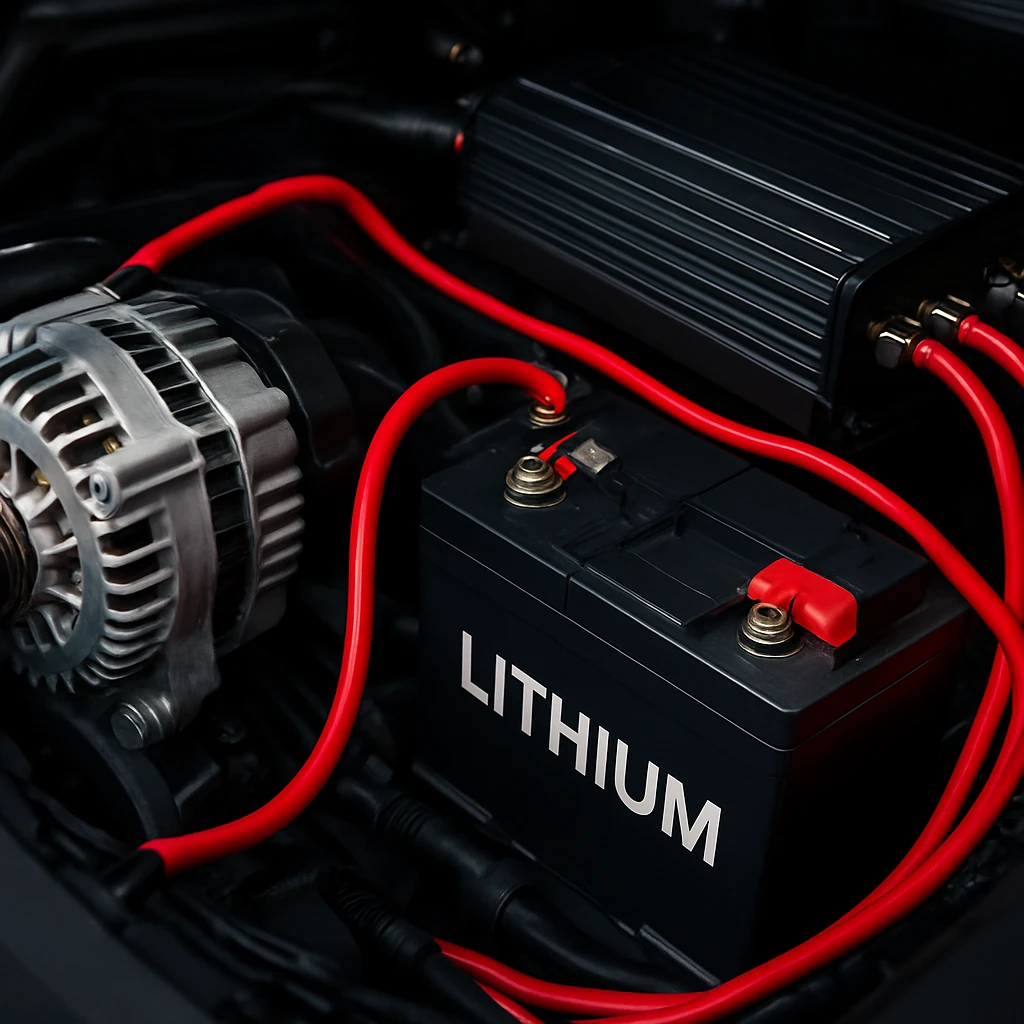
Here is the bottom line: decide the alternator path by matching your average current draw to real alternator (Original Equipment Manufacturer) output, then let an LTO (Lithium Titanate Oxide) SCiB (Super Charge ion Battery) bank handle the peaks.
In the next 12 months, more New Zealand builds will shift from AGM (Absorbent Glass Mat) to compact, fast-charging LTO (Lithium Titanate Oxide) packs that hold voltage under brutal demos while keeping amplifiers efficient.
What would your system sound like if every bass note landed at 14+ volts with effortless headroom and the right alternator upgrade for car audio, lithium banks for car audio, power delivery, voltage stability, car audio battery?
Power Your Build with Evolution Lithium Expertise
Get custom-built LTO (Lithium Titanate Oxide) SCiB (Super Charge ion Battery) banks delivering rapid bursts, stable voltage, fast charging, long life, and less bulk for demanding New Zealand car audio.
Appendix: Quick Reference Tables
Alternator (Original Equipment Manufacturer) vs Bank Roles
| Component | Primary Role | Time Scale | Design Tip |
|---|---|---|---|
| Alternator (Original Equipment Manufacturer) | Supply average current, charge bank | Seconds to hours | Size to 60 to 70 percent of average draw for cooling headroom |
| LTO (Lithium Titanate Oxide) SCiB (Super Charge ion Battery) Bank | Deliver burst current, stabilize voltage | Milliseconds to seconds | Choose higher C (Capacity) for SPL (Sound Pressure Level) peaks, more Ah (Ampere-hour) for demo time |
When You Can Skip the Alternator (Original Equipment Manufacturer) Upgrade
- Confirm average current with a clamp meter is below 60 percent of factory alternator (Original Equipment Manufacturer) output at cruise.
- Prove voltage stability at the amplifier remains above 13.4 volts during your typical demo length.
- Use an Evolution Lithium LTO (Lithium Titanate Oxide) SCiB (Super Charge ion Battery) bank sized to your burst current, with robust Big Three wiring and correct fusing.
Additional Practical Tips
- Carry spare ANL (Automotive National Laboratories) fuses and a calibrated DMM (Digital Multimeter) at shows.
- Document alternator (Original Equipment Manufacturer) pulley ratios; a larger alternator pulley may reduce slip under load and improve reliability.
- If running dual alternators (Original Equipment Manufacturer), isolate regulators or use a compatible controller to prevent hunting.
- Shop local in New Zealand: Evolution Lithium provides hand-assembled packs, honest advice, and after-sales support with safety information referencing Toshiba LTO (Lithium Titanate Oxide) SCiB (Super Charge ion Battery) testing.