

Wiring for SCiB LTO Lithium Banks: What Every Car Audio Enthusiast Needs to Know
If you’re running a high‑output car audio system with an SCiB LTO lithium battery bank, the wiring between your alternator, the bank, and your amplifiers has to be specced to handle the bank’s real current capability — not just “good enough” for a dozen or two hundred amps. Undersized cabling will strangle the voltage your amplifiers see, turn energy into heat, and can permanently damage your gear.
Evolution Lithium builds SCiB LTO battery banks around a single idea: stable voltage under load for serious car audio. But the best lithium bank in the world can’t deliver that stability if the wiring in your install is choking current and adding resistance. This article walks through what you need to know to choose, route, and protect cabling for a high‑current lithium‑backed system — whether you’re chasing tenths on the SPL meter or just want brutal daily reliability.
Why wiring matters 10× more with a high‑current lithium bank
A quality SCiB LTO battery bank (6S configuration, 15.0–16.2V operating window) has extremely low internal resistance. It’s designed to dump large currents near‑instantly and recharge fast from a capable alternator. This changes the wiring game completely:
- Voltage stability is the whole point. If the wire between the bank and your amplifiers drops 0.4V at 800A, you’ve knocked your system voltage from 15.6V to 15.2V — that’s a direct hit to amplifier output and cone control.
- Current spikes are real. A 30Ah 40C bank can deliver 1200A for a burp. Even if you’re not chasing competition numbers, the wiring must be sized for the potential the bank can push, not just your amplifier’s RMS rating.
- Recharge demands add load. High‑output alternators feeding a depleted SCiB bank can push 200–300A+ continuously. The entire charge path (alternator to bank and bank to amplifiers) needs to share the same careful gauge selection.
In short: a lithium bank amplifies every weakness in your wiring. Get it right, and you’ll have voltage that barely flinches on big bass drops. Get it wrong, and you’ll have hot cables and a very expensive battery bank that’s being asked to perform while suffocating its own output.
Wire gauge: bigger is cheaper than a second battery
American Wire Gauge (AWG) is the standard reference. A smaller AWG number means a thicker wire — and thicker copper means lower resistance, less heat, and less voltage drop.
The old rule of thumb “4 AWG is fine for most amplifiers” collapses when you’re feeding a 6S SCiB bank’s output to multiple high‑current monoblocks. Below is a practical guide based on typical Evolution Lithium bank sizes and the kind of current they can sustain. Always keep the total wire length (including the ground path) in mind — long runs need a heavier gauge to keep voltage drop under control.
| Bank capacity / current potential | Minimum power/ground gauge (up to 3m total run) | Notes |
|---|---|---|
| 20Ah 40C – 800A burst | 0 AWG (or parallel 4 AWG) | Single 0 AWG copper can handle the RMS demands; for repeated high-current use, parallel runs are safer. |
| 30Ah 40C – 1,200A burst | 0 AWG as a minimum; dual 2 AWG or single 2/0 AWG strongly recommended | Especially if the bank is mounted more than 1m from the amplifiers. |
| 40Ah+ or multiple banks | 2/0 AWG or custom bus‑bar system with multiple parallel runs | At this level, solid copper bus bars close to the amp rack are often better than long cable runs. |
| Speaker level (amplifier to subwoofer) | 10–12 AWG (short runs); 8 AWG for very high power SPL systems | Cost of upgrading speaker wire is small; 10 AWG oxygen‑free copper is a safe standard for dedicated bass systems. |
These aren’t “magic” numbers — they’re based on keeping the total round‑trip voltage drop below 0.3V under heavy load. If you’re unsure, use the Evolution Lithium battery calculator to work out your system’s real current demand, and then check a verified AWG current carrying chart while factoring in cable length.
Power cable, ground cable, and RCA signal cables: stop mixing them up
Every wire in a high‑current lithium audio system has a single job. The consequences of mis‑matched cables are worse when the bank can push huge current without sagging.
Power and ground cables
Use the same gauge for both the positive and the negative run. The ground path sees exactly the same current, and a skinny ground cable will heat up just as fast. Connect the bank’s negative terminal directly to a bare‑metal chassis point as close as possible — no seat‑belt bolts, no painted brackets. Evolution Lithium banks use a low‑impedance terminal layout, so a short, fat ground cable is your cheapest performance upgrade.
Speaker wire
Stranded oxygen‑free copper (OFC), minimised lengths, and a gauge that matches the amplifier’s real output. Don’t let the hype fool you: once the signal leaves the amplifier, it’s high‑voltage AC. The main enemy here is resistance heating — not mystical skin effect. A twisted‑pair speaker cable can reduce inductive pickup, but in a DC‑lithium‑bank world, plain OFC zip cord properly sized is still excellent.
RCA interconnect cables
Low‑level signals are fragile. Run RCAs down the opposite side of the car from the main power cable. Look for shielding that actually works — double‑braid or triple‑shielded designs with good connector contact. If you hear alternator whine after installing a lithium bank, the problem is almost always a ground loop or poorly shielded RCAs, not the bank itself.
OFC vs. CCA: don’t let a $50 saving cost you voltage
The difference between oxygen‑free copper (OFC) and copper‑clad aluminium (CCA) becomes a genuine safety and performance issue in a high‑current SCiB system.
| OFC (Oxygen‑Free Copper) | CCA (Copper‑Clad Aluminium) | |
|---|---|---|
| Conductivity | Near‑100% IACS | ~60% of copper, rising to higher resistance under heat |
| Resistance (same AWG) | Low and stable | Noticeably higher, especially on long runs |
| Heat generation | Minimal at rated current | More heat for the same current, risking insulation breakdown |
| Suitability for lithium banks | Mandatory for any system above 500W RMS that needs reliable voltage | Acceptable only for very short, low‑current accessory wiring; not for main bank feeds |
SCiB LTO banks like the ones Evolution Lithium builds can discharge 40C in bursts. At 1,200A, the extra resistance in a CCA 0‑AWG run can waste hundreds of watts as heat — the exact opposite of what a lithium upgrade is meant to achieve. Spend the extra on OFC; you’ll earn it back in stable voltage and cooler cables.
Fusing, distribution, and protecting the bank
Fusing is not about protecting your amplifier — it’s about protecting the wire from melting and setting the vehicle on fire. In a lithium‑bank system, fuse placement and sizing become even more critical because the bank can source enormous fault currents.
- Place a main fuse holder within 30cm of the bank’s positive terminal, the same way you’d fuse at the front battery. This protects the entire cable run.
- After a power distribution block, fuse each amplifier feed individually at the distribution point.
- Fuse rating should not exceed the wire’s ampacity. For OFC 0 AWG in a short run, 325A is a realistic upper limit; if you need more current, use a bigger gauge or parallel runs, not a bigger fuse.
- In a dual‑bank or dual‑alternator setup, all energy sources must be fused independently. Evolution Lithium’s car audio battery comparison explains why lithium’s low impedance makes over‑current protection non‑optional.
Grounding an SCiB lithium bank: short, flat, and clean
A poor ground is the most common cause of voltage drop and noise in car audio. SCiB banks rely on a low‑resistance path right back to the alternator case and chassis, so the ground wire must:
- Be the same gauge as the power wire.
- Connect to a bare metal chassis point — clean off all paint, rust, and sealant down to shiny steel.
- Be as short as possible, ideally under 45cm. The longer the ground wire, the more inductance and resistance you introduce.
- Use a high‑quality ring terminal that’s bolted or rivet‑nutted with a star washer to bite into the metal.
If you’re mounting the bank in the boot, don’t run a long ground cable all the way to the front. Instead, create a solid local chassis ground; the car body is a better conductor than any affordable copper cable when properly bonded.
Routing and installation standards that protect your system
Clean routing isn’t about looking good at a car show — it’s about preventing vibration damage, inductive interference, and short circuits in a high‑current environment.
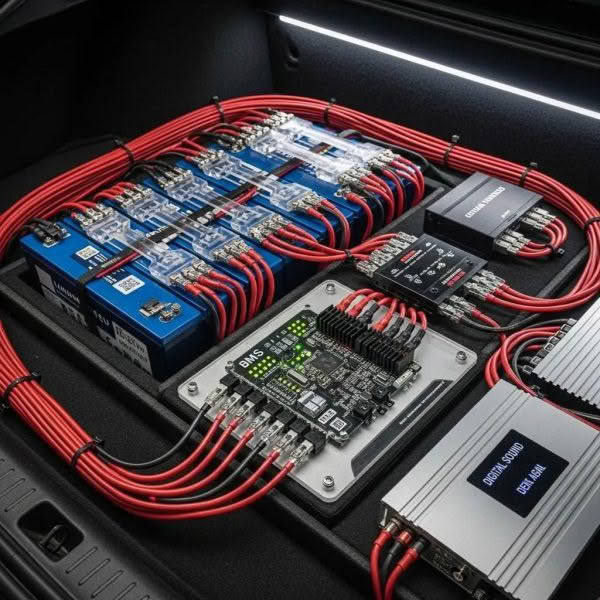
- Separate power and signal cables. Run main power wires down one side of the vehicle, RCAs down the other. At least 30cm of separation minimizes magnetic coupling.
- Use grommets anywhere wires pass through sheet metal. A 0‑AWG cable that chafes through on a firewall edge becomes a dead short directly across a lithium bank. That’s a fire waiting to happen.
- Avoid sharp bends — a tight radius can crack the copper strands over time and create a hot spot.
- Secure cables every 30–40cm with zip ties or cable clamps to stop movement. In a bass‑heavy vehicle, vibration will murder an unsecured cable in months.
- Label your wiring during install. It makes troubleshooting and future upgrades trivial, especially if multiple amps and distribution blocks are involved.
Quick steps before you power on
- Disconnect the main battery/alternator before starting work — SCiB banks aren’t toys.
- Measure all power and ground runs for continuity and check for shorts before connecting the bank.
- Set your voltmeter to monitor the amplifier terminals while playing a bass sweep at moderate volume. A drop of more than 0.5V from the bank’s resting voltage indicates a wiring fault or undersized cable run.
- Double‑check all terminal torque; loose connections cause arcing and massive voltage instability.
- Ensure all fuses are correctly rated and properly seated.
Frequently asked questions about wiring lithium car audio banks
Can I use the existing factory wiring when adding an SCiB LTO bank?
No. Factory wiring is designed for the vehicle’s standard electrical loads, not for a high‑discharge lithium battery bank feeding multiple amplifiers. You need a dedicated run of OFC cable from the bank to the amplifier distribution point, sized for the bank’s capable current output.
What’s the right fuse size for a 30Ah SCiB bank?
The fuse protects the wire, not the bank. Choose a fuse rated equal to or slightly below the ampacity of your chosen power cable. For a single 0‑AWG OFC cable (rated ~325A for typical car lengths), a 300A ANL or MIDI fuse is appropriate. If you build with dual 2‑AWG leads, each gets its own fuse. The bank itself is current‑limited by its internal chemistry and active balancer — but the wiring is not.
Why does my voltage at the amplifier read lower than at the bank?
That’s voltage drop across the cable. It’s caused by resistance in the wire and connectors. Measure the voltage at the bank terminals and then at the amplifier terminals under load. If the drop is more than 0.3–0.5V, your cable gauge is too small, the ground path is resistive, or you have a poor termination somewhere.
Do I need special wire for the higher voltage of a 6S LTO bank?
6S SCiB banks run between 15.0V and 16.2V in normal use — well within the insulation rating of standard automotive OFC cable (typically 60V DC or higher). No special high‑voltage wire is needed. The main difference is that because the voltage is higher, any voltage drop represents a bigger percentage loss in your system’s dynamic headroom, so wire sizing becomes even more critical.
Is aluminium wire ever acceptable for a car audio lithium system?
CCA has about 60% the conductivity of copper, so a thicker gauge is required to achieve the same resistance. In high‑current SCiB applications, the required CCA gauge often becomes impractical to route and terminate. Save CCA for temporary test setups or low‑current accessories. For the main bank‑to‑amplifier path, only full‑copper OFC should be used.
Where Evolution Lithium fits in
Evolution Lithium designs and builds SCiB LTO battery banks specifically for the car audio community in New Zealand and Australia. Every bank is assembled in Blenheim, Marlborough, using genuine Toshiba SCiB cells, and is intended to deliver the stable voltage and high current that serious systems demand. When you’re installing a lithium bank that can source four‑figure amps, the wiring isn’t an afterthought — it’s the final link in the chain that lets the bank do its job. If you’re planning a new install or upgrading an older lead‑acid setup, explore Evolution Lithium’s SCiB LTO battery banks and use our battery calculator to match the bank to your amplifiers before you order a single metre of cable.
Evolution Lithium7 Soper Lane, Springlands, Blenheim, Marlborough, New Zealand
Phone: +64 22 073 1730 | Email: sales@evolutionlithium.co.nz
Open 24/7 — evolutionlithium.co.nz