
Mixing lithium and agm batteries car audio

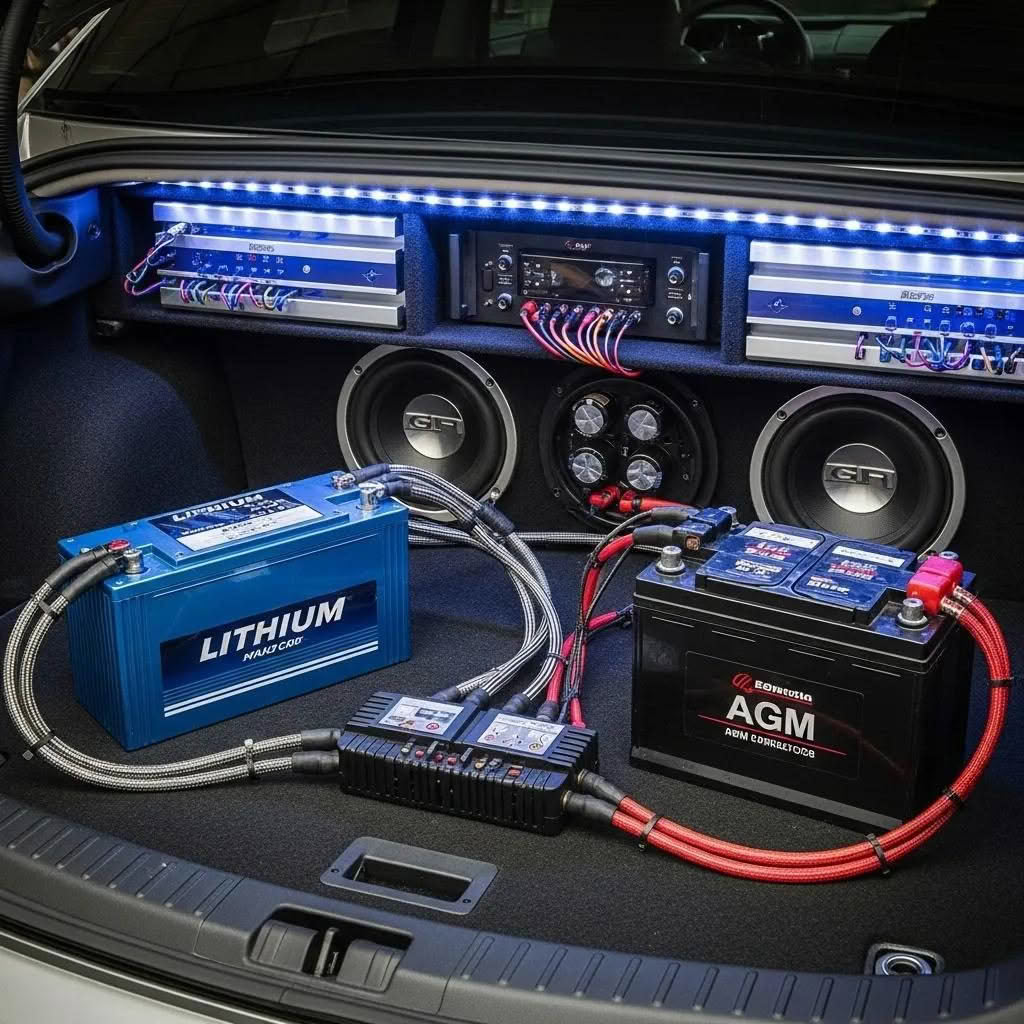
Mixing lithium and AGM batteries in a car audio system means pairing two different battery chemistries—typically LiFePO4 (or other lithium variants) with absorbed glass mat (AGM) lead-acid batteries—to meet both starting and deep-cycle energy demands. This guide explains when mixing is possible, why it can cause problems without proper isolation and management, and what practical wiring and alternator strategies prevent damage while maximizing audio performance. Readers will learn voltage behavior differences, wiring topologies including isolators and DC-DC chargers, clear safety practices around fusing and BMS requirements, and lifecycle/cost comparisons useful for deciding whether to upgrade. The article maps step-by-step wiring instructions, provides three entity-attribute-value (EAV) comparison tables, and offers troubleshooting flow steps for parasitic drains and alternator compatibility. By the end you’ll understand the electrical relationships between lithium and AGM banks, how to wire them safely, and how to size charging and alternator components to keep your car audio system stable under heavy loads.
Can You Mix Lithium and AGM Batteries in a Car Audio System?
Mixing lithium and AGM batteries is technically possible but requires safeguards to avoid cross-charging, accelerated degradation, and safety hazards; the core mechanism is that differing resting and charge voltages drive unwanted current flow between banks when they are not electrically isolated. Properly implemented isolation prevents the higher resting voltage of lithium from passively discharging into an AGM bank, and compatible charging profiles or dedicated charging devices ensure each chemistry receives the correct voltage and current. The immediate benefit of a mixed system is combining lithium’s high usable capacity and weight savings with AGM’s cost efficiency for starter or backup roles. Understanding the primary technical risks leads directly to specific wiring and device choices that neutralize those failure modes and preserve lifecycle value.
When deciding whether to mix chemistries, evaluate three practical conditions that must be satisfied:
- Isolation: Each battery bank must be electrically separated when the engine is off to prevent passive current flow.
- Charging compatibility: Alternator or charger must either be compatible with both chemistries or a device (DC-DC charger / smart isolator) must provide separate charge profiles.
- Battery management: Lithium banks must be protected by an appropriate BMS with disconnect thresholds and monitoring.
These three conditions form a simple decision checklist to determine if a mixed installation is safe and reliable; failing any one condition increases risk of damage and unexpected discharge. Assessing isolation, charge control, and BMS readiness clears the path to safe wiring, which is the next crucial topic.
What Are the Voltage Differences Between Lithium and AGM Batteries?
Lithium (LiFePO4) batteries typically present a nominal voltage around 12.8V with a relatively flat discharge curve and resting voltages often higher than equivalent lead-acid at similar state of charge; AGM lead-acid batteries have a nominal 12.0V and a steeper voltage-to-SOC relationship. The mechanism driving issues in mixed systems is simple: when two batteries with different open-circuit voltages are connected, current flows from the higher voltage bank into the lower until equilibrium is reached, causing parasitic discharge and unintended balancing. For example, a lithium bank at about 13.3V connected directly to an AGM at 12.6V can push current into the AGM overnight, which both wastes lithium cycles and can subject the AGM to inappropriate currents. Understanding these resting and charge voltage ranges helps explain why isolators or independent chargers are mandatory when mixing chemistries.
Transitioning from voltage behavior to operational risk analysis highlights why wiring topology and protective devices are essential components of a reliable mixed battery system.
What Are the Main Risks of Mixing Lithium and AGM Batteries?
The main risks when combining lithium and AGM batteries are parasitic discharge of the lithium bank into the AGM, incompatible charging profiles leading to over- or under-charging of one chemistry, and shortened service life or safety events if lithium cells become over-discharged or over-charged. In practice, a common failure scenario is a lithium house battery discharging into a lower-voltage AGM starter battery overnight, triggering deep discharge events on the lithium pack that the BMS must correct, and possibly breaching warranty or creating failure. Mitigation requires isolation devices, a BMS configured for automotive thresholds, and chargers that adapt to LiFePO4 charge curves or separate the banks for charging. Recognizing these risks informs the wiring choices covered in the next section, where isolators, DC-DC chargers, and correct fuse placement solve most real-world problems.
By understanding these risk vectors—parasitic drain, charge mismatch, and BMS dependency—you can plan wiring topologies that protect each bank and maintain audio performance.
How to Wire Lithium and AGM Batteries Safely in Your Car Audio Setup

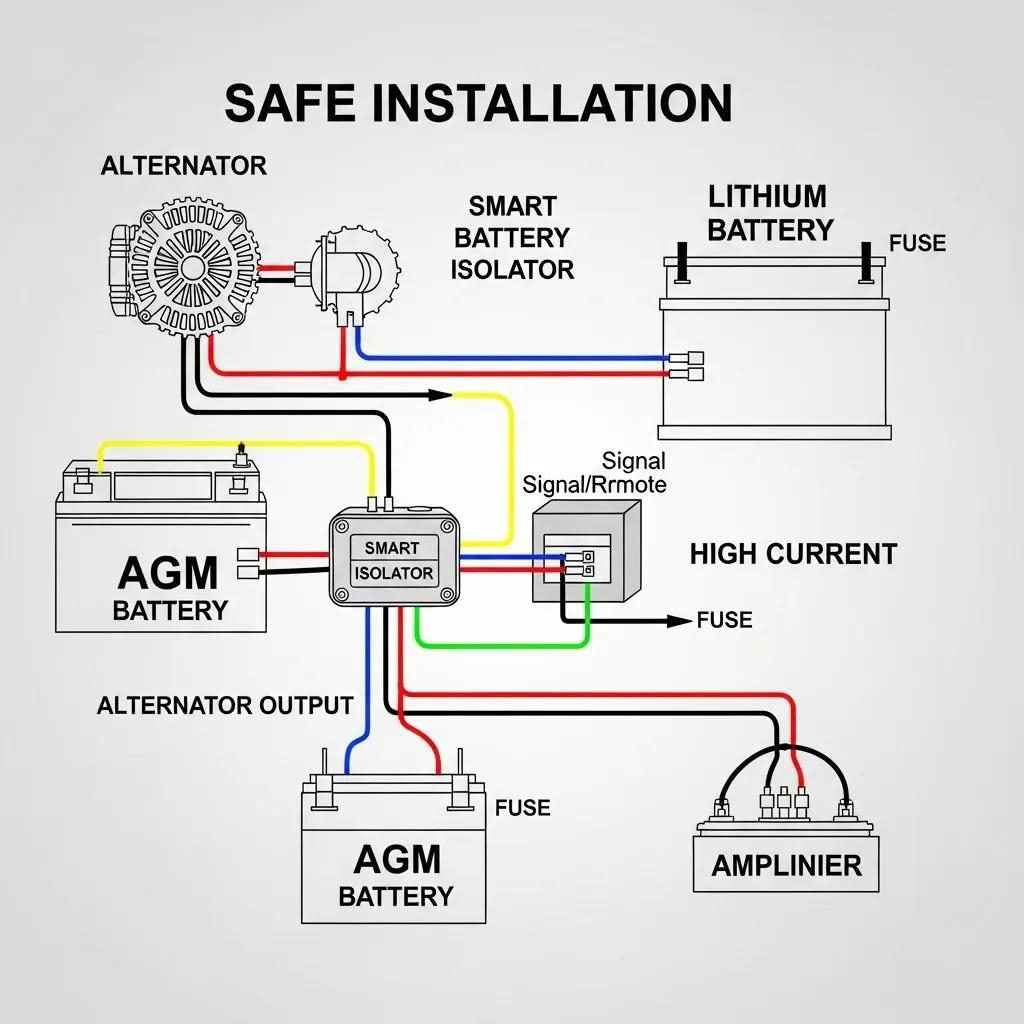
Safe wiring in mixed battery car audio systems is about controlling electrical pathways: isolate battery banks when appropriate, route alternator charging through devices that deliver correct charge profiles, and fuse each conductor to interrupt faults quickly. A properly executed wiring topology creates defined roles for the lithium house bank (deep cycle for amplifiers), the AGM starter/backup bank, the alternator/voltage regulator, and protective devices like isolators, bus bars, and high-current fuses. Implementing these principles improves voltage stability at the amplifier while preventing cross-bank current flow and reducing parasitic drain during vehicle off periods. The following step list describes a reliable wiring workflow to implement these protections in a typical trunk/under-hood layout.
- Disconnect and document: Remove keys, disconnect the negative terminal first, and trace existing wiring to document original grounds and runs.
- Place batteries and ground strategy: Mount the lithium house battery in a ventilated, secure location with a short thick ground return to a common chassis point; keep AGM starter near the engine bay.
- Install isolator/DC-DC charger: Use a high-current isolator or DC-DC charger between banks so each receives the correct charge voltage and the lithium bank has BMS-compatible input.
- Fuse and bus bars: Fuse each battery with an appropriately rated ANL/HEI or fuse block at the battery positive, and distribute loads through bus bars sized for peak amplifier current.
- Alternator wiring and sensing: Route alternator output through the isolator device or DC-DC charger; ensure voltage sensing leads return to the battery bank requiring regulation.
- Testing and validation: Reconnect negative last, measure resting voltages, start engine and verify charge voltages for each bank, and simulate amplifier load to confirm absence of cross-bank flow.
These numbered steps form a minimum safe wiring workflow that minimizes risk and lets you verify each functional milestone; each step prepares the system for the next diagnostic or protective layer. Proper wiring sets the stage for selecting the correct isolator type and understanding how isolators behave in mixed systems.
What Is the Role of a Battery Isolator in Mixed Battery Systems?
A battery isolator prevents cross-discharge between battery banks when the engine is off while allowing the alternator to charge both banks when running; isolators come as mechanical solenoids, diode banks, or solid-state relays (SSRs) and each type has trade-offs in voltage drop and control behavior. The isolator’s mechanism is to open the DC path between banks under no-charge conditions, stopping the higher resting voltage lithium bank from passively feeding the AGM. Selection criteria include continuous current rating matching amplifier peak draw, low voltage drop to avoid undercharging, and compatibility with alternator regulation or DC-DC chargers. Understanding isolator behavior leads naturally to step-by-step wiring instructions that ensure correct placement and fuse protection.
Sizing and choosing the correct isolator helps avoid unexpected current flow and simplifies alternator charging coordination, which the step-by-step wiring instructions below make concrete.
What Are the Step-by-Step Wiring Instructions for Lithium and AGM Batteries?
Follow this ordered procedure to install mixed battery wiring safely and validate operation under load. Begin by isolating and documenting, then physically mount batteries and fuse points, route heavy gauge wiring with proper terminations, and install the isolator or DC-DC charger between battery positives. Connect alternator output to the charging input of the isolator or DC-DC device using short runs and appropriate gauge, and ensure the lithium bank’s BMS has a charge input with proper precharge/fuse protection. After mechanical and wiring steps, perform voltmeter checks at rest, during engine running, and while applying an audio load to confirm proper charging behavior and lack of cross-bank current flow. Finally, secure and label all connections, and retest after a short road session to confirm no parasitic draw or voltage anomalies.
These ordered steps reduce installation errors and provide clear test points for verifying that isolation, charging, and protection devices are functioning as intended before returning the vehicle to normal use.
Lithium vs. AGM Batteries for Car Audio: Performance, Lifespan, and Cost Comparison
Comparing lithium (commonly LiFePO4) and AGM batteries for car audio shows clear differences in usable capacity, weight, charge speed, and cycle life; LiFePO4 typically delivers more usable amp-hours at lower weight and many more cycles, while AGM is often cheaper up front and robust for starter duties. The mechanism behind these differences is the lithium chemistry’s lower internal resistance and flatter discharge curve which sustains voltage under load, improving amplifier headroom and reducing clipping. For many audio systems the result is better perceived loudness and fidelity with lithium, but the trade-off is higher capital cost and the need for a BMS and compatible charging. Below is an EAV table that summarizes key attributes side-by-side to support decision making.
| Chemistry | Attribute | Value |
|---|---|---|
| LiFePO4 (Lithium) | Cycle life | ~2000–5000 cycles |
| LiFePO4 (Lithium) | Usable DoD (recommended) | 80–90% usable |
| LiFePO4 (Lithium) | Typical resting voltage | ~12.8–13.3V |
| AGM (Lead-acid) | Cycle life | ~200–800 cycles |
| AGM (Lead-acid) | Usable DoD (recommended) | 30–50% usable |
| AGM (Lead-acid) | Typical resting voltage | ~12.0–12.7V |
This table clarifies why lithium often yields lower cost-per-cycle and much lighter systems, while AGM remains a durable, lower-cost option for starter or occasional deep-cycle loads. Choosing between them depends on use case: mobile show systems and repeated deep-cycle use favor lithium, while budget or starter-heavy systems can justify AGM.
How Do Lithium Batteries Outperform AGM in Car Audio?
Lithium batteries outperform AGM by delivering a flat discharge voltage that maintains amplifier supply under heavy bursts, offering higher usable capacity per kilo and accepting faster charge currents from alternators or DC chargers; the key mechanism is lithium’s low internal resistance which supports higher instantaneous currents without severe voltage sag. Practically this means better amplifier headroom during bass hits, fewer audible dropouts, and quicker battery recovery between songs or events. Quantitatively, lithium can offer several times the cycle life and a 30–60% weight reduction compared to AGM banks of equivalent usable capacity. These performance distinctions explain why many advanced practitioners choose lithium for competition or frequent heavy-use audio systems.
Understanding lithium advantages leads into recognizing scenarios where AGM remains a sensible, cost-effective choice.
What Are the Advantages and Limitations of AGM Batteries in Car Audio?
AGM batteries remain attractive due to lower upfront cost, tolerance to vibration, and the ability to operate without a cell-level BMS; their sealed design and robustness under physical stress make them suitable for starter and occasional deep-cycle roles. The limitation is shallower usable capacity—AGM should not be regularly discharged beyond 30–50% without shortening life—and slower charge acceptance which can leave systems undercharged after long runs of high audio load. For budget builds, backup starter banks, or installations where upgrading alternator or charger systems is impractical, AGM is a sensible choice that trades long-term lifecycle cost for simpler system integration. These use cases frame when upgrading to lithium is justified, particularly where weight, usable capacity, and charge speed deliver measurable performance benefits.
Understanding charging and discharge cycles clarifies practical charger and alternator requirements for each chemistry.
How Do Charging and Discharge Cycles Differ Between Lithium and AGM?
Charging and discharge cycles differ in recommended voltages, depth-of-discharge, and charge acceptance rates; LiFePO4 typically charges to about 14.2–14.6V with higher current acceptance and safe frequent deep discharges, while AGM/lead-acid charges to about 14.4–14.8V but requires a less deep average DoD to preserve cycle life. The mechanism is chemistry-dependent: lithium cell balancing and lower internal resistance permit fast recharge and deep cycling, whereas AGM needs bulk/absorb/float stages and is prone to sulfation if left at low state of charge. Practically, this means alternator or charger programming should either supply a LiFePO4 profile or isolate banks and supply each bank its correct profile via a DC-DC charger or multi-stage charger.
These charging distinctions inform alternator configuration and whether a dedicated charger or smart isolator is necessary in a mixed system.
What Is a Battery Management System and Why Is It Essential for Lithium Batteries?

A Battery Management System (BMS) is an electronic control layer that protects lithium cells by monitoring voltage, current, temperature, and performing cell balancing; it prevents overcharge, over-discharge, and uncontrolled cell drift which are critical failure modes unique to lithium chemistries. The BMS’s mechanism includes disconnecting charge or load when thresholds are exceeded, balancing cell voltages during charge to equalize SOC, and providing overcurrent/thermal cutoffs to avoid cascade failures. For lithium in automotive audio use, a properly specified BMS preserves cycle life, allows safe high-current delivery, and provides remote monitoring or alerting for anomalous conditions. Understanding BMS functions is essential before integrating a lithium bank alongside an AGM bank, because the BMS dictates safe operational boundaries and interacts directly with isolators and alternator inputs.
Knowing how a BMS behaves under fault or charge conditions clarifies how it should be wired and tested in mixed setups.
How Does a BMS Protect Lithium Batteries in Mixed Setups?
In mixed setups the BMS protects lithium batteries by disconnecting the battery from charging or discharging when cell-level thresholds are crossed, by balancing cells during charge to prevent individual cell overvoltage, and by communicating or acting through remote cutoff signals to the isolator or charger to prevent harmful charging sequences. For example, if a lithium cell string approaches overvoltage during alternator charging, the BMS can open its charge relay and signal the isolator to stop further current, preventing cell damage. Important BMS features for mixed systems include adjustable disconnect thresholds compatible with automotive alternator voltages, precharge circuits to avoid large inrush currents to the BMS, and temperature monitoring to avoid charging in extreme conditions. These interactions mean BMS selection and configuration are central to a safe and durable hybrid installation.
These protective behaviors pair with system-level protections like fusing and correct alternator configuration to create a robust installation.
Can AGM Batteries Work Without a BMS in Hybrid Systems?
AGM batteries do not require a cell-level BMS because their sealed lead-acid construction lacks the independent cell balancing and overvoltage sensitivity of lithium packs; however, system-level protections—proper fusing, isolators, and smart charging devices—are still necessary to prevent damage and unintended interaction. The mechanism of protection for AGM in hybrid systems is achieved through correctly sized fuses and isolators that prevent cross-bank currents and through DC-DC chargers that deliver appropriate multi-stage charge profiles to the AGM bank. While AGM can function without a BMS, pairing it with a DC-DC charger or smart isolator is often recommended when it shares charging sources with lithium to ensure each chemistry receives its recommended charge algorithm.
This practical protection reduces warranty risk and extends AGM service life in hybrid configurations.
How to Optimize Alternator and Electrical System for Mixed Lithium and AGM Car Audio Batteries
Optimizing the alternator and electrical system involves matching alternator continuous output to amplifier and battery recharge demands, ensuring voltage regulation meets chemistry requirements, and stabilizing distribution with heavy gauge wiring and adequate capacitance. The alternator’s mechanism of action is to replace energy drawn by audio loads and recharge batteries; if alternator output is insufficient relative to peak current demands and recharge requirements, repeated voltage sag and slow recharge will shorten battery life and degrade audio performance. Techniques to optimize include using high-output alternators, adding capacitance or battery banks to buffer short peaks, and ensuring voltage sensing and regulator behavior align with the charging device architecture. Understanding when to upgrade the alternator requires simple current budgeting and monitoring under real load.
These alternator considerations inform concrete upgrade thresholds and measurement techniques described in the next subsection.
When Is an Alternator Upgrade Needed for Mixed Battery Systems?
An alternator upgrade is needed when sustained or repeated voltage sag occurs during typical use, when recharge times after events exceed acceptable windows, or when calculated system draw exceeds alternator continuous output by a significant margin. Use this checklist: measure amplifier RMS/peak draw during typical tracks, add accessory currents and charging needs, and compare to alternator continuous rating; if repeated sag under bass hits drops voltage below safe charging thresholds or you cannot restore battery SOC within drive intervals, upgrade is warranted. A simple example calculation compares amplifier peak current (amps = watts / system voltage) against alternator continuous current to reveal deficits. Alternatives include installing a second alternator, upgrading to a high-output unit, or adding energy storage (capacitors/battery bank) to reduce peak demands on the alternator.
These criteria tie back into wiring and battery decisions and the goal of maintaining stable voltage at the amplifier for reliable audio performance.
How Does Voltage Stability Affect Car Audio Performance?
Voltage stability affects amplifier headroom, distortion characteristics, and perceived loudness because amplifiers deliver power proportional to supply voltage; significant sag reduces available power, causes clipping, and introduces distortion that harms fidelity. Measurement steps include placing a voltmeter across the battery while playing representative bass passages and noting voltage under peak and average loads; expected voltage dips should stay within a safe window defined by amplifier and battery specs. Mitigation strategies are thicker wiring, larger bus bars, local capacitance (stiffening capacitors), and ensuring batteries are close to the amplifier to minimize supply impedance. Maintaining stable voltage not only improves sound quality but reduces thermal stress on amplifiers and electrical components.
Voltage stability considerations complete the chain from battery chemistry to wiring to alternator choices and lead naturally into troubleshooting and maintenance practices.
What Are Common Troubleshooting Issues When Mixing Lithium and AGM Batteries?
Common troubleshooting issues include parasitic drain that empties one bank overnight, charging mismatches where one bank is chronically undercharged or overcharged, and wiring or grounding faults that produce intermittent voltage drops or noise in the audio system. Diagnostic approach should be systematic: measure resting voltages per bank, inspect isolator/charger operation during engine running, and perform amp-draw tests with the vehicle off to identify parasitic draws. Corrective actions range from replacing faulty isolators, reprogramming or adding DC-DC chargers, repairing grounds, or adjusting BMS thresholds.
The next subsections provide diagnostic steps for parasitic drain and a maintenance schedule to extend hybrid system life.
How to Identify and Fix Parasitic Drain in Mixed Battery Systems?
Identify parasitic drain by first measuring each bank’s resting voltage after the vehicle has been off for several hours; typical expected resting voltages vary by chemistry but abnormal drops indicate drain. The diagnostic steps are: (1) disconnect the isolator to separate banks and remeasure to see which bank is draining, (2) perform a parasitic amp test at the fuse box to quantify draw and locate the circuit, and (3) inspect common culprits like aftermarket head units, amplifiers with remote turn-on faults, or poor grounds. Quick fixes include installing or repairing isolators, correcting grounding issues, and adding a low-current cutout relay for persistent accessory drains. When draws persist after these steps, involve a specialist to prevent damage to lithium BMS systems or AGM overdischarge.
These practical steps provide a clear path from detection to remediation and reduce the likelihood of unexpected failures in the field.
What Maintenance Practices Extend the Lifespan of Hybrid Battery Setups?
Routine maintenance for hybrid setups includes monthly resting voltage checks, quarterly BMS and isolator function tests, annual alternator output verification, and inspection of wiring and fuse integrity; these activities prevent small issues from becoming catastrophic failures. Specific tasks: verify BMS logs and firmware status where available, ensure isolator solenoids or SSRs operate cleanly under load, measure alternator voltage under load and no-load conditions, and check terminals for corrosion or loose connections.
Proper storage practices—keeping lithium at a partial state of charge and protecting batteries from extreme heat—also extend service life. Structured maintenance schedules and documented test values make troubleshooting faster and keep both lithium and AGM banks performing reliably.
Optimizing Alternator and Battery Systems for Fuel Economy: AGM and Li-ion Integration
ABSTRACT: The fuel economy of a vehicle can be improved by recuperating the kinetic energy when the vehicle is decelerated. However, if there is no electrical traction component, the recuperated energy can be used only by the other electrical systems of the vehicle. Thus, the fuel economy improvement can be maximized by balancing the recuperated energy and the consumed energy. Also, suitable alternator and battery management is required to maximize the fuel economy. This paper describes a design optimization process of the alternator and battery system equipped with recuperation control algorithms for a mid-sized sedan based on the fuel economy and system cost. A vehicle model using AVL Cruise is developed for cycle simulations and validated with experimental data. The validated model is used for the parametric study and design optimization of the alternator and battery systems with single and dual energy storage. In this paper, recuperation systems with Flooded, AGM, and Li-ion batteries are co
Design Optimization of alternator and battery systems with a recuperation control algorithm for a mid-sized sedan, S Kim, 2015