How to Calculate the Best Wire Size and Fuse Amperage for Your Car Stereo System
Introduction
Setting up a car stereo system that truly delivers requires more than just plugging in amplifiers and speakers. The foundation of any high-performance audio setup lies in calculating the correct wire size and fuse amperage for your specific power demands. Getting these calculations wrong can result in frustrating voltage drops, distorted sound, overheating components, and potentially dangerous electrical fires.
Whether you’re a weekend warrior tweaking your daily driver or an SPL competitor pushing thousands of watts, understanding these electrical fundamentals will make the difference between a mediocre system and one that performs at its peak. A quality car stereo battery serves as the heart of your system, but without proper wiring and protection, even the best power source won’t deliver optimal results.
This comprehensive guide walks you through the essential calculations needed to size your wiring and fuses correctly. You’ll learn how to assess your system’s true power requirements, choose between different wire types like OFC cable versus cheaper alternatives, and select appropriate fuse ratings that protect without limiting performance. We’ll also explore how advanced power solutions, particularly Evolution Lithium’s LTO battery banks with genuine SCiB cells, can simplify these calculations while providing superior voltage stability for demanding audio applications.
Understanding Your Car Audio System’s Power Demands
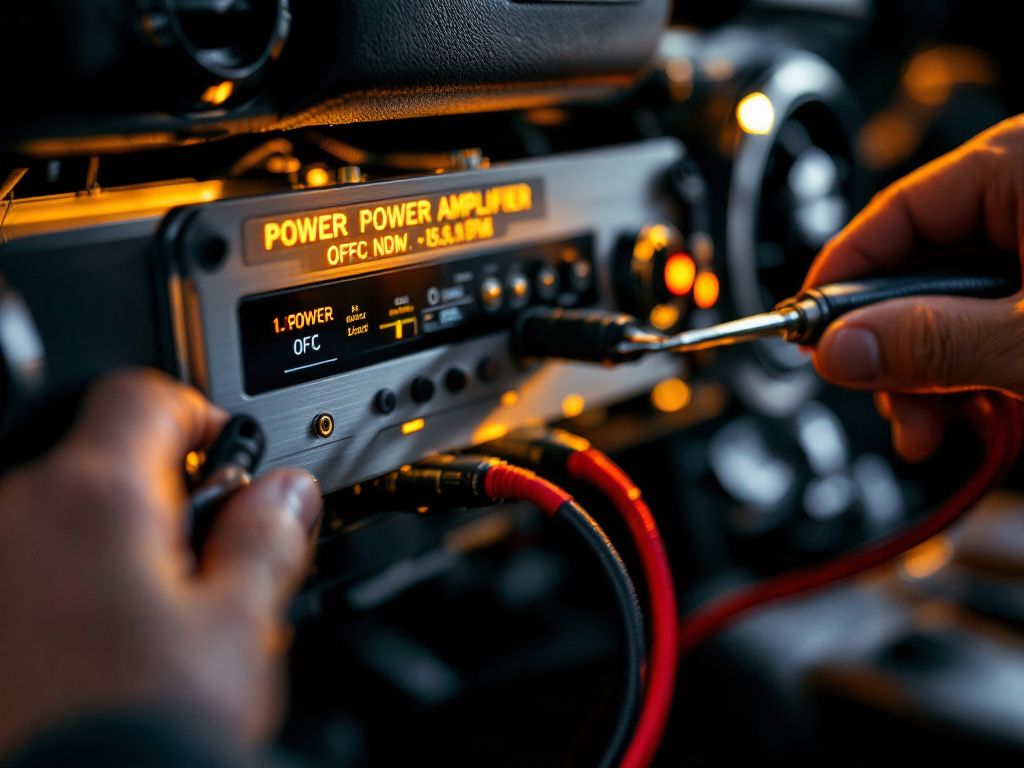
Before selecting any wiring or fuses, you need to accurately determine how much current your car stereo system will actually draw. This calculation forms the foundation for every other electrical decision in your installation.
The first step involves understanding the difference between RMS and peak power ratings. Always use RMS (Root Mean Square) power when calculating your system’s needs, not the inflated peak or maximum power numbers that manufacturers love to advertise. RMS represents the continuous power an amplifier can sustain, which directly correlates to the steady current draw your car stereo battery will need to supply.
To calculate total amplifier wattage, add up the RMS ratings of all amplifiers in your system. A four-channel amplifier rated at 50 watts RMS per channel contributes 200 watts to your total system power. If you’re running multiple amplifiers, sum their individual RMS outputs to get your complete power picture.
Amplifier efficiency significantly impacts actual current draw from your car stereo battery. Class D amplifiers typically operate at 80-90% efficiency, while Class A/B amplifiers manage around 60-70% efficiency. This means a 600-watt RMS Class D amplifier actually draws about 750 watts from your electrical system when accounting for inefficiency.
Class D amplifiers: 80-90% efficiency
Class A/B amplifiers: 60-70% efficiency
Here’s the current calculation process:
Calculate total RMS watts from all amplifiers
Divide by amplifier efficiency percentage
Divide result by system voltage (13.8V to 14.4V)
For example, that 600W RMS Class D amplifier at 80% efficiency running at 14.4V draws approximately 65 amperes: (600 ÷ 0.80) ÷ 14.4 = 52.08 amperes.
But what happens when your car stereo battery can’t maintain stable voltage under load?
Traditional lead-acid batteries experience significant voltage sag when supplying high current to powerful audio systems. This voltage drop forces you to oversize wiring to compensate for the additional resistance and power loss. Evolution Lithium’s LTO battery banks eliminate this guesswork by maintaining remarkably stable voltage even during extreme discharge cycles. Their genuine SCiB cells provide consistent 12.8V output regardless of current demand, making your wire size calculations more accurate and reliable.
The stability offered by these advanced LTO battery solutions means your carefully calculated wire sizes will perform as intended throughout your system’s lifespan. You won’t need to account for voltage degradation over time or inconsistent power delivery that plagues conventional battery technologies.
Choosing the Right Wire Size (Gauge)
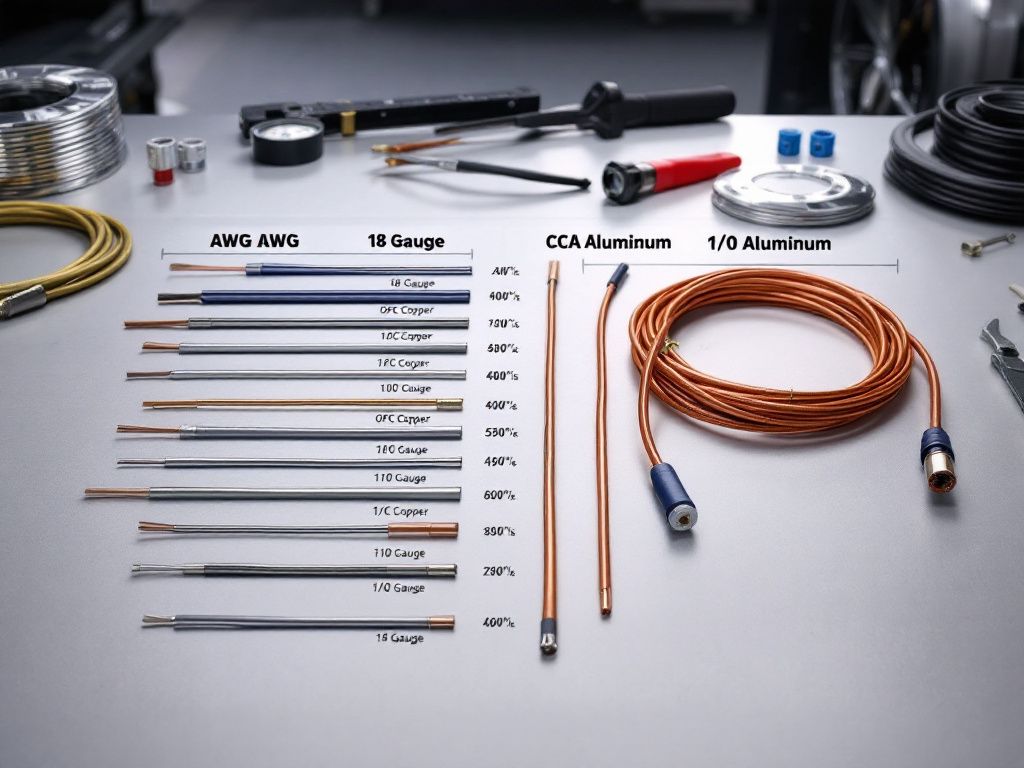
Selecting the proper wire gauge directly impacts your system’s performance, safety, and longevity. The American Wire Gauge (AWG) system uses inverse numbering – lower gauge numbers indicate thicker wires with less electrical resistance. This relationship becomes critical when delivering high current to power-hungry amplifiers.
The choice between Oxygen-Free Copper (OFC cable) and Copper-Clad Aluminum (CCA) significantly affects your system’s performance and safety. OFC cable, constructed from high-purity copper, offers nearly 100% conductivity with excellent resistance to corrosion, heat, and mechanical stress. This superior conductivity translates to minimal voltage drop and efficient power transfer, making OFC cable the preferred choice for serious car audio enthusiasts.
CCA wire presents a more budget-friendly option but comes with substantial compromises. The aluminum core provides only about 61% of copper’s conductivity, resulting in higher resistance, greater voltage drop, and increased heat generation. While CCA might work for lower-power applications, any system exceeding 500 watts RMS benefits dramatically from OFC cable’s superior performance characteristics.
Several factors influence your wire gauge selection beyond just material choice. Total current draw, calculated in the previous section, provides the primary sizing criterion. Wire length from your car stereo battery to amplifier locations also affects gauge requirements – longer runs demand thicker wire to maintain acceptable voltage drop levels.
Industry-standard wire gauge charts factor in both current capacity and distance to recommend appropriate AWG sizes. These charts typically specify that both power and ground wires should match in thickness to ensure balanced circuit performance. Common applications include:
18-12 gauge: Speaker connections
8 gauge: Moderate power systems (under 500 watts)
4 gauge: Mid-level amplifiers
1/0 AWG or 2/0 AWG: High-power competition systems (over 2000 watts RMS)
System Power (RMS) | Wire Distance | Recommended AWG | Wire Type |
|---|---|---|---|
Under 500W | Up to 10 feet | 8 AWG | OFC Cable |
500W – 1000W | Up to 15 feet | 4 AWG | OFC Cable |
1000W – 2000W | Up to 20 feet | 2 AWG | OFC Cable |
Over 2000W | Any distance | 1/0 or 2/0 AWG | OFC Cable |
Consider upgrading your vehicle’s “Big 3” wiring when installing high-power systems. This upgrade replaces the factory wiring with larger OFC cable for:
Battery positive to alternator positive
Battery negative to chassis ground
Engine block to chassis ground
These improvements reduce overall system resistance and support the increased electrical demands of powerful car audio systems.
Evolution Lithium’s LTO battery banks maintain such consistent voltage output that your initial wire sizing calculations remain valid throughout the system’s operational life. Unlike traditional batteries that degrade and require increasingly larger wire sizes to compensate for voltage loss, these SCiB-based systems preserve electrical performance characteristics that keep your installation running optimally for years.
Calculating the Correct Fuse Amperage
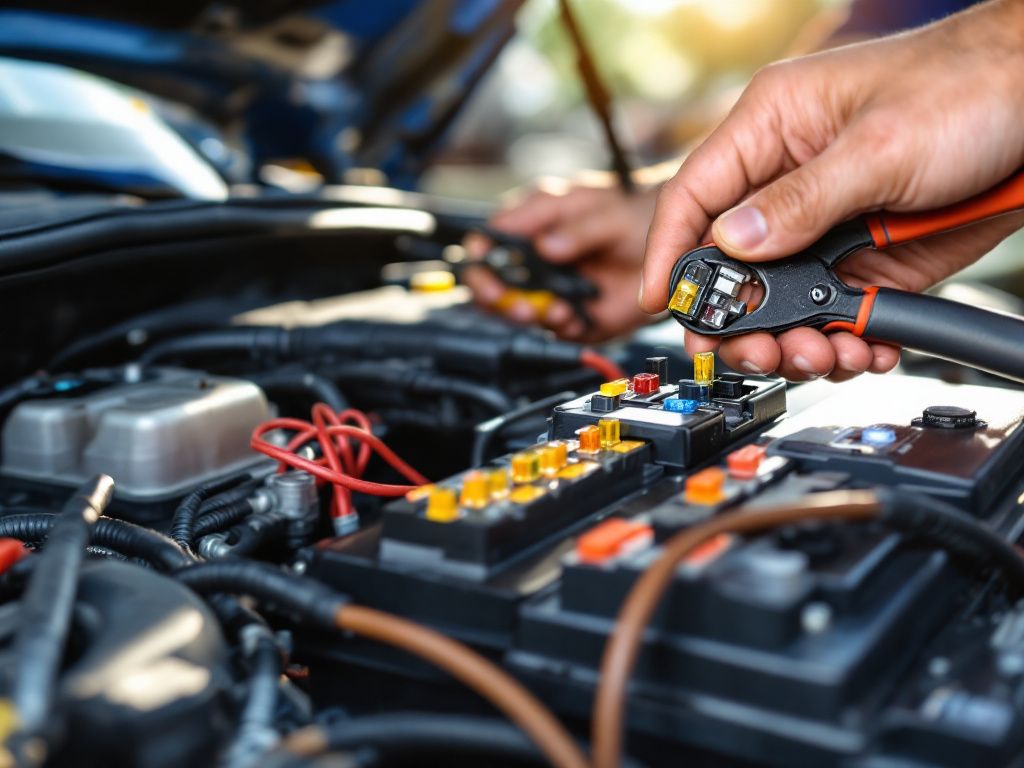
Fuses serve as the critical safety component protecting your entire electrical system from overcurrent conditions, short circuits, and potential fires. Installing the correct fuse amperage protects your investment while ensuring reliable operation under normal conditions.
The main power fuse must be positioned as close to your car stereo battery as possible, ideally within 18 inches of the positive terminal. Any wire section between the battery connection and fuse remains unprotected, creating a potential fire hazard if damaged. This placement ensures comprehensive circuit protection from the power source through your entire installation.
The fuse selection process follows these steps:
Check manufacturer recommendations
Calculate maximum continuous current draw
Select fuse rating slightly above maximum draw
Ensure rating stays within wire capacity
For instance, if your system draws 85 amperes maximum, a 100-ampere fuse provides appropriate protection without nuisance blowing during normal operation. When your calculated draw falls between standard fuse sizes, generally choose the next higher rating to prevent unnecessary fuse replacement while maintaining adequate protection.
Different fuse types serve various applications in car audio systems:
ANL and CNL fuses: High-current applications (over 100 amperes)
Mini ANL fuses: Compact packages for smaller installations
Multiway fuse holders: Multiple amplifier systems
Multiway fuse holders provide elegant solutions for systems with multiple amplifiers, allowing individual protection for each amplifier while maintaining centralized fusing at the main power input. Evolution Lithium offers quality multiway fuse holders designed to handle the high current demands of serious car audio systems while providing reliable long-term performance.
The consistent power delivery from Evolution Lithium’s LTO battery banks simplifies fuse selection by providing predictable current draw patterns. Traditional batteries with voltage sag characteristics can cause amplifiers to draw varying current levels, complicating fuse sizing decisions. With stable voltage from SCiB cells, your amplifiers draw consistent current, allowing precise fuse calculations that protect effectively without unnecessary safety margins.
Proper fuse sizing protects not only your equipment but also your vehicle’s electrical system and personal safety. The investment in quality fusing components pays dividends through reliable protection and peace of mind during high-power listening sessions.
The Role of Advanced Power Solutions: Evolution Lithium LTO Battery Banks
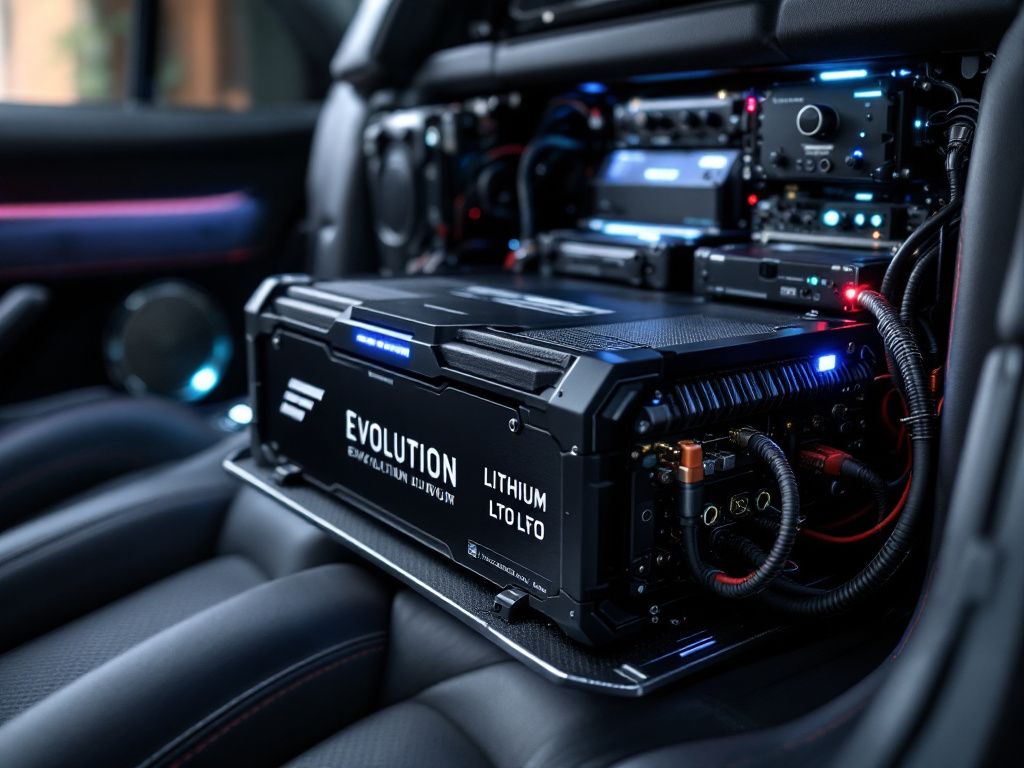
High-performance car audio systems demand power sources capable of delivering massive current without voltage instability. Traditional automotive batteries struggle under the extreme current demands of competitive SPL systems or high-output daily drivers, making advanced power solutions essential for serious enthusiasts.
Evolution Lithium’s LTO battery banks represent the pinnacle of automotive power technology, specifically engineered for the demanding requirements of car audio applications. Built around genuine SCiB cells from Toshiba, these battery banks maintain exceptional voltage stability even during extreme discharge cycles that would cripple conventional batteries.
The superior voltage stability offered by these LTO battery systems eliminates the guesswork from wire sizing and fusing calculations. While traditional batteries might sag from 12.6V to 10V under heavy load, Evolution Lithium’s SCiB-based systems maintain consistent voltage output throughout their discharge cycle. This stability means your carefully calculated wire sizes and fuse ratings perform exactly as intended, without the need to overcompensate for voltage drop.
LTO battery advantages include:
Exceptional voltage stability during discharge
Rapid charging capability
Extended cycle life (thousands vs. 500-1000 cycles)
High discharge rates up to 80C
Consistent performance throughout lifespan
The exceptional cycle life of LTO technology provides outstanding value for serious car audio enthusiasts. Where traditional batteries might last 500-1000 charge cycles before significant capacity loss, Evolution Lithium’s LTO battery banks endure thousands of cycles while maintaining their original performance characteristics. This longevity means your initial electrical system design remains valid throughout the battery’s operational life.
These battery banks excel in high-discharge applications, delivering peak currents that would stress or damage other battery technologies. The SCiB cells can sustain discharge rates up to 80C, providing the instantaneous current needed for dynamic musical passages or SPL competition runs. This capability ensures your amplifiers receive adequate power without voltage limitations that could cause clipping or distortion.
For systems exceeding 1500 watts RMS, pairing Evolution Lithium’s LTO battery banks with a high output alternator creates an optimal power delivery system. The alternator maintains the battery bank’s charge level during operation while the LTO cells handle peak current demands that exceed alternator capacity. This combination provides both sustained power for extended listening sessions and peak power for demanding musical passages.
The engineering expertise behind Evolution Lithium’s products shows in every detail, from the hand-assembled construction to the quality components used throughout each battery bank. These systems represent New Zealand’s premier source for high-performance automotive power solutions, backed by deep understanding of car audio requirements and commitment to superior performance.
Conclusion
Proper wire sizing and fuse amperage calculations form the foundation of any successful car audio installation. By accurately assessing your system’s power demands, selecting appropriate wire gauges with quality OFC cable, and sizing fuses correctly, you create a robust electrical foundation that supports optimal performance and safety.
The integration of advanced power solutions like Evolution Lithium’s LTO battery banks with genuine SCiB cells elevates your system’s capability while simplifying the design process. These battery banks provide the voltage stability and current capacity needed for demanding car audio applications, from daily-driven systems to competition-level SPL builds.
Remember that your car stereo battery serves as more than just a power source – it’s the heart of your entire electrical system. Investing in quality components and proper calculations ensures your audio system delivers the performance you expect while protecting your valuable equipment investment. With careful attention to these electrical fundamentals, your installation will provide years of reliable, high-quality sound reproduction.
FAQs
Q1: What is the main difference between OFC and CCA wire?
OFC cable uses pure copper throughout its construction, providing excellent conductivity with minimal resistance and superior corrosion resistance. CCA wire features an aluminum core with copper cladding, offering lower cost but significantly reduced conductivity (about 61% of pure copper) and higher resistance that can impact system performance, especially in high-power applications.
Q2: How often should I check my car stereo system’s fuses?
Fuses require minimal maintenance under normal conditions, but visual inspection during routine system maintenance helps identify potential issues. Check fuses immediately if you experience power problems, component failures, or unusual system behavior. Always replace blown fuses with identical amperage ratings to maintain proper protection.
Q3: Can I use a smaller gauge wire if my runs are very short?
Wire gauge selection should primarily match your current requirements rather than distance alone. While shorter runs reduce voltage drop, undersized wire can still overheat and create safety hazards even over short distances. Always consult reliable wire gauge charts that factor both current draw and distance for optimal performance and safety.