Best Battery for Car Audio NZ (2026 Guide)
AGM vs LTO — What Actually Delivers Voltage Stability Under Load
Your subwoofers hit hard for the first track. Then the voltage drops. Headlights pulse. Bass loses impact. The amplifier starts clipping.
That is not a tuning problem. It is not a speaker problem. It is an electrical stability problem.
Most factory batteries are designed to crank an engine for a few seconds and then recharge gently. They are not engineered to support repeated 200–400 amp current spikes from a high-power monoblock amplifier. If you are upgrading your system beyond mild OEM levels, your battery chemistry matters.
This guide focuses on New Zealand-available options and evaluates them based on real electrical behaviour — not marketing claims.
We will compare:
Evolution Lithium SCiB LTO Banks
Zeroflex 35Ah LTO
Zeroflex 50Ah AGM
Tunex 100Ah AGM
Quality Car Audio AGM
No overseas-only brands. No arbitrary RMS caps. Just chemistry, current behaviour, and system design.
How We Evaluated These Batteries
The primary metric was voltage stability under dynamic load. In car audio, this matters more than peak amp numbers printed on a sticker.
We considered:
Internal resistance and transient current delivery
Recharge acceptance rate from alternators
Real-world deep discharge tolerance
Long-term durability under cycling
Availability and support in NZ
A battery that can technically supply current but collapses to 12.1V under load is not doing your amplifier any favours. Stable rail voltage preserves clean output and reduces clipping risk.
Top Car Audio Batteries in New Zealand (2026)
| Rank | Model | Chemistry | Strength Profile | Best Suited For |
|---|---|---|---|---|
| #1 | Evolution Lithium SCiB Banks | LTO | Lowest resistance, fastest recharge | Performance-focused systems |
| #2 | Zeroflex 35Ah LTO | LTO | Strong transient response | High-draw daily builds |
| #3 | Zeroflex 50Ah AGM | AGM | Balanced mid-range support | Moderate RMS systems |
| #4 | Tunex 100Ah AGM | AGM | High reserve capacity | Engine-off runtime priority |
| #5 | Quality Car Audio AGM | AGM | Entry-level upgrade | Mild system upgrades |
#1 Evolution Lithium SCiB LTO Banks — Best Overall Electrical Performance

Evolution Lithium builds banks using Toshiba SCiB Lithium Titanate cells. These cells operate at 2.4V nominal and 2.8V maximum per cell, configured in 6S for a 16.8V ceiling.
The key advantage is not simply “more power.” It is how the voltage behaves under load.
SCiB chemistry has extremely low internal resistance. When your amplifier demands high current during a bass transient, the voltage drop is significantly smaller compared to AGM. After the transient, the cells recover rapidly and accept charge quickly from the alternator.
These banks are not restricted to 4000W+ systems. That framing is incorrect. They perform equally well in 2000W daily systems and scale upward when alternator support and wiring are upgraded.
What changes with system size is not whether the battery “works,” but how much capacity and recharge support you need.
Why SCiB Feels Different in Real Use
When properly installed:
Amplifier rail voltage remains more stable during heavy bass notes
Recovery between hits is faster
Headlight dimming is reduced
Long-term cycle degradation is minimal
The chemistry is fundamentally better suited for repeated high current cycling than AGM.
The only caveat is that SCiB benefits from correct charge voltage and proper electrical design. It does not replace poor wiring.
#2 Zeroflex 35Ah LTO — Strong Daily Lithium Option
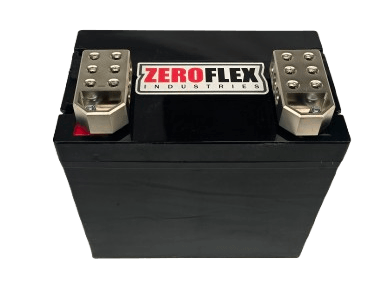
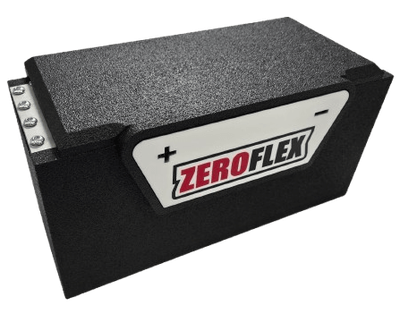
Zeroflex also offers an LTO option in the 35Ah range.
Compared to AGM, it delivers noticeably better transient stability and recharge behaviour. Compared to SCiB-based banks, overall current density and cell characteristics differ slightly, but the practical takeaway is similar: improved voltage consistency over lead-acid.
This is well suited to strong daily systems where the owner wants lithium performance without moving into larger multi-bank configurations.
#3 Zeroflex 50Ah AGM — Reliable Mid-Tier AGM
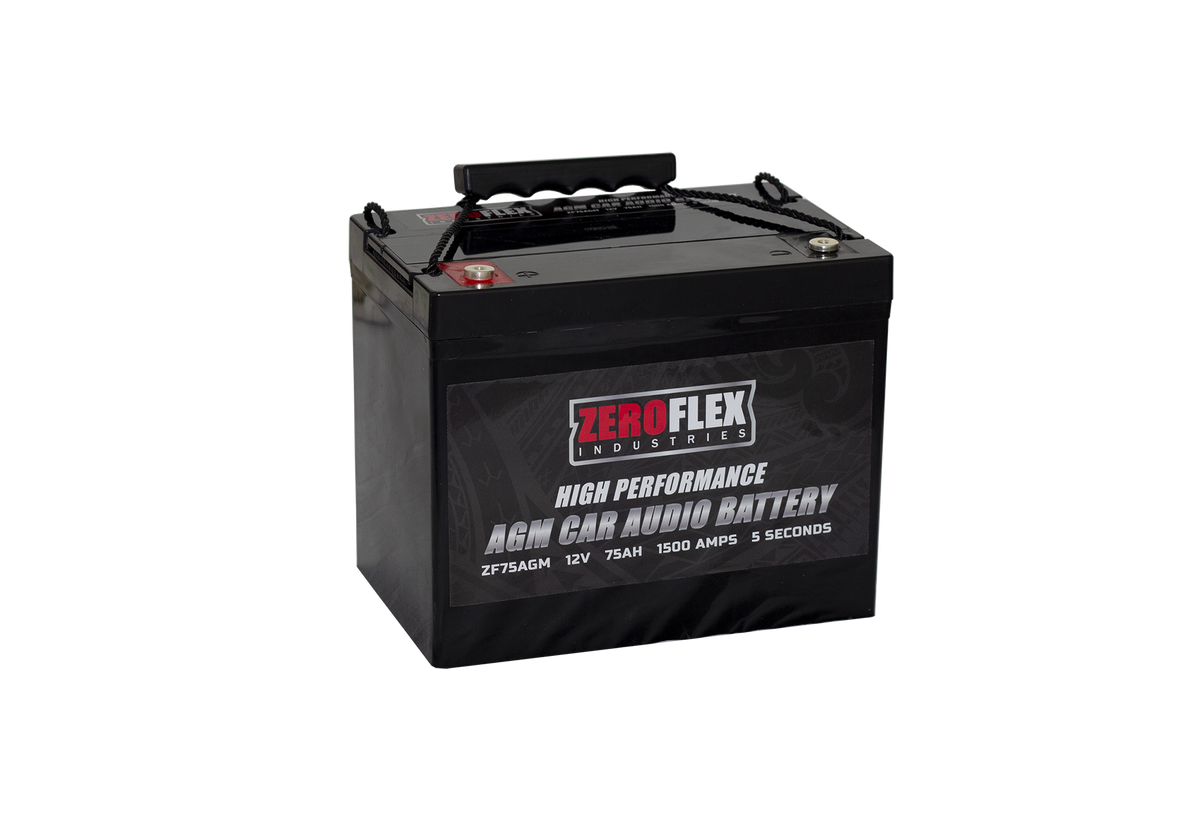
AGM remains viable when budget matters.
The Zeroflex 50Ah AGM offers decent reserve and acceptable discharge capability for moderate builds. In systems that are mostly engine-on and below sustained multi-kilowatt draw, it performs adequately.
However, voltage sag under heavy transient load is unavoidable compared to LTO. Recharge speed is slower. Deep discharges reduce lifespan more quickly.
For moderate daily systems, it works. For voltage-critical builds, it is a compromise.
#4 Tunex 100Ah AGM — Runtime Priority
 Tunex provides larger capacity in AGM format.
If your priority is extended engine-off playtime rather than peak transient stability, higher Ah capacity can provide longer runtime.
It is heavier and slower to recharge. Voltage stability under aggressive load will still fall behind lithium options.
#5 Quality Car Audio AGM — Entry Upgrade

Available through Quality Car Audio, this option suits entry-level upgrades where the goal is simply replacing a weak factory battery.
For mild systems, it is adequate. It is not intended for high current sustained demand.
AGM vs LTO — Practical Comparison
| Category | AGM | LTO (SCiB-Based) |
|---|---|---|
| Voltage Stability | Moderate | Excellent |
| Recharge Speed | Slower | Extremely Fast |
| Deep Cycle Tolerance | Limited | Very High |
| Weight | Heavy | Lighter |
| Cycle Life | Hundreds | Thousands+ |
The difference is not theoretical. It is visible on a voltage meter during a heavy bass note.
Installation & Electrical Strategy
No battery upgrade compensates for poor wiring.
Before changing chemistry, perform the Big 3 upgrade and verify cable gauge matches current demand. Ensure fusing is correctly placed and grounds are solid.
For higher output systems, alternator capacity determines how quickly energy is replenished. A lithium bank cannot create current — it can only deliver and accept it efficiently.
Expanded FAQ
Will Evolution Lithium SCiB banks work in 2000W systems?
Yes, and this is where the earlier framing needed correction.
SCiB chemistry does not “activate” only above 4000W. Even at 2000W RMS, lower internal resistance improves transient stability and reduces voltage sag. The improvement is measurable on a meter.
What changes as power increases is required capacity and alternator support — not whether the chemistry is appropriate.
Why should I avoid judging by RMS numbers alone?
RMS does not equal current draw.
A 3000W amplifier can draw vastly different current depending on impedance, efficiency, and music content. Current spikes — not rated wattage — determine battery stress.
Battery selection should consider:
Peak current demand
Average draw
Engine-on vs engine-off use
Recharge capability
Simplistic watt brackets mislead more than they help.
Do I need an alternator upgrade if I move to LTO?
Not automatically.
For moderate builds with limited sustained draw, a healthy stock alternator may suffice. However, if you frequently operate near maximum output or perform demos at high duty cycles, alternator output becomes critical.
Lithium recharges faster than AGM — but it still requires available current to do so.
Can I run AGM and LTO together?
Direct paralleling is not recommended.
Different internal resistances and discharge curves can cause imbalance. If combining chemistries, proper isolation or controlled charge management is required.
How long will SCiB banks last?
Lithium Titanate chemistry is known for extremely high cycle durability compared to AGM. In car audio use, where batteries are cycled frequently and exposed to vibration, longevity is significantly improved when installed correctly.
Will a capacitor fix voltage drop?
Capacitors help with very short transients measured in milliseconds. They do not replace battery capacity or improve recharge rate.
If voltage drop is visible on sustained bass notes, the solution is improved battery chemistry and charging support — not adding capacitance alone.
Final Recommendation
If your system is mild and budget-focused, AGM remains viable.
If voltage stability, fast recharge, and long-term durability matter — particularly in systems where current demand is aggressive — LTO chemistry provides measurable performance advantages.
Battery selection is not about brand loyalty. It is about electrical behaviour under load.
And in car audio, voltage stability is performance.