LTO Battery Banks: The Ultimate Guide to Lithium Titanate for Car Audio
This guide explains everything you need to know about LTO (Lithium Titanate Oxide) battery technology and why it’s the ultimate power solution for high-performance car audio systems.
What is an LTO (Lithium Titanate Oxide) Battery?
First, let’s clarify the acronym that’s causing a stir in the car audio world. LTO stands for Lithium Titanate Oxide, a unique and powerful type of rechargeable lithium battery. While most people associate “lithium” with their phones or laptops, LTO is a different beast altogether, engineered specifically for high-demand applications like competition-level car audio (SPL), electric vehicles, and grid storage.
Its power comes from its unique chemistry. Unlike traditional lithium-ion batteries that use carbon on the anode (negative) side, LTO batteries use an anode made of lithium titanate nanocrystals. This fundamental difference is the key to its incredible safety, ultra-long lifespan, and astonishingly fast charging capabilities.
The Science Behind LTO’s Superior Performance
The magic of an LTO battery is in its nanoscopic structure. The lithium titanate anode is structured like a crystal lattice, which dramatically increases its effective surface area. Think of it like a smooth highway versus a road network with thousands of on-ramps. This massive surface area allows electrons to move in and out with incredible speed and efficiency.
Furthermore, LTO is known as a “zero-strain” insertion material. This means the anode’s physical structure doesn’t expand or contract significantly during charging and discharging cycles. This structural stability is why LTO batteries can endure tens of thousands of cycles without degrading, unlike other batteries that wear out from mechanical stress. This also contributes to its excellent performance across a wide range of temperatures.
Why SCiB™ Cells Are the Gold Standard
Not all LTO cells are created equal. The pinnacle of LTO technology is Toshiba’s SCiB™ (Super Charge ion Battery). These cells are globally recognized for their unparalleled performance, rigorous quality control, and proven safety record in demanding industrial applications.
At Evolution Lithium, we exclusively use genuine, new Toshiba SCiB™ cells in every hand-assembled battery bank. This commitment to quality ensures our customers receive a power source that delivers on its promises. Be wary of unbranded, recycled, or counterfeit LTO cells on the market; they lack the safety certifications and performance consistency of genuine SCiB™ technology.
The 5 Key Advantages of LTO for Car Audio Systems
So, what does all this science mean for your sound system? It means solving the most common and frustrating problems that plague car audio enthusiasts.
1. Unbeatable Voltage Stability: The End of Dimming Lights
The most notorious problem in high-powered car audio is voltage sag. When your bass hits hard, your amplifier demands a huge rush of current. A weak battery can’t supply it fast enough, causing the system’s voltage to drop. This leads to dimming headlights, amplifiers clipping (which can damage speakers), and inconsistent sound.
LTO batteries maintain an incredibly stable and high voltage, even under the most brutal loads. Their low internal resistance allows them to discharge massive amounts of current instantly without flinching. This means your amplifiers get the clean, consistent voltage they need to perform at their peak, giving you louder, clearer, and more dynamic sound.
2. Extreme Power Density & Rapid Charging
Power density refers to a battery’s ability to discharge and recharge a massive amount of current relative to its size. LTO is the undisputed champion here. An LTO bank can absorb energy from your high-output alternator far faster than any AGM or standard lithium battery.
This means your alternator works more efficiently, and your battery recovers almost instantly between heavy bass notes. For SPL competitors, this is a game-changer, allowing for powerful, consecutive burps without waiting for the voltage to recover.
3. Incredible Lifespan: 20,000+ Cycle Life
A battery “cycle” is one full charge and discharge. Here’s how LTO stacks up against the competition:
AGM/Lead-Acid: 300-700 cycles
Standard Lithium-ion (LiFePO4): 2,000-5,000 cycles
LTO (Lithium Titanate): 20,000+ cycles
An Evolution Lithium LTO bank is a long-term investment. While the upfront cost is higher than AGM, it will outlast dozens of them, saving you money and hassle over the life of your system. It’s the last car audio battery you’ll likely ever need to buy.
4. Superior Safety and Thermal Stability
The “lithium” name often causes concern about fires, but LTO chemistry is fundamentally different and vastly safer. The lithium titanate anode is highly resistant to thermal runaway, the chain reaction that causes other lithium batteries to overheat and catch fire when damaged or short-circuited.
While LTO has a very wide operating temperature range, we do not recommend under-bonnet installation. The extreme, sustained heat of an engine bay is detrimental to the long-term health and safety of any lithium battery chemistry. For maximum performance and longevity, your LTO bank should be installed in a cooler, well-ventilated area like the cabin or boot.
LTO vs. AGM vs. Other Lithium: A Technical Showdown
Choosing the right battery technology can be confusing. Here’s a straightforward comparison focused on what matters for car audio.
LTO vs. AGM/Lead-Acid: The Old Guard vs. The New King
This isn’t a fair fight. AGM was a great technology for its time, but it simply can’t compete with LTO in a high-performance audio environment. LTO is lighter, provides vastly superior voltage stability, has a lifespan that’s over 30 times longer, and can handle far more power. While AGM has a lower upfront cost, its poor cycle life and performance issues make it the more expensive option in the long run.
LTO vs. LiFePO4 / LFP: The Lithium Civil War
LiFePO4 (Lithium Iron Phosphate) is a popular and capable lithium chemistry, often used in off-grid and marine applications. It’s a huge step up from AGM. However, when it comes to the extreme discharge demands of car audio, LTO has the clear advantage. LTO has a significantly higher C-rating (charge/discharge capability) and performs better in cold weather. For enthusiasts who need the absolute best voltage stability and power delivery, LTO is the specialised, superior choice.
Comparison Summary Table
| Feature | LTO (Lithium Titanate) | LiFePO4 (LFP) | AGM (Lead-Acid) |
|---|---|---|---|
| Voltage Stability | Excellent | Good | Fair |
| Lifespan (Cycles) | 20,000+ | 2,000-5,000 | 300-700 |
| Safety | Excellent | Good | Fair |
| Weight | Excellent | Excellent | Poor |
| Upfront Cost | High | Medium | Low |
System Requirements: Is Your Car Ready for an LTO Upgrade?
An LTO battery is a powerful component, but it works best as part of a well-planned electrical system. Dropping one into a stock setup without the right supporting upgrades will only create a bottleneck.
The Role of a High-Output Alternator
To take full advantage of LTO’s rapid charging, you need an alternator that can supply enough current. Stock alternators are designed to run the car’s electronics and slowly top off a lead-acid battery. They are completely insufficient for serious audio systems. A high-output alternator is essential to keep your LTO bank charged and your system playing at its full potential.
Why the ‘Big 3’ Upgrade is Non-Negotiable
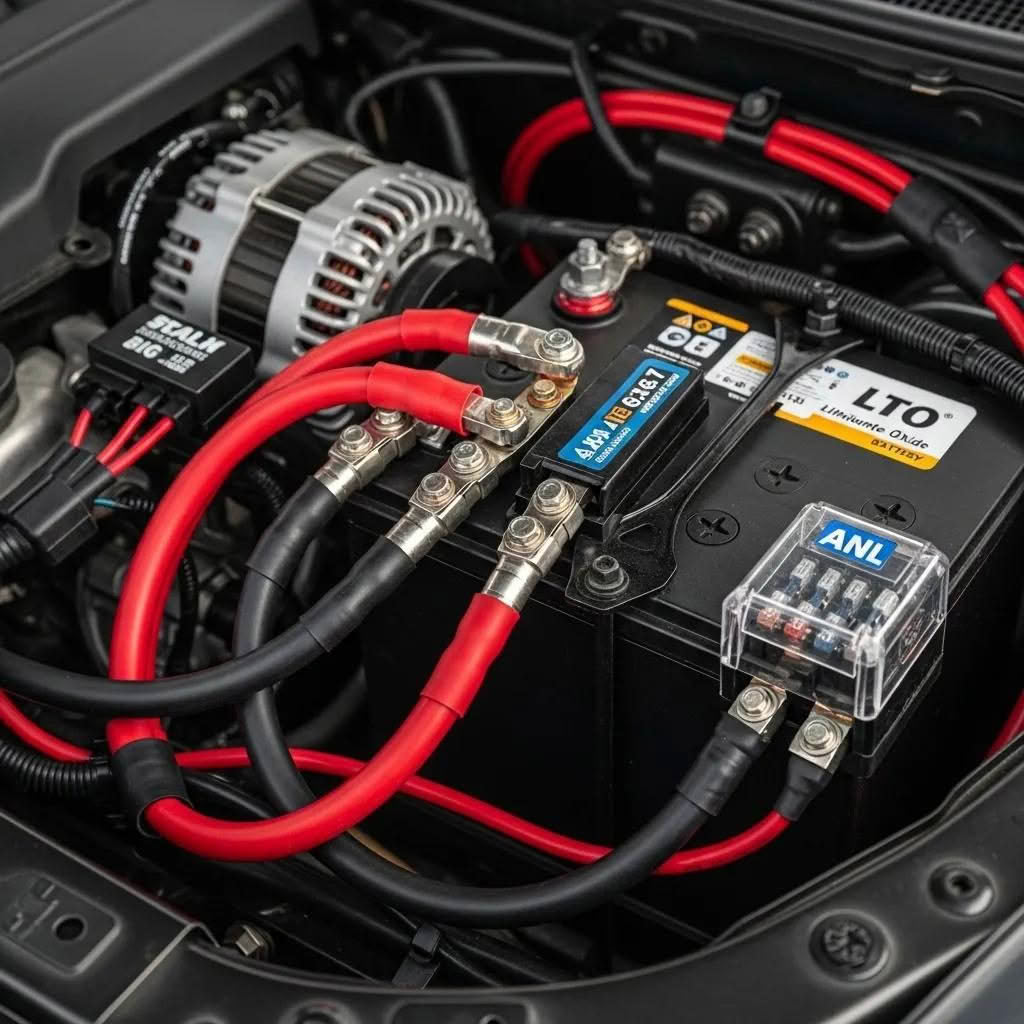
The “Big 3” is a foundational wiring upgrade that every serious car audio enthusiast must perform. It involves upgrading three key cables:
Alternator positive to battery positive
Battery negative to the vehicle’s chassis
Engine block to the vehicle’s chassis
This upgrade replaces thin, restrictive factory wires with thick, low-resistance cable (like 0-gauge OFC), ensuring that power can flow freely from your alternator to your battery and throughout the system. Without the Big 3, you are choking your LTO bank’s ability to perform.
Who Needs an LTO Battery Bank?
LTO is the ultimate solution for:
SPL Competitors: Needing maximum power for short, intense bursts.
“Bass Heads”: Demanding extreme power for ground-pounding daily systems.
High-Fidelity Enthusiasts: Seeking the cleanest possible power for their amplifiers.
If you have a stock or low-power system (under 1500W RMS), an AGM battery may be sufficient. But if you’re serious about performance and tired of voltage sag, an LTO bank is the single best electrical upgrade you can make.
Unsure what your system needs? Contact us for expert advice!
Sizing and Choosing Your Evolution Lithium LTO Bank
Now that you understand the technology, let’s get practical. Choosing the right size bank is crucial for system performance.
Matching Your Bank to Your System’s Goals
Sizing an LTO bank isn’t about a simple, universal formula. It’s about matching the battery’s capability to your specific goals, system power, and alternator output.
For Daily Music Systems: The primary goal is often to supplement the alternator and eliminate voltage sag during heavy bass notes. A smaller bank (e.g., 30Ah-40Ah) paired with a robust high-output alternator is often the perfect combination.
For SPL & Demo Systems: The goal is massive reserve capacity for “engine off” demos or competition burps. This requires a larger bank (60Ah and up) that can supply the system’s full current draw on its own.
Because every system is unique, the best approach is to get a personalized recommendation. Tell us your RMS power, your alternator’s amperage, and what you want to achieve, and our experts can help you choose the perfect bank.
The Evolution Lithium Difference: Hand-Assembled in NZ
Every Evolution Lithium battery bank is meticulously hand-assembled with care in Blenheim, New Zealand. We don’t cut corners.
Genuine Toshiba SCiB™ Cells: We only use new, A-grade cells for maximum performance and longevity.
Solid aluminum Bus Bars: We use thick, solid for all connections to ensure minimal resistance and maximum current flow.
Heltec Balancing Boards: Each bank includes an active balancing board that monitors the cells, ensuring they remain perfectly balanced for optimal health and a long service life.
Installation and Charging Best Practices
To get the most from your LTO bank, follow these guidelines:
Secure Mounting: Ensure the bank is securely mounted in a location free from excessive vibration and heat.
Optimal Charging Voltage: While our LTO banks will charge on a standard alternator voltage (13.8v-14.8v), the optimal charging voltage for Toshiba SCiB™ cells is 15.6v – 15.9v. Achieving this range with a voltage-adjustable high-output alternator will unlock the absolute fastest recharge rates and peak battery performance. No special external charger is needed for in-car use, but your alternator is key. However its handy to have a 10a 30v DC adjustable power supply for charging if needed.
Frequently Asked Questions
Can I mix an LTO battery with my existing AGM battery?
It is not recommended. Different battery chemistries have different charging and discharging characteristics and voltages. Running them together can lead to one battery overworking or undercharging the other, reducing the performance and lifespan of both.
What is ‘voltage sag’ and how does an LTO battery fix it for car audio?
Voltage sag is a temporary drop in your car’s electrical system voltage when your amplifiers draw a large amount of current for a heavy bass note. LTO batteries have extremely low internal resistance, allowing them to deliver massive current instantly without the voltage dropping, which keeps your amps fed with stable power.
Do I need a special charger for an LTO battery bank?
For in-car use, no special external charger is required. We recommend a 10a DC adjustable power supply. The bank charges from your alternator. However, to achieve the fastest charging and best performance, your alternator should ideally be set to charge between 15.6v and 15.9v. Standard 14.4v systems will charge the bank, but at a lower state orlf charge (capacity).
How long do
Evolution Lithium LTO batteries actually last?
The Toshiba SCiB™ cells we use are rated for over 20,000 charge/discharge cycles. For a car audio application, this translates to an incredibly long service life. It is truly a “buy it for life” component for your audio system.
Are LTO batteries safe to install under the bonnet of my car?
No. We strongly advise against installing any lithium battery, including LTO, in the engine bay. While LTO is exceptionally stable, the extreme and sustained heat from an engine can degrade the battery’s cells over time, reducing its lifespan and compromising its long-term safety.
What’s the difference between LTO and a LiFePO4 battery for car audio?
Both are excellent lithium technologies. However, LTO is superior for high-current car audio applications due to its higher discharge rate (C-rating), much longer cycle life, and better voltage stability under extreme loads. LiFePO4 is a great general-purpose battery, but LTO is the specialist for serious power demands.
Explore Our Hand-Assembled LTO Battery Banks
Every unit is hand-assembled with care in New Zealand
Built with genuine, high-performance m SCiB cells
Trusted by SPL competitors and car audio enthusiasts across NZ