 Skip to content
D.I.Y Car Audio Lithium Batteriy breakdown
How to Build a DIY Car Audio Lithium Battery for High-Performance Sound Systems
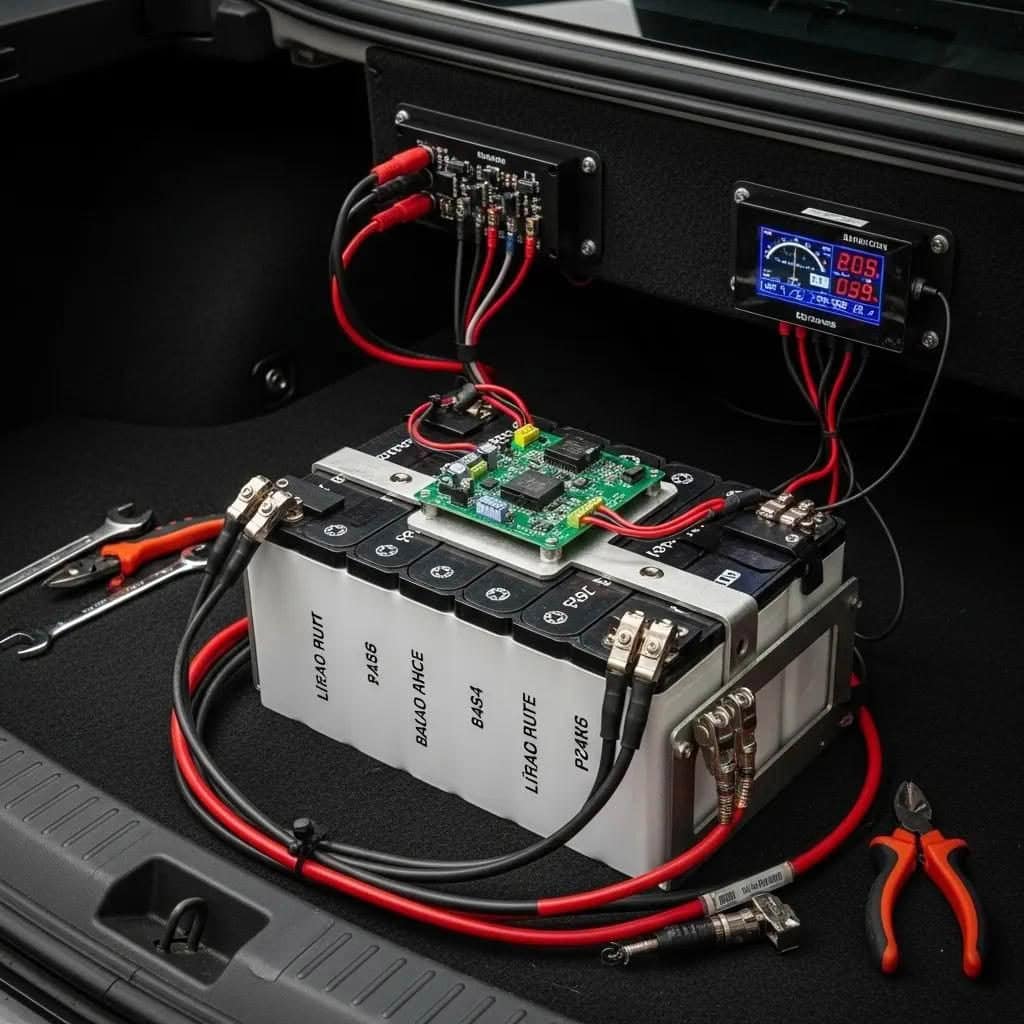
Building a DIY car audio lithium battery pack gives high-performance sound systems a compact, high-current energy source that maintains stable voltage under heavy transient loads. This guide explains what a DIY car audio lithium battery is, why chemistries like LiFePO4 and LTO matter for audio, and how correct wiring, BMS selection, and charging practices prevent voltage sag and improve amplifier performance. Many installers and enthusiasts face problems such as alternator compatibility, rapid voltage drop during bass hits, and premature cell imbalance; a properly designed lithium pack addresses these by combining appropriate cells, robust busbar wiring, and a matched battery management system. You will learn how to choose between LiFePO4 and LTO for common use-cases, step-by-step pack assembly with safety checks, correct wiring and fusing practices, BMS selection and active balancing options, and charging and maintenance strategies that preserve cycle life and performance. Throughout the article we use terms like prismatic lithium cells, BMS, C-rate, and DC-DC chargers to keep technical guidance precise and actionable for DIY builds.
Which Lithium Battery Chemistry Is Best for DIY Car Audio: LiFePO4 vs. LTO?
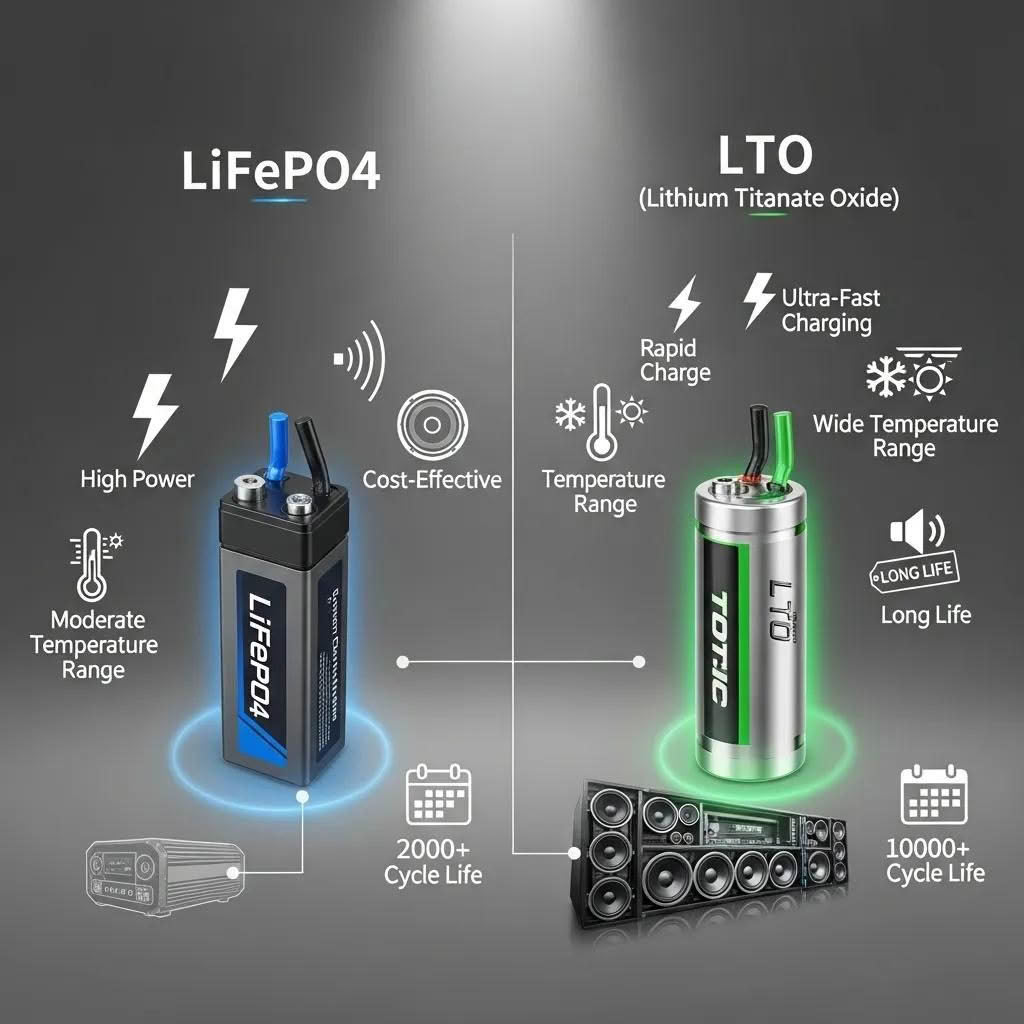
LiFePO4 (lithium iron phosphate) and LTO (lithium titanate oxide) are two lithium chemistries with distinct tradeoffs for car audio: LiFePO4 offers excellent safety, long cycle life, and moderate charge rates, while LTO provides ultra-fast charge/discharge capability and extreme cycle endurance at higher cost and lower nominal voltage. The mechanism that matters for audio is internal resistance and allowable C-rate; lower internal resistance and higher continuous/peak C-rates reduce voltage sag during amplifier transients and improve headroom. For most daily drivers and serious audio hobbyists, LiFePO4 balances safety, cycle life, and cost; for competition rigs that require rapid recharge between runs or very aggressive peak currents, LTO can be superior despite the price and weight penalty. Below is a concise comparison table to clarify typical metrics and help you decide which chemistry fits your intended use-case.
This comparison shows LiFePO4 is generally the practical choice for most DIY car audio packs because it delivers a strong balance of safety, usable cycle life, and cost-effectiveness, while LTO is reserved for specialized rapid-charge or extreme-duty applications.
What Are the Key Benefits of LiFePO4 Car Audio Batteries?
LiFePO4 chemistry yields compelling benefits for car audio systems because it combines thermal stability, robust safety characteristics, and a long useful cycle life, which together reduce long-term ownership costs and fire risk. The chemistry’s relatively low internal resistance maintains higher terminal voltage during amplifier transients, which translates to better headroom and consistent SPL performance under demanding playback. Typical LiFePO4 cells used in automotive audio come in prismatic formats with capacities suited to audio banks (e.g., medium-to-high Ah ratings) and continuous/discharge ratings adequate for long bass bursts when properly paralleled. Because LiFePO4 tolerates deeper discharge cycles than lead-acid without rapid degradation, it also reduces the need for overly large battery banks in many installations, which simplifies enclosure design and reduces vehicle weight. Understanding these advantages helps determine pack sizing and protection strategies for safe, reliable audio performance.
The unique properties of LiFePO4 chemistry, including its long cycle life and improved safety, make it a strong contender for high-performance applications.
How Does LTO Chemistry Enhance Fast Charging and Power Delivery?
LTO’s defining characteristic is its ability to accept very high charge and discharge currents while sustaining many more cycles than most other lithium chemistries, which directly benefits competition-level car audio where short recharge windows or repeated high-current events are common. Mechanistically, LTO cells have a more resilient anode structure that lowers degradation under rapid cycling and reduces risk of thermal runaway, allowing designers to push higher C-rates for both charge and discharge. The tradeoffs are higher cost per Ah and lower nominal cell voltage, which can require more cells in series or different pack topologies to reach 12V-class systems; these tradeoffs are often acceptable for teams needing rapid turnaround and durability. For everyday installations where recharge time and extreme cycle counts are not primary concerns, LiFePO4 remains the cost-effective recommendation, but for specialized fast-charge needs, LTO delivers unique performance benefits worth the premium.
How Do You Build a DIY Car Audio Lithium Battery Pack Step-by-Step?
A safe DIY build follows a strict sequence: select cells and BMS to match required Ah and continuous/peak currents, mechanically assemble cells with vibration-resistant mounts and insulated busbars, wire the pack with appropriately sized conductors and fuses, perform initial balance charging and verification, and finally test under realistic audio loads while monitoring temperatures and voltages. Proper sequencing reduces the risk of shorts, imbalance, or cell damage: mechanical work first, then low-voltage electrical checks, then BMS wiring, then controlled initial charge and balance.
This section provides a step-by-step workflow and an itemized components checklist so your build stays repeatable and auditable.
The parts list below explains required components and minimum recommended specs.
- Prismatic lithium cells sized to meet Ah and C-rate requirements, typically matched within the same batch for voltage and internal resistance.
- Battery Management System (BMS) rated for pack current and cell count with balancing capability and protections for over/under-voltage, temperature, and short circuit.
- Bus bars or copper/Aluminum braided straps, insulated standoffs, and vibration-damping mounts to secure cells.
- Main fuse, fuse holder, and appropriate ring terminals plus heavy-gauge wire sized to peak current.
- Enclosure with thermal consideration, fire-resistant separators, and service access for monitoring leads.
What Components Are Needed for a DIY Lithium Battery Pack?
A reliable pack combines matched prismatic cells, a BMS sized to expected continuous and peak currents, and mechanical parts that control vibration and thermal behavior; those components together define pack performance and safety. Cells should be sourced with consistent specifications — nominal voltage and Ah rating — and selected for a minimum continuous discharge rating that exceeds expected amplifier draw plus headroom for peaks. The BMS must support cell count and provide active or passive balancing, overcurrent and temperature protections, and, if desired, communication outputs for monitoring. Mechanical essentials include a rigid enclosed box with ventilation or heat paths, insulated bus bars, non-conductive separators between cells, and secure mounting points to handle vehicle vibration. Selecting quality connectors, an appropriate main fuse, and monitoring taps completes the parts list and prepares the build for assembly and balancing steps described next.
The mechanical properties of prismatic Li-ion batteries are a critical consideration for designing robust battery packs capable of withstanding demanding operational conditions.
How Do You Assemble and Balance Prismatic Lithium Cells Safely?
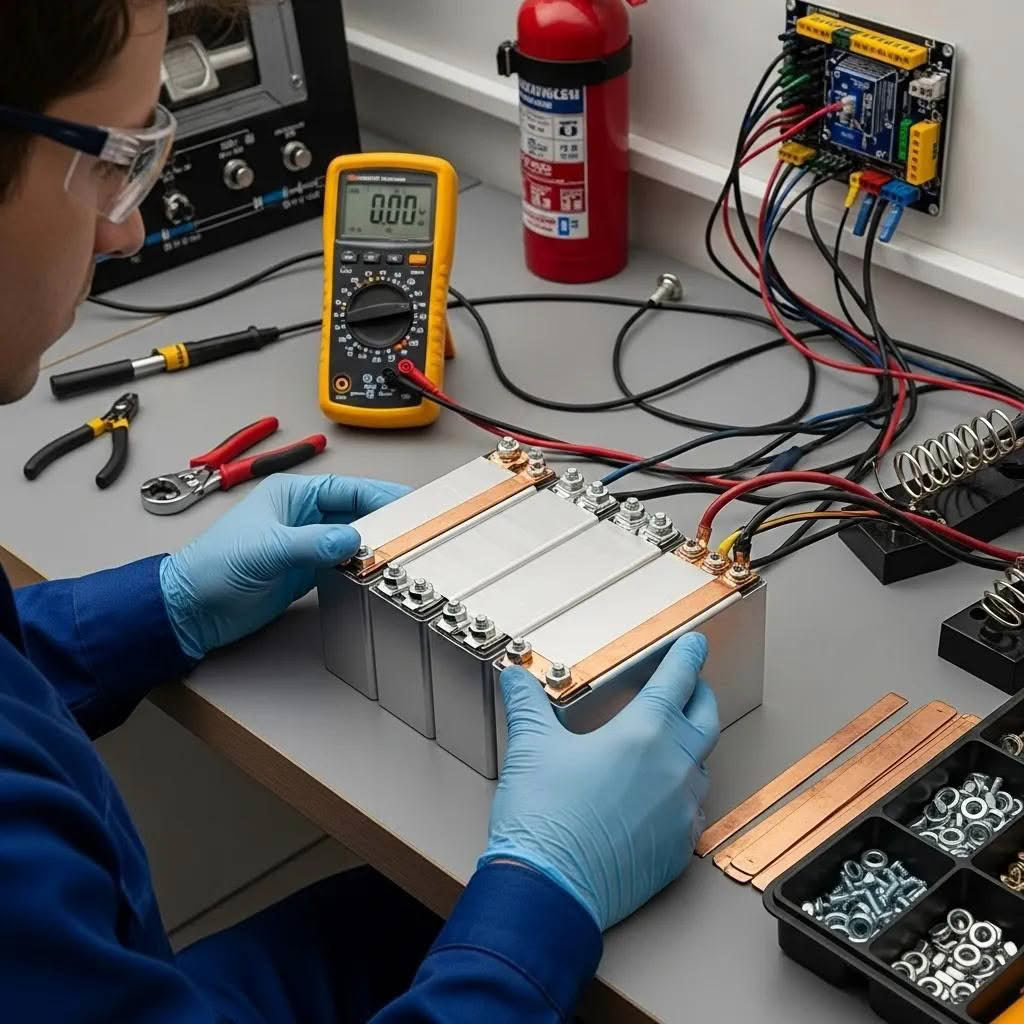
Assembling prismatic cells begins with careful orientation so all positive and negative terminals align consistently; spacing and vibration isolation protect cell cans from physical stress that accelerates failure. Use insulated bus bars or welded/bolted copper straps sized for expected peak current and follow torque specs if bolting bus bars; always insulate exposed connections with heat-shrink or mechanical covers to prevent shorts. After mechanical assembly, wire the BMS per manufacturer wiring diagrams, route temperature sensors to representative cell locations, and perform a low-voltage continuity and isolation check before connecting the pack to a charger. Initial balancing involves a controlled charge with the BMS and balancer active until all cell groups report equal voltage within a few millivolts; verify balance under a light load and then proceed to full-load testing while monitoring cell voltages and temperature to ensure stable operation.
How Do You Wire and Fuse a DIY Car Audio Lithium Battery System?
Correct wiring and fusing are critical to both system safety and minimizing voltage loss under high current. The canonical wiring layout separates charge input from the main load path, places the BMS between pack terminals and load/charge points as specified, and positions the main fuse close to the battery positive terminal to protect wiring and cells from short circuits. Proper cable sizing and low-resistance busbars reduce voltage drop that otherwise manifests as sag during bass transients, improving amplifier headroom and transient response. The table below summarizes common wire gauges, amp capacities, and recommended fuse sizes for typical audio power levels to guide safe conductor selection and overcurrent protection.
This wiring component table highlights the need to match conductor and fuse sizing to expected continuous and peak currents; the next section explains an annotated wiring diagram and placement of sensing, charging, and monitoring leads for real-world integration.
H3: What Is the Proper Wiring Diagram for Lithium Batteries in Car Audio?
A proper wiring diagram places the battery pack main positive through a short run to the main fuse close to the battery, with the amplifier and DC-DC or alternator charging circuits tied to the fused output; the battery negative should be bonded to the vehicle chassis at a single point to minimize loop currents and noise. The BMS sense leads and charge input should connect per the BMS instructions: cell taps to individual cell groups, BMS ground to pack negative, and BMS charge/discharge MOSFETs or relay outputs in the main positive path if the BMS is designed to interrupt the load. Optional monitoring shunts or voltage-sensing points should be placed near the pack to capture accurate pack current and voltage for logging. Ensuring physical separation and shielding of audio signal ground wiring from high-current battery wiring reduces the risk of alternator whine and ground-loop noise in the audio chain.
How Do You Choose the Right Fuse and Grounding for Your Battery Pack?
Fuse selection hinges on expected peak current, conductor ampacity, and the maximum short-circuit current the pack and wiring might see; choose slow-blow or ANL types where appropriate, and always install the main fuse within a few inches of the positive battery terminal to protect the cable and pack from direct short circuits. Grounding technique matters as much as fuse sizing: use a single-point chassis ground near the amplifier or battery negative with robust bolting and anti-corrosion treatment to ensure low-resistance connections and minimize noise. For audio noise mitigation, run power and signal grounds separately until a single star-ground point or use ground loop isolators where necessary to prevent hum. Correct fuse placement and a disciplined grounding scheme together reduce catastrophic failure risk and preserve audio fidelity under high current draw.
How Do You Select and Install a Battery Management System for Car Audio Lithium Batteries?
A BMS is the pack’s active guardian: it monitors cell voltages and temperatures, provides overcharge and over-discharge protection, limits current under fault conditions, and balances cell voltages to preserve pack life. Selecting a BMS requires matching its nominal cell count support, continuous and peak current rating, balancing method, and communication outputs to the demands of your audio system and vehicle charging sources. The table below lays out BMS feature comparisons and recommended attributes so you can map pack requirements to an appropriate protection and balancing solution.
Selecting the right BMS ensures protection against common failure modes and integrates balancing and monitoring into the pack; the following subsection details essential BMS functions and why each is critical in an audio context.
The Battery Management System (BMS) is essential for the safe and efficient operation of lithium-ion batteries, particularly in demanding applications like electric vehicles.
What Are the Essential Functions of a BMS in Car Audio Applications?
Essential BMS functions include overcharge protection to prevent cell voltages rising above safe thresholds, over-discharge protection to avoid capacity loss, short-circuit and overcurrent protection to interrupt catastrophic faults, and balancing to equalize cell voltages over time; these features collectively prevent thermal events and extend usable cycle life. In car audio, deep discharge during long shows or high idle draws from amplifiers is a common failure point, so a BMS with accurate low-voltage detection and configurable cutoffs is necessary to protect cells. Temperature monitoring helps the BMS enact current limiting if pack heating occurs under sustained high current, preventing thermal runaway scenarios. Because audio loads are pulse-heavy, a BMS that handles high peak currents without nuisance trips while still protecting against real faults is the best practical compromise.
How Do You Integrate an Active Balancer with Your Lithium Battery Pack?
Active balancers transfer charge from higher-voltage cell groups to lower ones, improving long-term capacity retention, especially in large or uneven packs where passive bleed resistors waste energy during balancing; active balancing is particularly beneficial when cells see frequent partial-state-of-charge cycling. Integration requires wiring balancer modules to cell taps or BMS communication lines and ensuring the balancer supports the pack’s cell topology and current. During commissioning, run several controlled cycles allowing the active balancer to level cell voltages while monitoring with an external pack monitor if available; this helps reveal any mismatched cells or assembly issues. For DIY packs intended for heavy-duty or long-term service, adding active balancing measurably reduces imbalance-driven capacity loss and helps keep pack internal resistance low over lifespan.
How Do You Charge and Maintain Your DIY Car Audio Lithium Battery?
Charging and maintenance practices determine usable pack life and day-to-day reliability; use chargers and charge profiles compatible with your chemistry, manage alternator interactions, and schedule balancing and monitoring to catch anomalies early. LiFePO4 commonly expects a bulk/absorb voltage near 14.2–14.6V for 12V-class packs, with no traditional float required; LTO has different voltage windows and may need specialized charge settings, so verify chemistry-specific ranges. Alternator charging behavior varies by vehicle — modern smart alternators may apply variable voltage profiles that can undercharge or overheat a lithium pack without a DC-DC charger or dedicated regulator — so plan for a compatible charging path. The next section lists compatible charger types and practical maintenance steps to avoid voltage sag and deep discharge.
Below is a list of charger types and why each is used for lithium car audio systems.
- DC-DC chargers: Provide consistent lithium-compatible charge profiles while decoupling pack from variable alternator voltage and often include multi-stage charging for LiFePO4.
- Dedicated lithium smart chargers: Stationary chargers with LiFePO4 or LTO profiles for controlled bulk/absorb charging and initial balancing.
- Alternator direct charge with regulator: Possible for some setups but requires compatibility verification and often a battery-to-battery regulator to prevent under/overcharging.
H3: What Chargers Are Compatible with Lithium Car Audio Batteries?
Compatible chargers include DC-DC chargers configured for lithium profiles, and multi-stage smart chargers that support LiFePO4 voltage and charge curves; these deliver controlled bulk and absorb stages without applying inappropriate float voltages used for lead-acid batteries. For LiFePO4, aim for a charge voltage in the 14.2–14.6V range for a 12V-equivalent pack and avoid lead-acid float voltages above that, which can stress cells over time; for LTO, consult chemistry-specific voltages because they require different setpoints and often tolerate faster charge currents. When integrating with an alternator, using a DC-DC charger or a battery-to-battery regulator prevents variable alternator profiles from leaving the lithium pack partially charged or overheating it, which otherwise would reduce cycle life. Choosing a charger with appropriate current rating and a lithium profile ensures consistent and safe replenishment after heavy audio use.
How Do You Prevent Voltage Sag and Deep Discharge in Lithium Batteries?
Prevent voltage sag primarily by selecting cells with low internal resistance and adequate continuous and peak C-rate, sizing the pack Ah rating to expected system draw, and using heavy-gauge wiring and low-resistance busbars to minimize voltage drop under load. To prevent deep discharge, configure BMS low-voltage cutoffs to protect cells, monitor state-of-charge with a reliable gauge or shunt, and consider redundant energy sources like a dedicated starter/isolator or DC-DC charger to replenish the pack between extended sessions. Diagnostic checks such as measuring terminal voltage under simulated amplifier load, verifying BMS trip points, and logging temperature spikes reveal issues before they cause permanent damage. Implementing these design choices and monitoring practices reduces both transient sag that affects sound and cumulative deep-discharge events that shorten pack life.
What Are the Advantages of Lithium Batteries Compared to AGM for Car Audio?
Lithium chemistries such as LiFePO4 and LTO outperform AGM (absorbed glass mat) lead-acid batteries in several critical dimensions for car audio: lower weight and smaller volume for the same usable capacity, higher usable depth-of-discharge, superior cycle life, and lower internal resistance that preserves amplifier headroom under transient loads. Mechanically, lighter packs free space and simplify mounting while improving vehicle dynamics; electrically, steady voltage under load reduces distortion and provides clearer transients. Economically, lithium’s higher upfront cost can be offset by longer cycle life and better usable energy, yielding competitive total cost of ownership in many installations. The following list summarizes key advantages and their practical impacts on audio systems.
- Weight and space savings: Lithium packs deliver equivalent usable energy at substantially lower weight, simplifying installation and allowing placement closer to amplifiers.
- Improved voltage stability: Lower internal resistance preserves voltage under transient loads, improving amplifier headroom and perceived sound quality.
- Longer cycle life and lower TCO: Greater usable cycles reduce replacement frequency and can lower cost per usable cycle versus AGM.
These advantages make lithium an attractive upgrade for both daily-driver and competition audio systems, but they also demand careful system design to fully realize benefits while avoiding charging and integration pitfalls.
How Does Lithium Improve Voltage Stability and Sound Quality?
Lithium batteries exhibit lower internal resistance than AGM batteries, which keeps terminal voltage higher during high current draws and reduces the voltage droop that causes amplifier clipping and transient compression. Improved voltage stability translates directly into enhanced amplifier headroom, tighter bass transients, and reduced distortion, especially during rapid, repeated peaks typical of car audio playback. Practically, listeners may notice more consistent SPL readings and fewer dynamic compressions when a lithium pack replaces an underperforming AGM in a high-power system. These electrical improvements arise from the chemistry’s ability to deliver high C-rate currents with less internal heating, which preserves both short-term performance and long-term cell health.
H3: What Cost and Weight Savings Can You Expect from DIY Lithium Builds?
DIY lithium builds typically yield significant weight savings compared to AGM equivalents — often 50% or more per usable Ah depending on cell selection and pack architecture — and can reclaim valuable installation space in the vehicle. When calculating cost, factor in the higher initial component cost for quality cells and a robust BMS against the longer cycle life and higher usable depth-of-discharge that reduce replacement frequency; on a per-cycle basis, lithium frequently becomes more economical for moderate to heavy use. Conservative planning uses lifecycle estimates and cost-per-usable-Ah to decide whether a DIY lithium pack provides return on investment for your usage profile, and monitoring pack health over time ensures you capture the full economic advantage of lower weight and extended lifespan.